

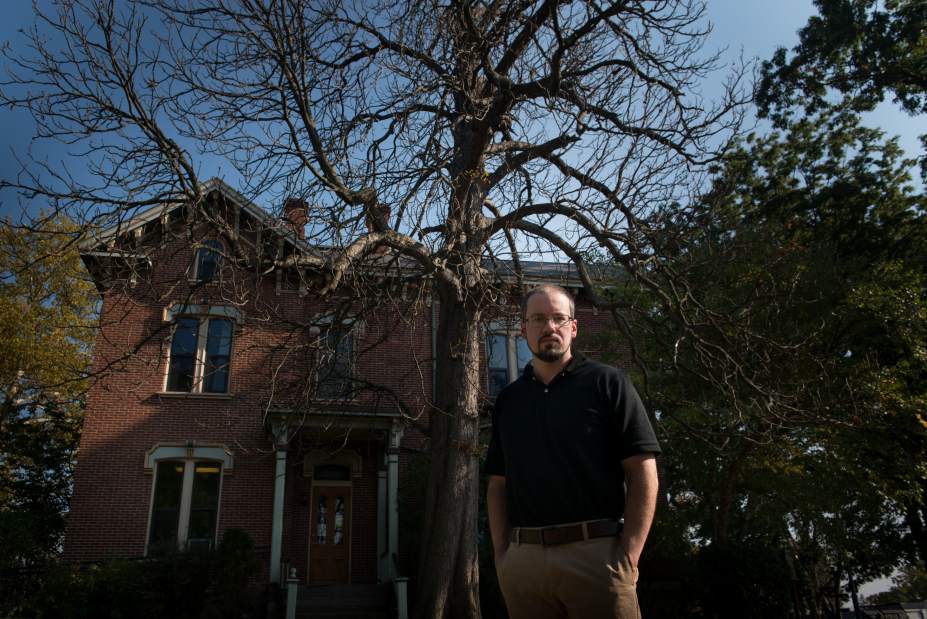
There's a reason why Western Pennsylvania is brimming with tales of ghosts and supernatural occurrences: Almost everything in America that's weird, wild or strange has come through the region.
“Pennsylvania is the crossroads of all kinds of folklore, historically,” says Thomas White, editor of “Supernatural Lore of Pennsylvania: Ghosts, Monsters and Miracles” (The History Press, $19.99). “The stuff that happened in the Deep South and California stayed there. Everything else funneled through Pennsylvania, out through Pittsburgh, down the Ohio River Valley and out through St. Louis, where it spread out again.”
White will visit Mystery Lovers Bookshop in Oakmont on Oct. 21 and Carnegie Library of Pittsburgh's Downtown branch on Oct. 23. He'll appear at Zelienople Public Library on Nov. 3.
“Supernatural Lore of Pennsylvania” is White's ninth book. A curator of special collections at Duquesne University's Gumberg Library and an adjunct professor of history at Duquesne and La Roche College, he views ghostly tales as more than just frightening experiences.
“They're a form of history,” he says. “They may not be the official history, but they are a way people remember past events and, often, they remember people who aren't recorded in normal history. If you look at a lot of ghost stories from the 1800s, they're about women or immigrants or slaves.”
In the region, some of the best known stories feature women. The ghost of Slag Pile Annie haunted steelworkers for decades. The legend of Betty Knox, a farmer whose spirit is said to appear near Dunbar, Fayette County, dates to the 1840s. At the Andrew Bayne Memorial Library in Bellevue, the ghost of Amanda Bayne (daughter of Andrew) is said to make appearances at the site, which used to be her home.
Perhaps the most infamous tale is that of the Pig Lady of Cannelton, part of Beaver County lore for almost 220 years. The Pig Lady is the story of Barbara Davidson, who was murdered and decapitated in 1795 at the age of 18. It has inspired at least one play. There have been numerous sightings of Davidson's ghost, sometimes headless, sometimes with a porcine head.
According to White, these stories tended to change and take on new dimensions until they were written down.
“Part of the problem with folklore is, once you write it down, you kind of change the story, in a way,” he says. “You make it a solidified form. But not everybody reads it. Often, people read the Internet version, which is often skewed, and that's fine, because that's how folklore develops and changes.”
The idea of reinventing stories keeps many ghost stories alive for successive generations. Notably, Blue Mist Road in North Park has been the rumored site of strange tales and stories for decades because of an alleged blue mist that engulfs the byway at night.
Most of the time, White says, there are logical explanations for the things that seem otherworldly.
“All this supernatural stuff happens in a space of transition, where boundaries of society and personal boundaries are vaguely defined,” he says. “That's why teenagers go on legend trips, to test boundaries. That's why a lot of roads are haunted, like Blue Mist Road. There's really nothing there, but the legend's changed every 10 years as a new layer reflects what's going on in society.”
After years of collecting stories of ghosts, spirits and werewolves (prominent in rural areas of Eastern and Central Pennsylvania), White says that most of the stories are explainable. But he's not completely closing the door on the existence of spirits.
“I have an open mind about it,” he says. “I've seen some weird stuff over the years, but I can debunk a good 90 percent of things. But there is a slim margin of cases or events that are unexplainable.”
Rege Behe is a contributing writer for Trib Total Media.
