


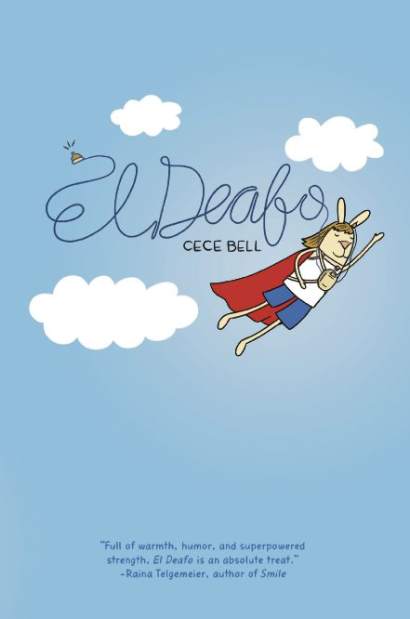


Cece Bell wasn't interested in writing about her disability. She'd established herself as a children's author and illustrator and wasn't ready to address being deaf in her work, let alone figure how to do it economically and with style.
Then came an encounter with a rude woman in a grocery store near Bell's hometown in Virginia. The woman became mad when Bell kept asking her to repeat herself.
“I could have said, ‘Hey lady, I'm deaf,' but it wouldn't have come out right,” says Bell, who will appear Nov. 8 at Carnegie Library Lecture Hall in Oakland as a guest of Pittsburgh Arts & Lectures Kids.
Bell returned home “crying and enraged,” but from that episode “El Deafo” was born: First as a blog that talked about how to deal with the deaf, then as a children's book that won a John Newbery Medal in 2014.
Using humor (think Tina Fey crossed with Bugs Bunny and a dash of Batman), “El Deafo” draws on Bell's experiences using a Phonic Ear, a device she used after losing her hearing at the age of 4 from a bout of meningitis. The apparatus, a small box strapped across the chest with wires to her ears, enabled her to clearly hear her teacher, who wore a microphone and a transmitter.
Only 5 when she started the first grade, Bell, 45, was never teased or bullied by her classmates. They were curious about the Phonic Ear and sometimes asked if they could try it, but because it was specifically calibrated for Bell, all they heard was feedback.
For Bell, however, it was a lifesaver.
“It helped me get through everything,” Bell says. “It was a way for me to succeed. Without it, I would have been lost. ... I did very well in school because of it. I didn't miss anything the teacher said.”
Bell studied English in college — “I did not study writing; I studied other people's writing” — before switching to art. Private by nature, she found an outlet via children books, including her popular Sock Monkey series — “Sock Monkey Goes to Hollywood,” “Sock Monkey Boogie Woogie” and “Sock Monkey Rides Again.”
But “El Deafo” gave her a quasi-celebrity status among children who are deaf and an equally strong following among kids who can hear.
“They're very excited (about ‘El Deafo'),” Bell says. “They kind of know me and are not in awe of me. The hearing kids, though, they're a little freaked out. ... Sometimes, they're surprised that I can speak. But overall, the reception has been really, really positive.”
Bell isn't sure if there will be another “El Deafo” book. The character would have to grow older without losing her innocence, and Bell really doesn't want to address issues of puberty and dating. She would love to see a movie version of “El Deafo,” although it would have to be a cartoon, not live action.
Bell would also like to see more characters who are deaf in pop culture. She points to the character of David in “Four Weddings and a Funeral” as an example of a person who is deaf being fully integrated into a group.
“You'd like to get to a point where nobody ever talks about (being deaf),” she says. “That's really the way the real world is, not the way it's portrayed in movies. You don't hear violins accompanying (a person who is deaf) every time they walk into a room.”
Rege Behe is a contributing writer for Trib Total Media.
