
https://archive.triblive.com/aande/celebrity-news/the-widowmaker-heart-attack-dont-ignore-symptoms/
The widowmaker heart attack: don't ignore symptoms

Twitter
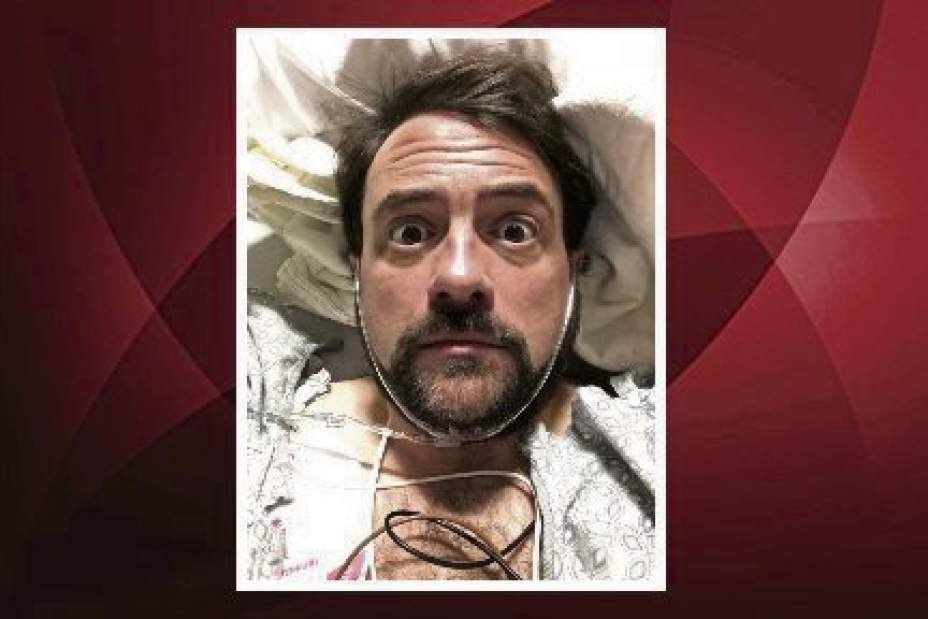
Kevin Smith posted this photo on Twitter after suffering a heart attack on Feb. 25.
Director, actor Kevin Smith is fortunate to be alive after suffering a massive heart attack known in dire terms as the "widowmaker."
Smith, known for films "Clerks" and "Dogma," sought medical help after feeling nauseous Feb. 25 at the Alex Theater in California, where he was performing a stand-up show.
"I started sweating buckets and my chest felt heavy," he wrote on Facebook. "If I hadn't canceled the second show to go to hospital, the doc said I would have died."
This particularly lethal heart attack occurs when the left anterior descending artery is completely blocked.
After the first show this evening, I had a massive heart attack. The Doctor who saved my life told me I had 100% blockage of my LAD artery (aka "the Widow-Maker"). If I hadn't canceled show 2 to go to the hospital, I would've died tonight. But for now, I'm still above ground! pic.twitter.com/M5gSnW9E5h
— KevinSmith (@ThatKevinSmith) February 26, 2018
According to myheart.net, there are three arteries that run over the surface of the heart and supply it with blood — one on the right side and two on the left. The one on the right is known as the right coronary. On the left side, which is the main side, there is the left anterior descending artery that runs down the front of the heart and supplies the front and main wall. The left circumflex supplies the side wall. When the LAD is totally blocked or has a critical blockage, right at the beginning of the vessel, it is known as the widowmaker, because the heart is deprived of a large supplier of oxygen. No one knows how the term came into being, but in the case of a widowmaker heart attack, cardiac arrest — and loss of consciousness — almost always happens very quickly, according to doctors quoted in a Time.com article. People with a blockage in their LAD artery may experience chest pain or tightness, and dizziness, fatigue, or shortness of breath during physical exertion. However, there are sometimes no obvious signs until a heart attack occurs. Making improvements Fans of the popular television show, "This Is Us," are no doubt still morning the loss of beloved character Jack Pearson. His character died in 1980 of a widowmaker heart attack after saving his family — and the dog — from their burning home. But area cardiologists say the term is no longer accurate because of advancements in heart attack treatment, especially since 1980. Quick treatment of a heart attack can save a person's life and reduce damage to the heart muscle. Blood flow needs to be restored to the heart 20 to 40 minutes following a heart attack. If not, then muscle begins to die. It usually takes six to eight hours for a heart attack to be complete, according to myheartsisters.org. The dead heart muscle will be eventually replaced by scar tissue. "The sooner, the better," Lee says. "When a heart attack begins, damage can occur within an hour or two." Celebrity fitness trainer Bob Harper suffered a widowmaker heart attack while working out at his gym in early 2017. He credits bystanders, who performed CPR and used the gym's automated external defibrillator (AED), with saving his life. Chakravarthy says men tend to have heart attacks while in their 40s. Women, on the other hand, tend to experience heart attacks a decade later. While the widowmaker is the most serious heart attack one can suffer, "all heart attacks carry a certain amount of risk," says Dr. Joon Lee, co-director of the UPMC Heart and Vascular Institute. The United States will have a heart attack every 40 seconds, according to the American Heart Association. Symptoms of a heart attack include chest discomfort, shortness of breath, nausea, pain in the back, jaw, stomach, or neck. Other signs include breaking out into a cold sweat or becoming light headed. "If you're suspicious, don't sit on it," says Dr. Mithun Chakravarthy, an Allegheny Health Network cardiologist. Seek treatment The treatment of a heart attack will vary depending on its severity. Treatments include angioplasty, special tubing that has a deflated balloon that is threaded up the coronary artery and then inflated, according to heart.org. Other treatments include: Bypass surgery: Here, new passages are created for blood flow to the heart muscle. Ablatio: A catheter with an electrode on its tip is guided to the heart muscle. Carefully selected heart muscle cells in a small area are then destroyed. Stent procedure: A wire mesh tube is used to open an artery. Atherectomy: A catheter with a rotating shaver is used to cut away plague in the artery. Transmyocardial Revascularization: A laser is used to drill a series of holes from the outside of the heart into the heart's pumping chamber. Heart Transplant: The diseased heart is removed and replaced with a healthy donor heart. Suzanne Elliott is a Tribune-Review staff writer. She can be reached at 412-871-2346, selliott@tribweb.com or via Twitter @41Suzanne.Copyright ©2026— Trib Total Media, LLC (TribLIVE.com)