
https://archive.triblive.com/aande/more-a-and-e/deaf-artist-expresses-what-she-hears-through-painting/
Deaf artist expresses what she ‘hears’ through painting

• |
TOM MOSSER
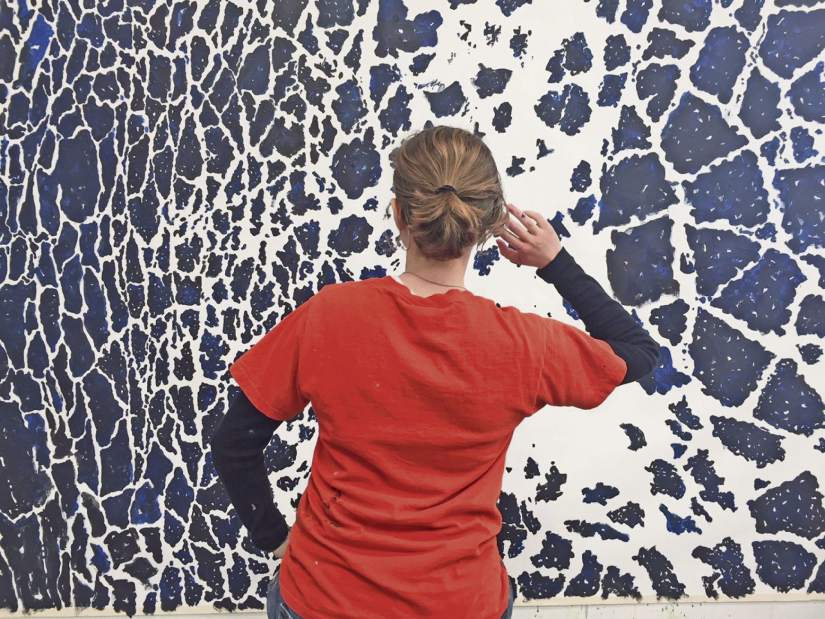
Andrea Echavarria, (center is a 29-year-old artist from Sewickley, was born deaf. She received a cochlear implant when she was 21 and incorporates sounds she hears in her artwork, which will be featured at an exhibit on April 13 at 448 Studios in Etna. She is shown here in the studio of Tom Mosser of Tom Mosser Design. He was her first art teacher and continues to work with her today. In the background is North Side-based film producer Tanya Dovidovskaya, who is helping with the show. Mosser's golden retriever Lucas is also a regular at the studio.
The darkness in these paintings represents the quiet.
Bright colors portray loud sounds.
The dots show sound being transferred … sometimes broken up … between the inconsistent noises.
Artist Andrea Echavarria, who is deaf, has a cochlear implant, an electronic medical device that replaces the function of the inner ear and provides sound signals to the brain. It’s allowed her to explore another world when it comes to her paintings.
Recurring shapes in her art signify the cochlear implant, which allows her to hear things after spending most of her life in silence.
She’s now hearing loud sirens, dogs barking and the calm of her mother’s voice, which has inspired her ideas for artwork to help her express what she hears.
She’s created a collection of these expressions — “The Art of Hearing: Works by Andrea Echavarria” — for a show from 6 to 9 p.m. April 13 at 448 Studios, in Etna. The 30 pieces will be for sale.
“I want to let people know that deaf people can do many things,” Echavarria says via Eileen Noble, a certified American Sign Language interpreter from Harmarville. “I can express myself through my art. It really feels awesome inside. It’s my passion.”
Echavarria says she couldn’t do it without the assistance of artist Tom Mosser, whose work has been featured at sports venues across the U.S. He was her first art teacher. Mosser describes himself as part mentor, eccentric uncle figure, goofy friend, buddy, part life coach, speech coach, big brother and fellow artist. He often writes inspiring messages to her on the studio walls and works daily on learning sign language.
“Any time I’m bumming out over a sore knee, or a sore elbow or something, I only have to look across the studio floor and I see what hurdles she overcomes daily,” Mosser says. “I’ve had a giant metal ruler for years. Every so often it will fall on the floor with a huge crash. Before the implant, Andrea would never move. Now, when it happens, she kind of jumps. And that makes me smile. I’m a much better artist and person for having been around her and her family.”
“Tom has been a blessing to her,” says Andrea Echavarria’s mother, Laurel. “She would never have expanded who she is as an artist without him. He pushes her in a kind and loving way. He tells her not to be afraid to make a mistake.”
Echavarria, 29, who works in oils, watercolors and acrylics, attended the Western PA School for the Deaf in Edgewood and the Art Institute of Pittsburgh and says she always knew she wanted to be an artist.
“I like being really creative and I have been using sounds I hear in my paintings,” she says. “I am a deaf person and I am proud of that. Hearing sounds is also an awesome thing.”
The transition to the implant in 2009 at age 21 wasn’t easy. It was overwhelming at times and she needed to turn the volume down on the implant.
“When I got the implant, I was wondering what I would be able to hear,” she says. “I was hoping to hear something. I didn’t know what to expect, after not hearing for so long. I began to hear sounds. I didn’t know what they were yet, but they were my dog barking, cars swooshing by on the street, my family’s voices, people talking, the telephone ringing.
“It’s hard to explain. It’s different than what you hear. Sometimes I get a headache if there’s a lot of noise. I wasn’t used to all the loud noises. I was used to a very quiet life before. I’m more confident around people now because I can speak a little now. And I just feel more connected to the world around me through sound. Technology has been a great thing for me to communicate and for my art. The only downside is hearing Tom sing — at least that’s what Tom says.”
If you can’t make it to the show on April 13, the paintings will be available through 448 Studios.
JoAnne Klimovich Harrop is a Tribune-Review staff writer. Reach her at 7248535062 or jharrop@tribweb.com or via Twitter @Jharrop_Trib.
Copyright ©2026— Trib Total Media, LLC (TribLIVE.com)