
Greensburg's Palace Theatre celebrates 90 years


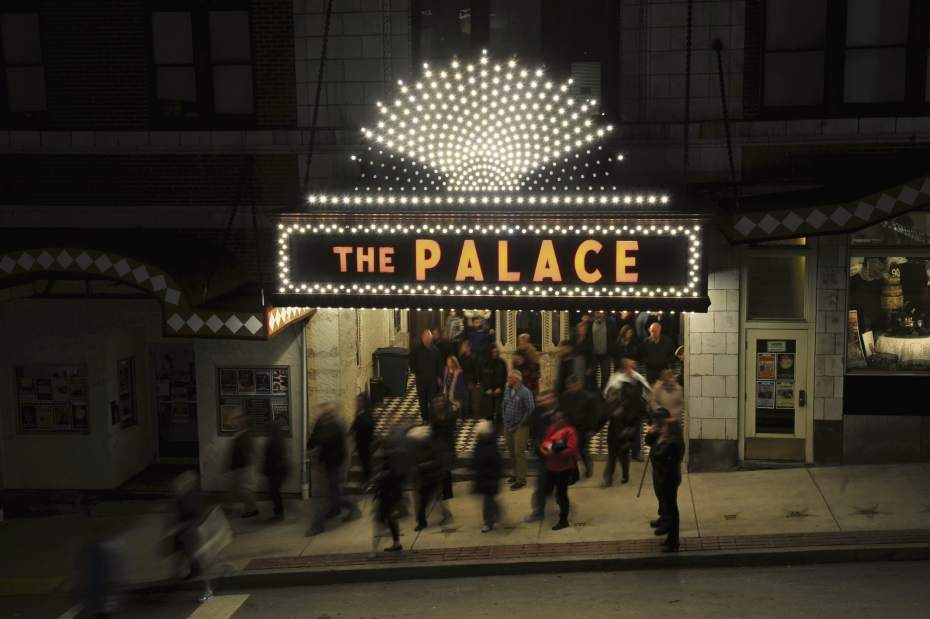


This year, the crown jewel of Greensburg entertainment venues marks 90 years in the business.
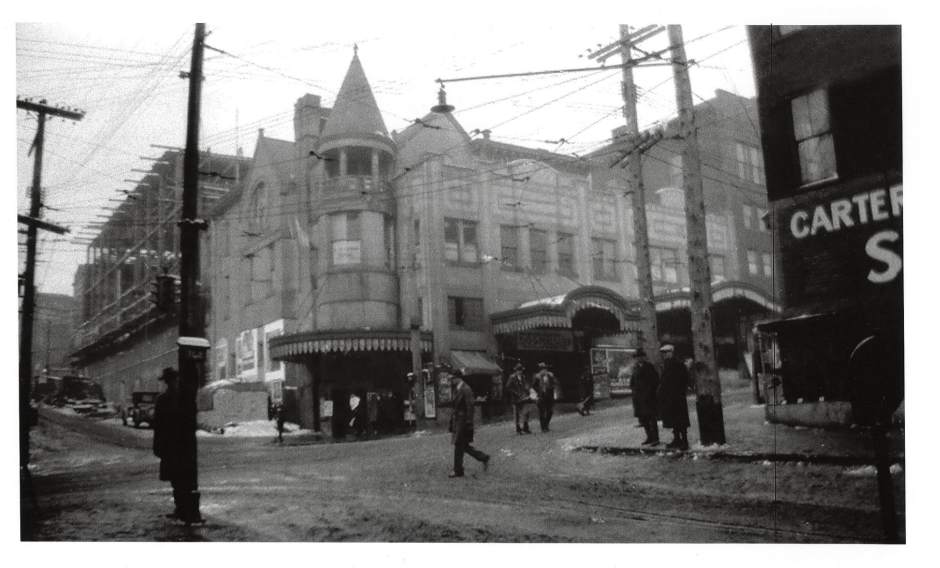
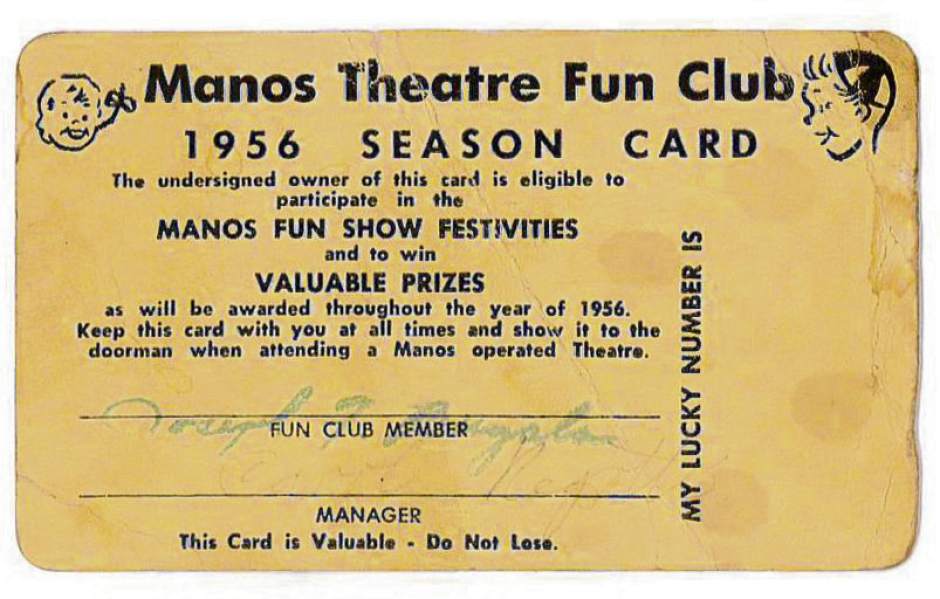
From its opening on Sept. 2, 1926, as the Manos Theatre, to its acquisition in 1990 by the Greensburg Garden and Civic Center, predecessor of the Westmoreland Cultural Trust, the site of the Palace Theatre has changed from hosting vaudeville acts to showing movies to regularly presenting local and national acts on its stage.
Part of the secret to the Palace Theatre's continuing success is simply giving the people what they want, says Teresa Baughman, director of operations, programming and marketing. In 2015, the Palace hosted 67 shows by national touring groups or performers, and was booked for 113 performances overall, including local groups such as Laurel Ballet, Stage Right, Westmoreland Symphony Orchestra and River City Brass.
Over the years, audiences in the 1,369-seat theater have seen the Glenn Miller Orchestra, Connie Francis, Ricky Nelson, Neil Sedaka, Arlo Guthrie, Tammy Wynette, George Carlin, Craig Ferguson, the Beach Boys, Jefferson Starship, Peter Frampton, Vince Gill and a host of touring stage shows and musicals.
The teen heartthrob Jonas Brothers sold out a show on Aug. 14, 2007, just months before joining Miley Cyrus on a national tour. On May 17, 2008, Wiz Khalifa, then named Rolling Stone's “New Artist to Watch,” performed.
The audience is drawn from throughout the region, bringing a boom to local businesses.
“The economic impact (the Palace) brings to Greensburg, especially the boutiques and restaurants on South Pennsylvania Avenue, is invaluable,” says Greensburg Mayor Robert Bell. “You go downtown on a Friday night when there's a show, and the places are packed.
“It's the single biggest asset Greensburg has both culturally and economically,” Bell says.
“An outside consultant estimated its impact to the community at $8.9 million a year,” says Trust President Mike Langer. “We are optimistic of the continued growth of the Palace Theatre and, like our predecessors, we will continue to create memories one show at a time.”
Chad Amond, president of the Westmoreland Chamber of Commerce, agrees that the Palace is an important part of the fabric of the community.
“For people out there working the daily grind, the availability of assets like the Palace Theatre helps to make all the hard work worthwhile,” Amond says “One thing that is absolutely critical to the area is that we have a strong arts community.”
Celebration plans
First in a series of anniversary events will be the Feb. 27 Party at the Palace, the Trust's annual signature fundraising event. Baughman is working to schedule some vaudeville-type nostalgia acts and a late-summer, early-fall gala with a big headliner.
Vaudeville played an important role in the venue's history.
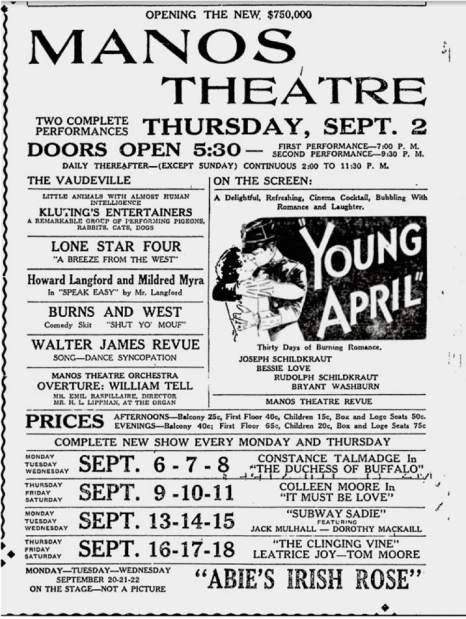
A play bill for the opening night of the Manos, from the trust's archives, lists a number of vaudeville-type acts, including Kluting's Entertainers animal show, comedy by Burns and West and the syncopated song and dance of the Walter James Revue.
On the movie screen was Cecil B. DeMille's “Young April,” teased as a “A Delightful, Refreshing Cinema Cocktail Bubbling With ... Thirty Days of Burning Romance.”
The next day, Baughman says, DeMille and legendary talent agent William Morris sent congratulatory telegrams on the opening.
The site's place in Greensburg entertainment predates the Manos. The Lomison Opera House was built around 1879, on the part of the property where the courtyard is now. Later, it was renamed the Keaggy Theater, which was converted into a sports arena for boxing and basketball in 1907, and was purchased by Michael Manos in 1917 and renamed the Strand Theatre.
A hotel once stood where the Palace is now. It was razed and the Rialto Theater opened there in 1920. Michael Manos, along with his four brothers and a cousin, completed the purchase of the entire block in 1924. The Rialto was re-christened as the Manos in 1926. During the later days of the Manos, it was strictly a movie theater with various owners. It was bought in 1977 by Carl V. Marinelli, founder of Greensburg's Hillview Bowling Lanes, and renamed the Palace Theatre.
The Palace retains much of the old-time grandeur of its French Renaissance-style in its interior.
Gone from the heyday of the Manos are some of the original murals and a flowing fountain with live goldfish. Still present are the golden marble ticket booth, a Vermont marble staircase, opera boxes and black-and-white checkerboard tile floors on the mezzanine and in the lobby.
The mezzanine features displays of 1920s movie projectors and photos of long-ago projectionists.
The addition of the Megan Intermission and Courtyard in 2004 came courtesy of the parents of Megan Smith, a Greensburg-Salem High School graduate who died at 18 in a car accident. Megan had been active in school theater productions.
Memories
As part of the 75th anniversary, the Trust is asking area residents to add to its historical archive by sharing memories, photos and memorabilia of both the Manos and Palace theaters. Of particular interest are written accounts of memorable shows or experiences, interior or exterior photos taken before 1990 and pre-1995 items such as programs, ticket stubs and posters.
Offerings will be showcased in a display during future shows, Baughman says: “I'd like to have the display stick around for the 100th anniversary in 10 years.”
One of the original murals, depicting a woman in what appears to be 1700s-era fashion, is an item that particularly piques Baughman's curiosity.
“I never learned from any source of information who painted the lobby mural. It was covered (in 2004) with drywall, not restored,” she says. “I would love to learn this year who painted it and who the subject was.”
Shirley McMarlin is a Tribune-Review staff writer. Reach her at 724-836-5750 or smcmarlin@tribweb.com.
Anniversary logo
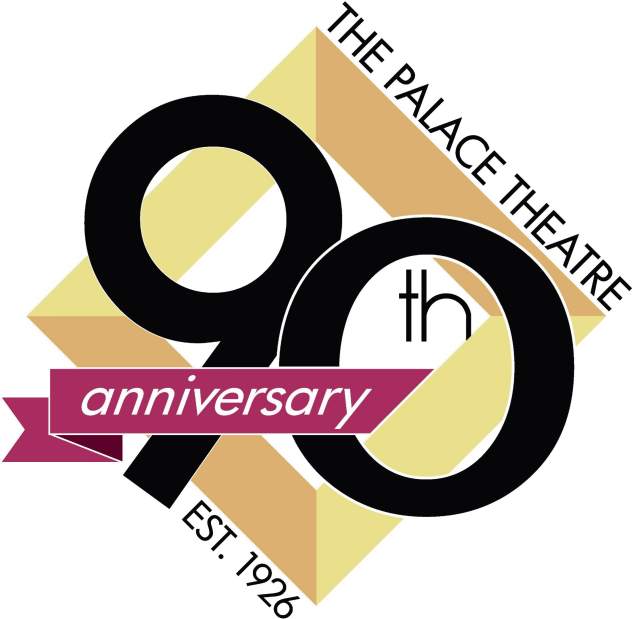
The Westmoreland Cultural Trust named Alexandra Parady of New Castle as the winner of the Palace Theatre's 90th anniversary logo contest. The prize includes a $250 Visa gift card and an invitation to the Party at the Palace.
Parady, a junior graphic design major at Seton Hill, says the contest spurred some friendly competition with fellow students.
“We shared ideas and critiqued each other's designs,” she says. “I figured it would be fun whether I won or not.”
Parady says the contest was right in her wheelhouse.
“The Palace is classically designed, and they wanted something to spruce up its image and modernize it,” she says. “Everything I do is modern, so I took that idea and ran with it.”
