
Pittsburgh-area Irish step dancers to compete in London for world titles

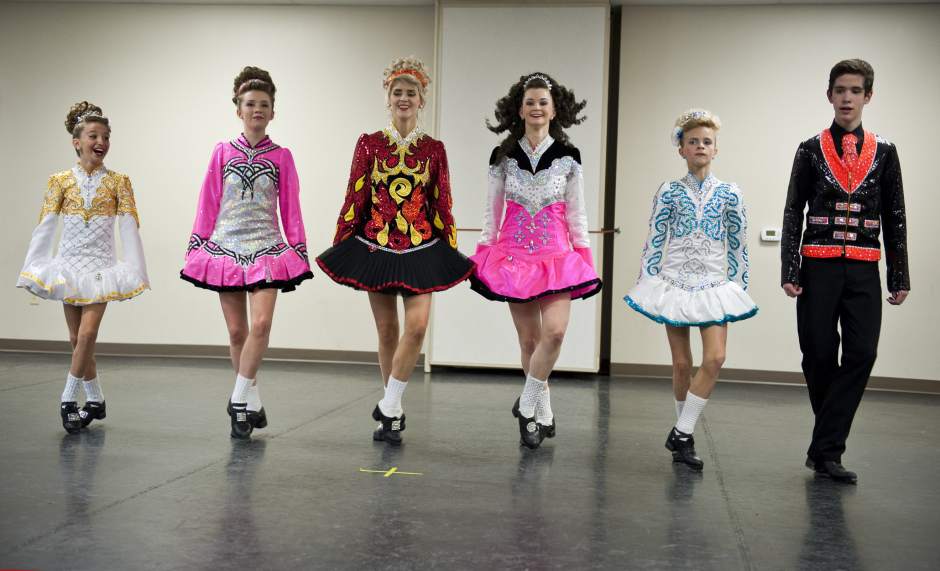
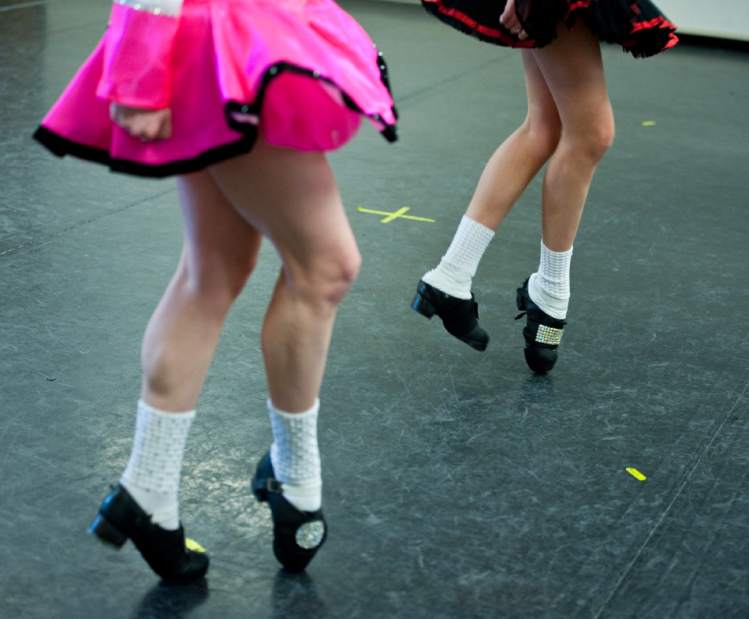
A line of six costumed Irish step dancers rehearse, their legs moving furiously while their arms remain stiffly at their sides like marble columns. Hard shoes rapidly click on the floor in the dance studio. The sound is thunderous.
“There's a big hole in the wall at the old studio,” jokes Meghan Bradley, 17, of Pine, as she pauses for a breather and talks about the inevitable kick that happens among dancers.
Melissa Barton — clad in a glittery hot-pink, white and black costume with a full-head wig of black curly hair — explains the secret of keeping the upper body still while dancing below the waist: “Use your core.”
These young ladies are among dancers from the Pittsburgh area going to London for the World Irish Dance Championships to be held April 13 to 20. The Bell School of Irish Dance in Marshall is sending 10 dancers, ages 11 to 21 — Barton and Bradley, as well as Kennedy Quinn, Abigail Bradley, Mikayla Fitzgerald, Aaron Wolf, Grace Eichenlaub, Lindsey Ferguson, Tom Stewart and Theresa Corgan.
Burke Conroy School of Irish Dance in Squirrel Hill — which has sent dancers to the world competition every year for at least 25 years — is sending Bebe Duffus, Audrey Hutton, Anna Muse and Katie O'Connor to the London contest.
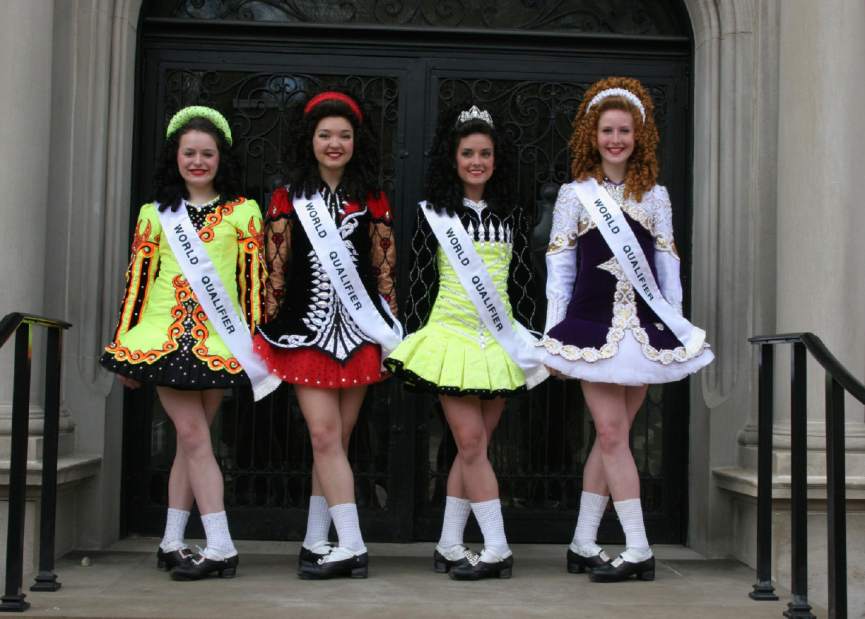
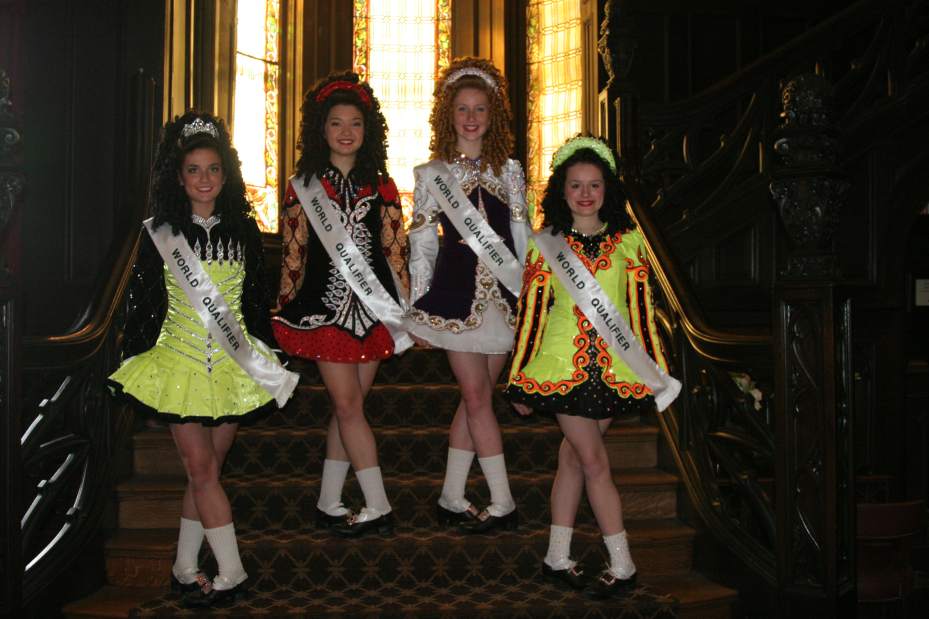
The dancers qualify first in either the regional or national competition in 2013. World competitors must be at least 10 years old to enter the contest, which is akin to the Olympics in the Irish dance world. Only 1 percent of Irish dancers in the world qualify, says Mary Conroy-Adams, a teacher at Burke Conroy.
“It's an amazing accomplishment for them,” she says. “The international exposure is amazing.”
Successful dancers typically combine an innate talent with an inner drive, hard work and family support, Conroy-Adams says. Many Irish dancers are daughters and sons of dancers.
Some people may think the Irish dance looks easy, but don't be fooled, Julia Bell, owner of the Bell school, says.
“They have to not only move their feet really fast, but they also have to keep their upper body still, which is a lot harder than it looks,” Bell says. “It's very athletic. Kids have to be very strong to do this. You use your whole body while you dance.”
Dancers wear two different kinds of shoes — soft like a ballet slipper, or hard with fiberglass tips — depending on what dance they are doing. The girls sport curly hairstyles from wigs — either full-head big wigs or tall bun wigs, coiffures that the dancer places atop cushions behind her fancy headband.
It's a time-consuming activity that goes beyond a simple hobby for many. The competing kids come to the studio as many as five to six times a week, and some spend $1,000 every year to buy a custom-made costume. Competitions are held all over the world.
So, what is the charm and appeal of Irish dancing, for the people who watch it and the people who do it?
“I think it's the uniqueness of it for the people who watch it,” Bell says. “Your upper body doesn't look like it's working very hard, and your feet are moving so fast. It's just different.
“For the people who do it, it's the friendships that they make over their career. These kids start with me at 9 years old.
“Irish dancing — it's something that sticks with you,” Bell says.
Barton, 20, of Shaler, is still dancing after 12 years, and heading to the London competition. Barton is attending Community College of Allegheny County, and in the fall, will begin at Slippery Rock University to major in early childhood education. Barton says she hopes to end up teaching dance.
Meghan — who wears a costume with flamelike patterns in red, yellow and black to depict her on-fire personality — strongly prefers the Irish dancing over other forms of dance.
“It's much more athletic,” says Meghan, who took dance lessons in ballet, tap and jazz when she was younger. “It's a lot more taxing on your body, but it's so much more fun. ... Even the lowest level of Irish dance is difficult.”
Abby — Meghan's 11-year-old sister, who went to her first world competition last year — likes the Irish dancing “because it's different.”
Blue-eyed Abby's costume complements her sister's fire theme with a sparkly, blue-and-white ice theme. Dancers work with a designer and come up with a personalized outfit to make them stand out as individuals.
“You want to grab the judges' attention right away,” Bell teacher Jolie Kilpatrick says.
The origin of Irish step dancing is shrouded in legend, and no one is exactly sure of the facts, dance historian Richard Powers says. The practice doesn't date back to ancient Celtic tribes, but it probably goes back to the 19th century.
Powers, a dance instructor at Stanford University in Palo Alto, Calif., says the many stories are part of the intrigue.
He says competition in Irish dancing is very difficult because judges raise the bar every year, and it gets harder and harder to win, and dancers must go “higher, faster, sharper.” “The technique has been getting to near-stratospheric levels,” Powers says.
Irish dancing has three categories: casual social dancing, competition and performance, like those dancers in “Riverdance,” Powers says.
Veteran world-championship qualifier Katie O'Connor, 17, of Shadyside, who dances at the Burke Conroy School and is the current Girls Under 17 Midwest Champion, overcame a broken femur bone last year to win the 2013 regional championship, as well as other local competitions, which are called feisanna.
Fellow Burke Conroy School dancer Audrey Hutton, 17, of Churchill, attended the 2014 All-Scotland Championships in February, where she placed third in her “soft shoe” round and was ranked 11th overall.
Julie Bradley, 51, Meghan's and Abby's mom, who also reared another daughter in the sport — Kaitie Bradley, now in college — says getting her girls to practices and major out-of-town competitions takes a lot of energy, but the efforts are gratifying to her and her husband, Kerry, both of whom are half-Irish.
“I like this for my children because it keeps the Irish heritage alive for them,” says Julie Bradley.
Kellie B. Gormly is a staff writer for Trib Total Media. She can be reached at kgormly@tribweb.com or 412-320-7824.
