
https://archive.triblive.com/aande/museums/art-exhibits-look-at-water-upcycled-materials/
Art exhibits look at water, upcycled materials

Guy Wathen | Tribune-Review
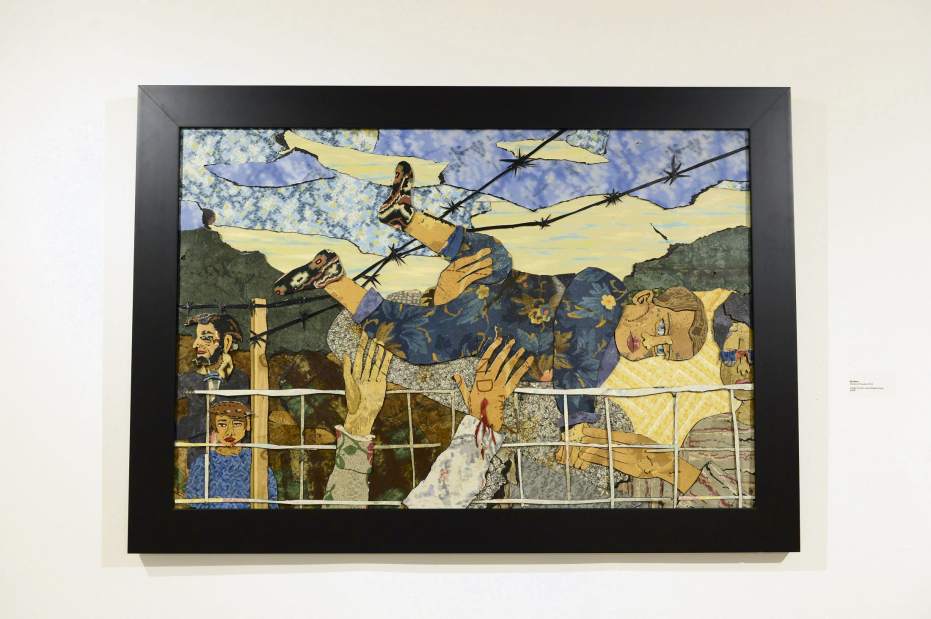
Bill Miller 'Chimes of Freedom', 2016
While most of the galleries at Pittsburgh Center for the Arts are currently filled with works by the group's artist and emerging artist of the year, two other exhibits at the center are worthy of attention: “surface | material” and “Barrie Kaufman: River, Stream, Tap.”
Presented in collaboration with the Re:NEW Festival, “surface | material” presents the work of four artists who use found objects and recycled materials with particular attention to the treatment of the surface.
Grace Summanen of Euclid, Ohio, uses fabric, plastic bags, toilet-paper tubes,or scrap paper to create lush abstract pieces that are as much paintings as they are sculpture.
“Waves” is one such piece that explores lines with folded fabric.
“For this piece, I was thinking about making strong vertical lines,” says the artist, who was inspired by the zip paintings of Barnett Newman (1905-70).
“I have always been interested in his work and how a simple line can have so much feeling,” she says. “While working with the material, the problem of what to do with the top and bottom came into play. This became the wave, the movement of the work.”
For an artist who grew up on Lake Erie, it's a fitting piece. “It is an important part of who I am and often shows up in my work,” she says of her upbringing.
Bill Miller of Forest Hills works with recycled vintage linoleum flooring as his medium, using only found colors and patterns and never painting on it.
His piece “Chimes of Freedom” was inspired by the many images he has seen of the recent refugee crisis, primarily in Syria.
“Though this piece is based on a photo from the Serbian war of the 1990s, the symbolism of the infant being lifted over barbed wire seemed to say something possibly optimistic about their future,” he says.
Ron Copeland of Friendship is well known for the art, furniture and lighting he produces from recycled signage in his Lawrence-ville studio. Here, his piece “A Chicken in Every Pot” makes reference to a handful of campaign slogans from former Presidents Herbert Hoover and Franklin D. Roosevelt promising for a better tomorrow during the Great Depression.
Depicting a mid-century family at a dinner table, Copeland says of it, “The predominant imagery of the family gathered together prevails as the noise of the handpainted adverts continue to faded and become less legible.”
Then there's the work of Ryder Henry of East Liberty. His “Blast Office #4” is fourth in a series of “Blast Offices” he has created out of recycled cardboard consumer packaging.
“These are high-energy office buildings that have nuclear reactors inside them,” Henry says. “The reactor cores are represented by green glass marbles. Their open, radially symmetrical design allows clearance for energy discharge in case of reactor core overload.”
It's a fantasy model, of course, but still somewhat plausible.
In the gallery next to “surface | material” is the solo exhibit “River, Stream, Tap” from West Virginia artist Barrie Kaufman.
Kaufman says the impetus for this exhibit came from the perspective of living in Appalachia and seeing the effects of mountaintop removal and other environmental assaults on the land.
“In 2014, coal-cleaning chemicals crept into the water source for my hometown, Charleston, W.Va.,” he says. “We could not bathe, touch or use our water for six weeks. The chemical stuck to the plastic water pipes and emitted a terrible smell.
“When you don't have water, you realize how important it is,” Kaufman says. So he wanted to create an exhibit focusing on water and decided to use glass as the main medium because of its reflective, luminous qualities.
“I am not a glass artist, but I was fortunate to have a residency at Pittsburgh Glass Center where I worked with a talented team of glass artists to bring my ideas to life,” he says. He also worked at Blenko Glass in Milton, W.Va., not far from his hometown.
The installation piece “Pouring Forth” dominates one wall, giving the appearance of water pouring from glass pipes that come out of the wall.
“Some of the water emits fire because we really don't know that our water is clean,” Kaufman says. “On the surface, it looks clean, but its quality is questionable.”
Another piece, “It's in the Pipes,” illustrates Kaufman's feelings about the West Virginia water crisis. Vertical glass pipes represent the plastic pipes many people have in their homes.
“They are filled with contrasting symbols of life and death — dead tree branches, saw blades, blackbirds and fire in contrast with green leaves, orchids and twisting flowers — showing the mixed up feelings we had,” Kaufman says. “We need water, yet our water is poisoned.”
The water drops in another wall-mounted installation, “A Single Drop,” move from vibrant greens and blues to blacks.
“These were created at Blenko Glass and also illustrate the water theme,” Kaufman says.
“Clean water, which is so universal, can be gone in an instant,” says Kaufman, who will speak, along with glass artist Jason Forck of the Pittsburgh Glass Center at 6 p.m. Oct. 6 at the Pittsburgh Center for the Arts.
Kurt Shaw is a Tribune-Review contributing writer.
Copyright ©2025— Trib Total Media, LLC (TribLIVE.com)