
https://archive.triblive.com/aande/museums/frick-exhibit-covers-150-years-of-french-art-collected-by-paul-and-bunny-mellon/
Frick exhibit covers 150 years of French art collected by Paul and Bunny Mellon

Virginia Museum of Fine Arts
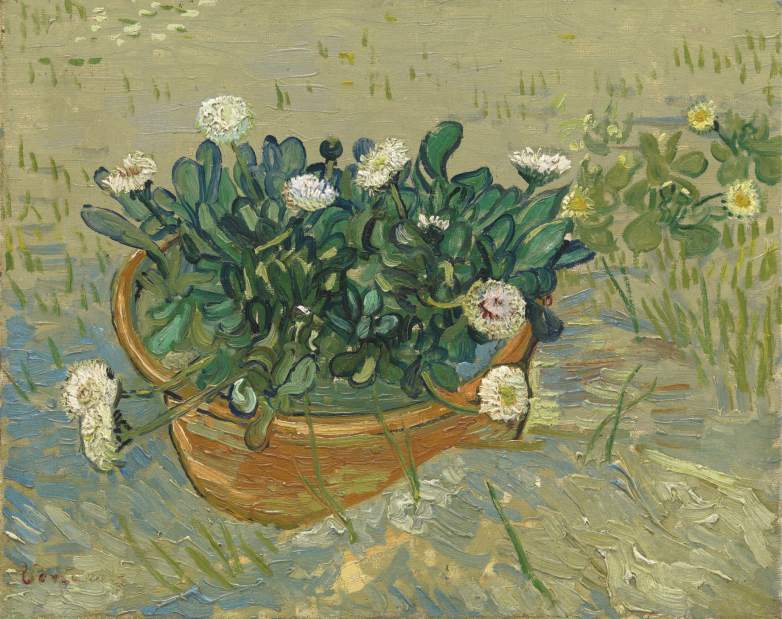
Vincent van Gogh (Dutch, 1853–1890) Daisies, Arles, 1888
The curious white specks have been removed from the famous painting that hung in the bathroom of Paul and Rachel "Bunny" Mellon's home.
Vincent van Gogh's "Daisies, Arles," was prominently displayed above the tub — which explains the spots most likely caused by someone brushing their teeth or splattering soap.
Art is supposed to be displayed and enjoyed, according to the Mellons, who acquired many famous, as well as not-so-famous works, during their marriage.
To ensure the pieces were enjoyed long after their deaths, they donated their collection, including the 1888 oil on canvas by Van Gogh. It depicts daisies in a terra cotta pot from an overhead perspective with complementary colors, especially the oranges of the pot and the shadowy blues around the plant.
Van Gogh said he signed it with "a very outrageous red signature because I wanted a red note in the green."
This painting is one of more than 70 masterpieces collected by Pittsburgh-born philanthropist Paul Mellon (1907-1999) and his wife Rachel "Bunny" Lambert Mellon (1910-2014). It is part of "Van Gogh, Monet, Degas: The Mellon Collection of French Art" from the Virginia Museum of Fine Arts in Richmond, Va., that will be on exhibit through July 8 at the Frick Pittsburgh in Point Breeze.
"Many of these pieces of art actually hung in the Mellon's home," says Robin Nicholson, executive director the Frick Pittsburgh. "These are pictures they held near and dear to their heart. It was kind of like Christmas when we opened the boxes. The Mellons acquired paintings, not always because of their monetary value, but by what they liked. And they enjoyed the art in every room of their house, including the painting in the bathroom that was exposed to beauty products."
Nicholson was previously head of exhibitions and deputy director for art and education at the Virginia Museum.
PHOTOS: Paintings by Van Gogh, Monet, Rousseau at the VMFA to go on tour for two years https://t.co/tVIFfJG6WL @vmfa #VMFA #art #vmfaontour #vangogh #monet #rousseau #rva pic.twitter.com/iuwjU73pWF
— RTD Culture (@RTDCulture) December 29, 2017
The exhibition reads like a who's who of French impressionism, says Jessica Haddad, Virginia Museum of Fine Arts public relations manager. The timing was right for the works to travel to Pittsburgh and other museums through September 2019 because the Virginia Museum is renovating and refurbishing its Mellon Galleries. She says this particular collection is interesting because of how it exemplifies the Mellon's collection strategies. They were delibrate in their acquisitions, carefully selecting and seeking out paintings and sculptures to add to their collection, she says. "Rather than put these works in storage during the renovations of our Mellon Galleries, the museum is delighted to have the opportunity to share these incredible works with art lovers across the United States — just as the Mellons would have wanted," Haddad says. What you will see A number of works have only recently been given to the Virginia Museum of Fine Arts and have not been publicly exhibited for a generation. Most of the pieces have been restored or reframed. The museum walls have been painted in blues and greens and the carpet replaced to best showcase the exhibit, which encompasses all the major movements and artists that defined French paintings of the 1800s and early 1900s, including almost all of the great names associated with French art from 1820-1920. The Frick is the first venue for this touring exhibition which includes two more works by Van Gogh (1853-1890): "The Laundry Boat on the Seine at Asnieres" (1887) and "The Wheat Field behind St. Paul's Hospital, St. Remy" (1889). Claude Monet (1840-1926) is represented by four works, including a large, late work capturing dazzling irises in his garden at Giverny, and 10 works by Degas (1834-1917) are featured, including the artist's most famous sculpture, "The Little Dancer." It caused a sensation when it was shown in the Sixth Impressionist Exhibition in 1881. Modeled in colored wax, the sculpture had real human hair tied with a satin ribbon, a cloth bodice and tutu, and pink ballet slippers. This shocking departure from the French classical tradition of sculpture antagonized the public and art critics alike, who concentrated on the perceived "ugliness" and "depravity" of the dancer, according to the catalog of the Virginia Museum of Fine Arts. Degas' "At the Milliner" represents one of his views of fashionable women in millinery shops. The focal point of the scene is the fashionably dressed customer as she assesses the merchandise. Shown from the back, she views herself in a mirror as she tries on a hat. Her face in the reflection, however, is shockingly absent, with a mysterious blank oval in its place. "It is so unusual," Nicholson says. "I believe it was done on purpose. It creates an element of intrigue." Paul Mellon said those type of elements are what make art interesting. "Art makes one feel the essence of something, turning the ordinary, everyday object or scene into a universal one." A philanthropist Paul Mellon's lifelong love of art resulted in extraordinary gifts to three institutions: The National Gallery of Art in Washington D.C., Yale University in Connecticut and the Virginia Museum, where he served as a trustee for more than four decades. In 1985, he was instrumental in the construction of a new wing to house his collection of British, American and French sporting art and works by French artists of the Romantic, Impressionist and Post-Impressionist periods. "We are delighted to have the rare opportunity to present this extraordinary collection of French art to Pittsburgh at the Frick Art Museum — not far from Paul Mellon's birthplace," Nicholson says. "In addition to its core of stunning Impressionist paintings, Van Gogh, Monet, Degas will dazzle audiences with masterpieces from every important school of French art from Romanticism through the School of Paris." The Frick Pittsburgh has direct ties to the Mellon family. Paul Mellon was the son of Henry Clay Frick's close friend and colleague, Andrew Mellon (1855-1937). It was Frick's daughter, Helen Clay Frick, who established the Frick Art Museum on the property that also includes her childhood home, Clayton. Both Henry Clay Frick and Andrew Mellon became known for their legacies as art collectors, the roots of which were formed when they traveled to Europe together in 1880. Paul Mellon and Helen Clay Frick (1888-1984) grew up in this milieu of collecting and philanthropy and were avid collectors throughout their lives. We popped into the museum today for a behind the scenes sneak peek of Van Gogh, Monet, Degas! Trust us, you don't want to miss this exhibition. Go to https://t.co/pvXC06QNb8 to reserve your tickets now! pic.twitter.com/7qv6QdgeFu— The Frick Pittsburgh (@TheFrickPgh) March 8, 2018
The format The exhibit is arranged around themes and ideas that were of particular interest to artists working during the rapidly modernizing world of the 1800s and early 1900s. Overarching these themes, however, are the tastes and interests of the Mellons, who started collecting art together, purchasing their first piece even before they married. Paul Mellon was an avid sportsman who enjoyed riding and bred racehorses. The French paintings with equine subjects depict aspects of horse racing, as well as the horse's many roles in 19th century society. His wife, was an avid gardener, and her love of flowers and the outdoors is evident in many of the couple's painting selections. Other thematic sections include: the French countryside, water, people, views of Paris, flowers, still-life subjects and interiors. Within these themes, important artists and movements of the 19th century are represented. • Gustave Courbet and Edouard Manet from the Realist movement. • Vincent Van Gogh, Pablo Picasso, Edouard Vuillard, Henri Matisse and Henri Rousseau, from post-Impressionism, Symbolism and other later 19th and early 20th century styles. • Impressionist works by Eugene Boudin, Paul Cezanne, Stanislas Lepine, Claude Monet, Berthe Morisot, Pierre-Auguste Renoir, Alfred Sisley and Camille Pissarro. "This group will never be together again so this is an amazing opportunity to see this one-of-a-kind exhibition," Nicholson says. "Paul Mellon's mission was to create a legacy and let people be able to see this collection. French art features bold colors and an amazing use of light. The pieces are about how the viewer sees it." Van Gogh, Monet, Degas https://t.co/pvXC06QNb8 pic.twitter.com/fzApF14xg4— The Frick Pittsburgh (@TheFrickPgh) March 13, 2018
JoAnne Klimovich Harrop is a Tribune-Review staff writer. Reach her at 724-853-5062 or jharrop@tribweb.com or via Twitter @Jharrop_Trib.Copyright ©2026— Trib Total Media, LLC (TribLIVE.com)