
https://archive.triblive.com/aande/museums/google-taking-street-view-technology-into-museums/
Google taking ‘street view’ technology into museums

• |
Tom Little
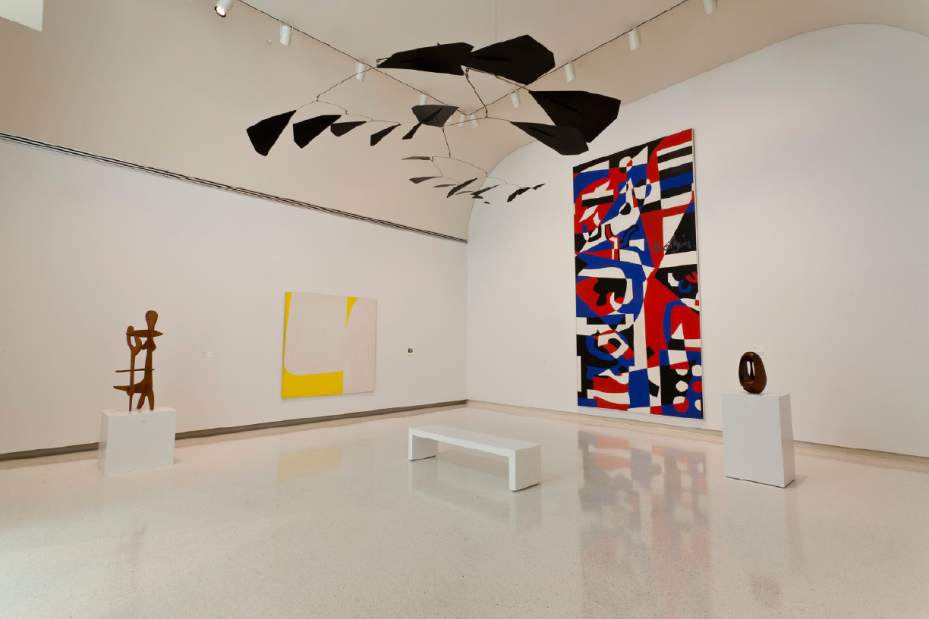
Installation view of 'Abstraction in the 1950s' in the Scaife Modern and Contemporary Galleries at the Carnegie Museum of Art, Oakland.
For the past three years, it has been possible to tour the great art galleries of the world without leaving home.
Got a longing to examine the Fragonard paintings that fill all four walls of a room at the Frick Collection in New York City, wander through the galleries of the Van Gogh Museum in Amsterdam or plumb the considerable depths of the Russian State Museum in St. Petersburg?
You can do all that during a single lunch hour with the Google Cultural Institute’s online Art Project (google.com/culturalinstitute), which takes armchair travel to a whole new level.
Using the same “street view” technology that makes it possible to get a 360-degree view of the neighborhood around that hotel you’re thinking of booking or to check out the key landmarks at a crucial intersection, Google has taken its cameras inside hundreds of museums big and small so you can virtually stroll through many of the galleries.
Unlike printed guides and art books that give a single view of a painting or sculpture, these gallery crawls allow you to wander through rooms at your pace and zoom in far closer than museum guards will tolerate to examine details. Select works have little black squares that, when clicked on, offer information about the title, artist and dates. As in a real museum, you can look up to see the mural on the ceiling or down to examine the parquet floor pattern.
The idea behind the project wasn’t to replace museums and their websites, but to widen awareness, says Piotr Adamczyk, a program manager with the London-based Google Cultural Institute.
“When people know more about a collection, they are more likely to want to visit it,” Adamczyk says. “We were trying to reach people who were trying to look for a particular artist or kind of art.”
From its beginning, the scope of the Art Project has widened to allow users to journey through outdoor natural and historic sites such as the Ajanta Caves in India and a section of a hiking trail along the Colorado River in the Grand Canyon.
Begun in 2011 with 17 sites, the Art Project has more than 630 partners in more than 60 countries. The site displays more than 6.2 million objects either as single images or as part of a gallery tour.
“I think it’s used in a variety of ways by different types of users — people planning a visit or interested in a particular museum, and you can search across collections, which is wonderful,” says Robert Goldsmith, deputy director and chief operating officer at the Frick Collection in New York, which was one of the first 17 sites. “When the Google site first launched, our Internet traffic doubled. I wouldn’t say it drives a lot of traffic now. But it makes people aware (of the Frick) who wouldn’t otherwise find us.”
Inspired by the Art Project, the Frick website also offers its own virtual tours of almost two dozen rooms in its museum (frick.org/visit/virtual_tour).
While the Cincinnati Art Museum has no information on whether the site has increased the museum’s attendance since it joined the Art Project in 2012, the museum’s web and digital-media manager Nicole Kroger does know that 47,200 people looked at items from its collection on the Art Project site in the past 90 days.
She also has heard from people who moved from Cincinnati and enjoy making virtual return visits on the Google site as well as a museum guard who sent a link back to his family in Russia so they could see where he worked.
“We saw it as an educational tool. But it really just gets the collection out there for more people to see,” Kroger says. “We have worked with educators who use it for a pre-tour exercise or after they visit to go back and do research on images they saw.”
To date, no Pittsburgh area museums have joined the Art Project. But that could change shortly.
Administrators at the Frick Art & Historical Center, Carnegie Museum of Art and the Andy Warhol Museum are moving forward with the Google Cultural Institute to make the museums’ collections more accessible online.
In addition to virtual tours, all three museums are working to include large portions of their collections — works on display and those that are archived — on the Google institute’s pages.
“It’s nice because a lot of museums don’t have resources to do this,” says Jeffrey Inscho, who recently left his job as the web and digital-media manager for Carnegie Museum of Art to become the manager of digital engagement at the Warhol. “I know when I was at Carnegie Museum of Art, they were working hard to get data that would be useable to Google and others. We are currently in (that) process (at the Warhol), as well.”
Robin Nicholson, who recently became the director at the Frick Art & Historical Center, sees the virtual tours as a good way to show potential visitors the interiors of the art museum, car and carriage museum, historic Frick family home and other buildings that are at the Point Breeze site.
“One of the big challenges is that we are not in one building,” Nicholson says. “But 80 percent will go … online to search before they travel anywhere, and that’s great for us. … The more data and interactives you have, the better.”
Nicholson knows that some worry virtual visits will decrease attendance: People will take a virtual tour and decide they’ve been there and done that.
But he disagrees. “Nothing will truly replicate the experience of being there,” Nicholson says.
Inscho takes a similar view.
“No one can argue that digital is the same as standing physically in the presence of art. I don’t think that’s equivalent to walking through galleries,” Inscho says.
Alice T. Carter is a staff writer for Trib Total Media. She can be reached at 412-320-7808, acarter@tribweb.com or via Twitter @ATCarter_Trib.
Copyright ©2026— Trib Total Media, LLC (TribLIVE.com)