

The works of three different artists -- Brian Fencl, Daria Pigg and Valetta -- make up a compelling exhibit titled "Human Behavior," currently at Gallerie Chiz in Shadyside.
Having a sardonic quality, Fencl's oil paintings and drawings "explore the breakdown in Western society and culture in a clash between the old and new," according to the artist. He does this mostly through the creation of an "everyman" character that he positions in his compositions like actors on a stage.
For example, in Fencl's oil painting "Fight in the Hall of Architecture," the artist places his characters in the Carnegie Museum of Art's Hall of Architecture, tussling with each other as if in a literal battle over high and low culture.
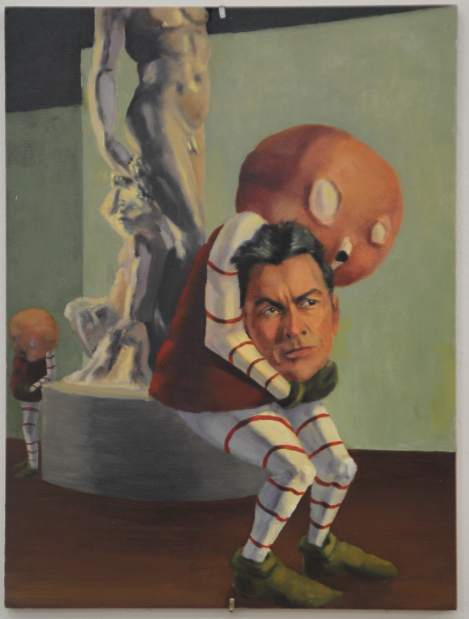
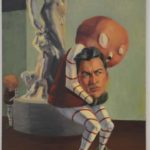
In "Man with the Head of Charlie Sheen," Fencl embraces pop culture and symbolism, having placed two of his figures again in a museum setting. One of them is walking in front of a statue of Bacchus, the Roman god of wine, carrying the head of Charlie Sheen, as if he is absconding with it.
"Charlie Sheen was clearly the most fascinating celebrity of 2011, and I am paying tribute to his mischief with this painting," Fencl says. "This is my way of putting portraiture in my work and I like the symbolic quality of the 'removed' head. I have a history of this in my work."
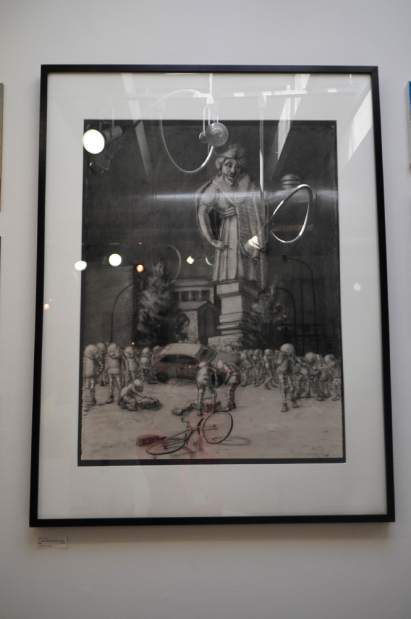
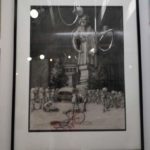
In "Riot at the Monument to the King," a charcoal-on-paper piece, Fencl tackles the "unrest we see across our country and throughout the Western world" by depicting his characters in the aftermath of what must have been a riot, in front of statue of Burger King. It is, Fencl says, a prediction of what could come: "What is right now a political statement -- Occupy Wall Street, class warfare, entitlement mentality -- has the potential to turn deadly serious and risk people's lives, our country's prosperity and freedoms," Fencl says. "This image asks the viewer to consider the future of the unrest as it grows and consumes new targets. By using the absurdity of pop symbolism to discuss a serious subject matter, it offers the viewer a new way of considering the topic."
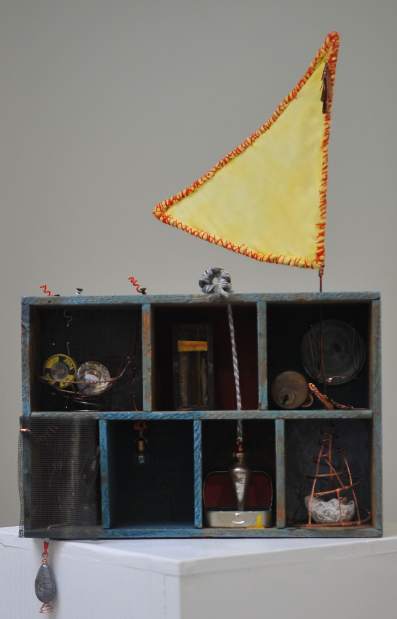
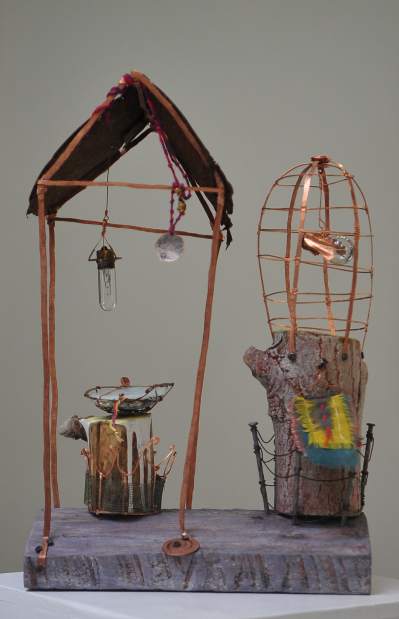
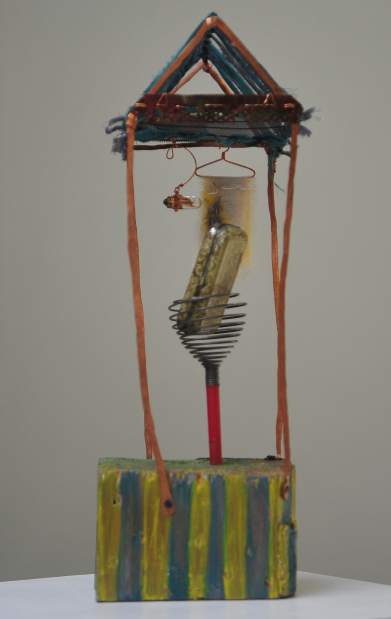
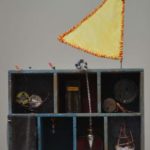
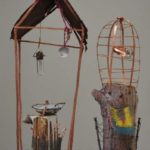
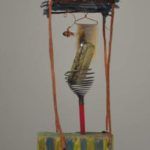
Daria Pigg's work, assemblage sculptures based on her own written verse is a complete opposite to that Fencl's.
To be more specific, Pigg describes her works as "combines," that is "most similar to sculptures or collage but not exactly either."
"Usually, my art process these days begins with writing, long before any actual form of building a work begins," she says. "Next, I'll start culling my favorite (words or phrase) from the writings, the bits and pieces I feel contain the most transferable visual content. I also am constantly collecting the physical parts and remnants of the works in much the same way, ever searching out intriguing visual bits to reconnect together."
Once she has chosen the words and their related pieces that she thinks would make a good combination, she then begins to assemble all these elements into a visual interpretation of the word story.
In this way, she says each work then actually becomes more like a single published copy of a book. "A better description of what I (create are) curious books," she says.
In some of the pieces, like "Whisperyard," the initial text she started with is located somewhere physically within the piece itself. Here, as in many of her works, the words are stamped or painted directly on the object itself.
Often, the words are within removable books of fabric, metal, or wood attached to the main object in some fashion. For example, in the case of "Wedding The Home" and "Vagabond Heartstir," a key part of the text is actually stamped onto removable "tokens" that can then be worn as a necklace or a bracelet.
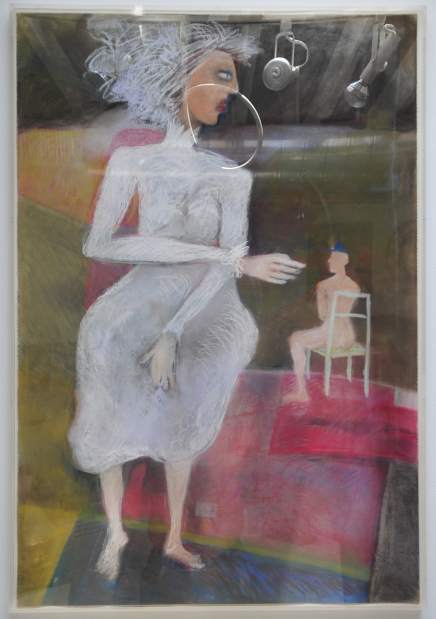
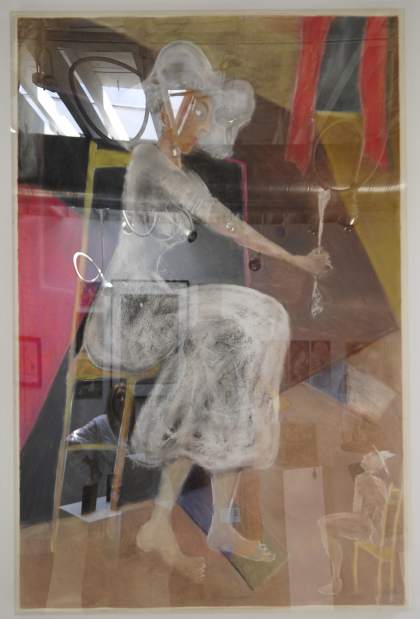
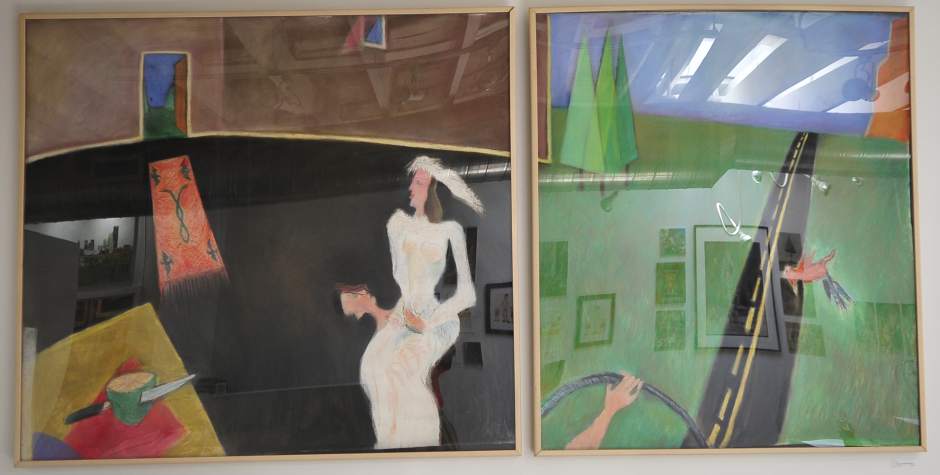
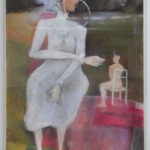
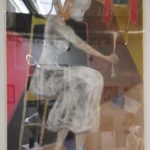
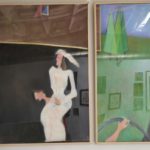
Finally, the works of Valetta (uses only one name) need little explanation. Pastel paintings, all with a figurative bent, according to the artist, "my pieces are all based on a stream-of-consciousness method."
"Several years ago, I was doing an oil sketch and an image of a bride really struck me. I now repeat the image in many of my works."
That goes a long way in explaining the brides depicted in the paintings "Wedding Bell Blues," "Seated Bride" and "Bridal Vow."
"I don't start a piece knowing what it means, but afterward I look at it and it just comes to me, the meaning," Valetta says,
For example, an image of "road kill" "just kind of happened," says Valetta, when creating "Wedding Bell Blues." "After I saw the finished product, I realized the road kill is death." In this work, as well as others, "There is a promise of a beginning and a promise of an end."<
