



Opening Friday at Fein Art Gallery on the North Side, the exhibit “Wess Smith, Digital Collage Artist” follows the continuing evolution of one of Pittsburgh's most creative and unusual digital artists.
Born with dichromatic colorblindness, which yields a perceptive confusion between reds and greens, Smith says that “for me, (it) results in a superior sensitivity to tone, warmth and coolness. This correlates to an unusual treatment of color, in what might otherwise, have yielded only a monochromatic effect.”
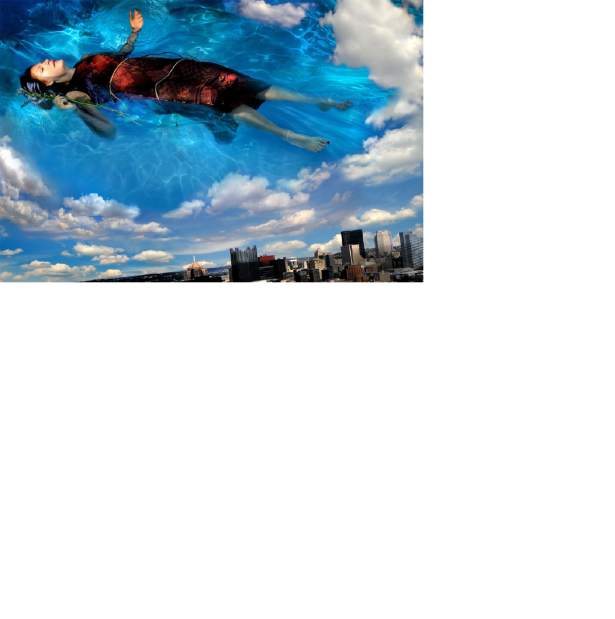
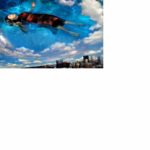
With nearly two dozen works on display, visitors to Smith's solo exhibit may recall among them his monumental work, “Ophelia,” which was exhibited in the 100th anniversary Associated Artist's of Pittsburgh Annual at the Carnegie Museum of Art in 2010.
Smith's “Ophelia II” was inspired by a painting of the same title by English Pre-Raphaelite painter John Everett Milais (1829-96). The original depicts a young woman, presumably dead, floating face up in a pond surrounded by heavy vegetation. Each plant had a symbolic meaning. For his “Ophelia,” Smith staged his older daughter in the same pose, only in his neighbor's pool.
“Milais painted his model in a large bathtub,” Smith says, “so, I felt we started on level footing. I placed my Ophelia somewhere above Pittsburgh, between heaven and hell.”
Smith lives and works in the Mission Hills area of Mt. Lebanon. His “studio” is a room in his home. All he needs is a high-resolution, 27-inch iMac; a second large screen to display the images that he works from, which he calls “my palette”; a 12-inch by 18-inch electronic drawing pad; and Photoshop and other digital paint software.
“I use an outside professional printer (Alex Patho of Glenshaw) and print on high-quality archival papers,” he says. “My biggest problem is where to hang and store all of my framed work, and the only thing I miss with oil medium is the smell of the paint and the textural look of the surface of the finished painting. However, I am beginning to explore 3-D printers to create that missing surface texture of Giclee prints. I print limited editions, usually around 30 prints.”
He received bachelor's and master of fine arts degrees in painting and printmaking at the Maryland Institute College of Art. Smith's early career was as a painter and university teacher. After earning a second master of arts degree from San Diego State University in television production, he shifted gears in mid-career to work in the video-production industry creating documentaries and managing a large corporate video-production and postproduction facility.
Eight years ago, he taught himself Photoshop and other digital paint software.
“I have always worked a lot from my photos, at first, using them as source, later, applying photos directly to the canvas via photo silk-screens, and now, using digital photos as the painting medium.”
The completed images in this exhibit are computer files that are printed as Giclee images on archival paper.
“While my paintings are composed of hundreds of photographic elements and can sometimes, at first viewing, be mistaken for a single photograph, they are not. ... The final images are of nothing that exists intact in the real world,” he says.
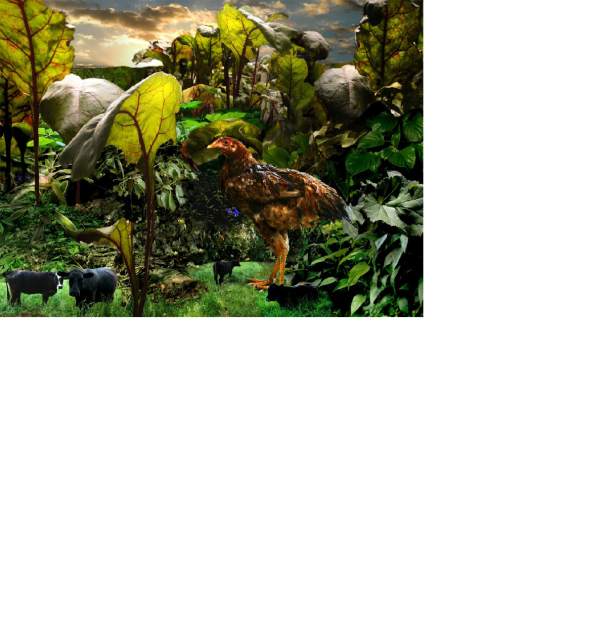
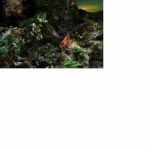
For the piece “Deep Woods Silkie,” Smith photographed a Silkie chicken on a farm where his granddaughter rode horses. “I carry my Nikon D300 camera everywhere, often taking photos with no ultimate purpose in mind, but that may be useful downstream,” he says. But here, he placed the chicken in the noticeably disadvantaged spot of becoming prey to a cunning fox.
Smith says he often likes to set up situations of vulnerability in his digital paintings, but he likes to “give the actors a chance of escape.”
“Here we have a predator and prey in a near-dusk rough environment that adds tension to the issue of vulnerability,” he says of the piece. “Is the chicken lost, can it fly, is the fox cunning enough?”
It's one of Smith's more popular works from his “Vulnerability” series; it's been in five exhibitions, most notability the 2010 Pennsylvania State Museum “Art of the State” exhibit.
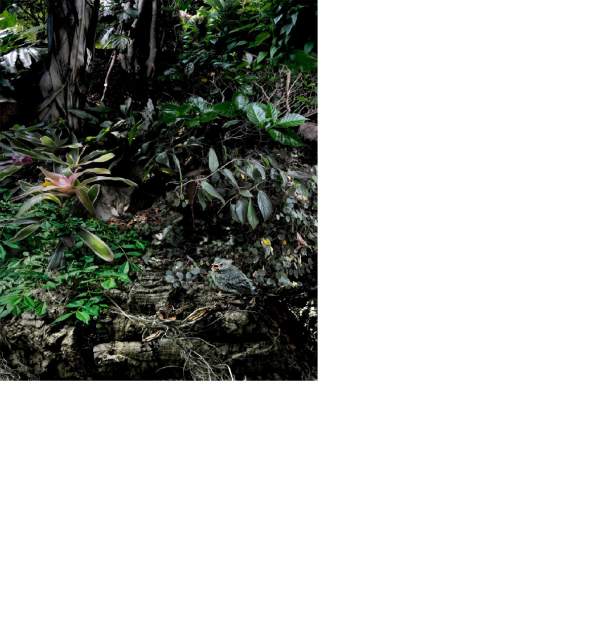
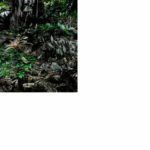
“Encounter 2” is another piece in Smith's reoccurring “Vulnerability” series, only in this one there is palpable tension between a cat and a baby bird.
“I mean what could be more vulnerable than a baby bird?” he asks rhetorically. “I shot the bird at my daughter's house right after it fell out of the nest.”
Visitors will likely notice that many of the plants and vines are the same as those in “Deep Woods Silkie.” Digital compositing allows Smith to “borrow” elements from other works.
He says, “at first, most people don't see the cat, which adds a bit to the unknown outcome. I shoot all of my own photographs and have a library, which I like to think of as my palette, of about 40,000 images. Many times, people look at my work, give me a big ‘love your work' and then ask, ‘where did you take that picture,' believing somehow I staged the whole thing.”
Kurt Shaw is the art critic for Trib Total Media. He can be reached at kshaw@tribweb.com.
