


Leadership within an orchestra has many aspects, none more important than setting a standard, a good example.
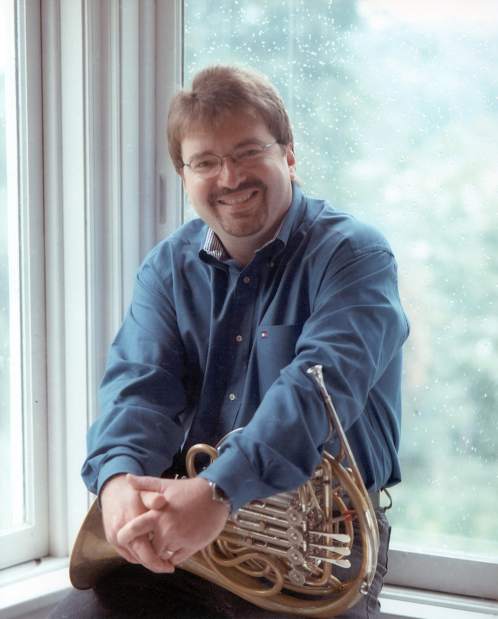
William Caballero has been the Pittsburgh Symphony Orchestra's principal horn since 1989. A favorite of audiences and musicians alike, Caballero always shares his solo bows with his section by extending his right arm toward them when he stands.
"I'm in awe of what he does on a daily basis. His playing inspires everyone on stage," says Cynthia DeAlmeida, the orchestra's principal oboe.
The Pittsburgh Symphony's music director Manfred Honeck was a member of the Vienna Philharmonic, which has a famously great horn section, before he became a conductor.
"When I did Tchaikovsky's Fifth here for the first time I thought, 'Wow! This man is able to create music with his horn that I never heard before,'" says Honeck, speaking of his Heinz Hall debut in May 2006. "Every nuance, every entrance technically fantastic. But he can play quietly in extremely beautiful music which made, for me, the second movement of the Tchaikovsky, which I've conducted very often, an unforgettable event."
Not surprisingly, other orchestras have sought to attract Caballero, most recently the Los Angeles Philharmonic in the fall of 2010. He played with the orchestra's celebrated young music director Gustavo Dudamel in Los Angeles and on a 12-city European tour.
"I had wanted to meet Dudamel and work with him and his orchestra. With that invitation I had the opportunity," Caballero says. "Part of the opportunity was to audition for the orchestra, which I agreed to. Dudamel is for real, and the Los Angeles Philharmonic is an outstanding organization."
Caballero says he didn't expect to win the Los Angeles position, but when he did he had to make a decision.
"Oddly enough, it came very quickly in wanting to stay in Pittsburgh even after multiple offers from the Los Angeles Philharmonic. There are many reasons," he says. "The main focus was, I felt more comfortable rearing my family in Pittsburgh. Secondly, Honeck explores German repertoire, which I love, and lets the brass section contribute in a two-way collaboration. The added bonus is that he treats us like his own family. Thirdly, there's always a learning curve when you switch to any other job. I felt better staying here and remaining a part of the music making that I've already been a part of for my most of my career."
Early years
Caballero, 52, was born in Santa Fe, N.M., where his mother, concert pianist Nancy Jane Boyle, died when he was 4. His father, Daniel Caballero, was a band director when his son was growing up, and left the public schools in 1982 to become an Episcopal priest.
They moved to Kenosha, Wis., when Caballero was 5. His dad married Gretchen Lentz, an English teacher, the next year. He started piano in third grade, horn in fifth grade and pipe organ in seventh grade.
"He was quite an interesting person even back then and very likable," his father says. "He got me interested in the Beatles. He was already listening. He's been a model of a person, a wonderful example for his siblings, Cathryn, Andrea and Michael."
After high school, Caballero went to the New England Conservatory of Music in Boston, where he studied with Richard Mackey, a member of the Boston Symphony.
"I met Bill in '77," Mackey says. "He was a good horn player, had good embouchure and good training in high school. He was very quick to learn. It's a thousand little things you push along to improve taste and awareness. You do it all your life."
Mackey and Caballero became friends and stay in touch to this day.
"Bill hasn't changed as a person," Mackey says. "He's just as pleasant and outgoing and democratic as ever -- no high horse, he's humble. He's gotten so unbelievably strong, he can do things on the instrument I never realized. I never could play like that."
After graduation, Caballero free-lanced in the Boston area, often playing as an extra with the Boston Symphony. In October 1982, he became acting third horn of the Boston Symphony.
He also was an unpaid fellow for two seasons at the Boston Symphony's Tanglewood Music Festival in Lenox, Mass., when he played under such luminaries as Leonard Bernstein, Kurt Masur and Seiji Ozawa. He even turned down lucrative work to play at Tanglewood.
Caballero held two major orchestral positions before he came to audition for the Pittsburgh Symphony. He was third horn of the Montreal Symphony from 1984 to 1985, where he improved his sense of chamber music style in a large orchestra. He left Montreal to become co-principal horn of the Houston Symphony (later becoming principal horn), where he learned how to lead his section.
Winning the job at Heinz Hall
In 1988, he tried out for the principal horn of the Pittsburgh Symphony, with Lorin Maazel as music director.
"I remember his audition very clearly," says symphony horn player Ron Schneider, who joined the orchestra in 1978. "He was in the finals but it was not so obvious he should be there."
The three finalists each played a week of concerts. One played "Symphonia domestica" by Richard Strauss. Another played "Petrouchka" by Igor Stravinsky. Caballero played "A German Requiem" by Johannes Brahms, the least "horn piece" of the three. He was in third place among the finalists.
"Bill shows up (for the Brahms) and was just warming up when Joe (Rounds, another member of the horn section) and I looked at each. We knew this was the winner," Schneider says. "It was that clear this guy would be perfect. He made people around him sound better. However he played then, he is far better now.
"There's a certain aggressive prominence to his concept, a brightness to the sound, an energy level. It's how I think a horn should sound in an orchestra," Schneider says. "He has a very responsive soft range and an amazing palette of articulations. In all the years we've played together, I've never heard a 'no speak' note or slur break from him -- not in rehearsals, not in concerts. Never. His fundamentals are just so strong it doesn't happen. He's missed things but never an uncontrolled miss."
Schneider also says he couldn't ask for or imagine a better section leader. Caballero is open to suggestions, even about his own playing, and, even more remarkably, will play in the section (not first chair) when one of his colleagues needs time off.
At home
Caballero lives in Edgeworth with his wife, Kathy, who is principal cello of Pittsburgh Opera Orchestra, and their three children -- Margaret, 13, Elinor, 11, and Will Jr., 9.
When they moved into their home, Bill caulked everything in his basement practice room. "Sound is like water," he says, "if it can find a way to leak it will." His soundproofing succeeded so well he could practice at midnight and not wake the children.
Caballero regularly performs at summer music festivals, usually the Grand Teton Music Festival in Jackson Hole, Wyo., and the Pacific Music Festival in Sapporo, Japan. This summer, he's teaching and performing at the Aspen Music Festival in Colorado and returning to the Pacific Music Festival. In Pittsburgh, he is an associate teaching professor of horn at Carnegie Mellon University.
Caballero has performed many concerti at Heinz Hall, including world premieres by Benjamin Lees and Andre Previn, and pieces by Wolfgang Amadeus Mozart, Strauss, John Williams and Benjamin Britten.
In September, he'll play and record the Strauss Horn Concerto No. 1 with Honeck and the symphony at the first of the season's BNY Mellon Grand Classics concerts.
"Bill and I were sitting around when we did the Mahler Fifth (Symphony) with Honeck last season," Schneider says. "We talked about how, when we were kids, this was what we wanted to do. We recorded the Mahler. We played it in big places. We didn't want to play ice shows. We wanted to play the pieces you listen to recordings of."
