
Ampco-Pittsburgh CEO sees ample opportunity for steel industry supplier

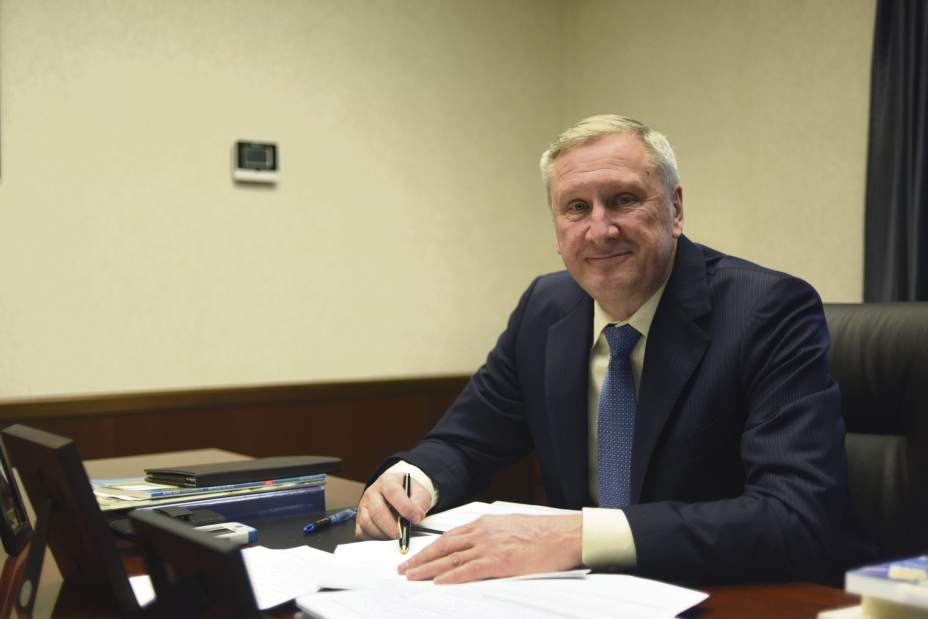
John Stanik came out of retirement in January 2015 to become CEO of Ampco-Pittsburgh Corp. and lead a turnaround at the Carnegie-based company that was struggling because of weakness in the steel industry.
Stanik, who had led a resurgence at Calgon Carbon Corp. in the mid-2000s, said Ampco-Pittsburgh, which produces rolls used in steel mills, can be successful because the company has a board that embraces change, workers who want to win and a plan in place to grow the business.
“Those are the three elements that I think are most important to make a turnaround occur,” Stanik said.
Stanik discussed a recent decision by the United States to slap tariffs on steel imports, the problems facing the company's main subsidiary, Union Electric Steel, and why acquisitions are part of his strategy during a recent interview with the Tribune-Review. Below are edited excerpts.
Trib: What is your outlook for the steel industry and Ampco-Pittsburgh?
Stanik: Prior to some things happening recently, I would have answered that question by saying that the market wouldn't really turn around until 2017. The fundamental problem in the market is the overcapacity of steel. The Chinese are exporting steel to support their workers. To have the Chinese tariff end up at 265 percent makes their competitiveness very difficult. I think it more importantly sends the message that the government is going to support the industry. Hopefully, it's also going to send the message to Europe, and hopefully the European Union will begin to protect more of the steel industry that's indigenous over there.
Trib: Is the European market important for Union Electric Steel?
Stanik: With the Akers acquisition (completed this month), we are now very international. We have four plants in Pennsylvania. We have one in Indiana. And then with the acquisition, we have a large plant in Sweden, a plant in Slovenia, our existing plant in the United Kingdom that we had previously and we have a joint venture in China. The Chinese have announced that they are going to reduce 150 million tons of steel capacity. People believe that's going to be over the next five years. And China is going to lay off 500,000 workers in the steel industry and 1.3 million workers in the coal industry. And what does all that mean for our customers? It may mean that the market begins to bounce back sooner.
Trib: And if the industry picks up, that means steel mill capacity increases and they need more steel rolls, correct?
Stanik: That's right. There have been a significant number of rolling mills that have closed in the last six or seven months.
Trib: Do you anticipate making more acquisitions to diversify the business?
Stanik: There is a strong possibility. The beauty of our forge capability here in North America is in order to approach the open-die forge market, we don't have to make any capital changes to our manufacturing facilities. We've proven that we can enter the fracking industry and provide valve blocks and various types of open-die forges to support the oil and gas business. We took open-die forge products from sales of $3 million in 2013 to $13 million in 2014 to $24 million in 2015. That $24 million number was primarily into only the middle of the second quarter last year, when the oil industry collapsed and the market opportunity was reduced. While we have that capability, we believe if we make certain acquisitions we can expand the markets we can approach because we don't have experience outside those areas that I mentioned.
Trib: The acquisitions would allow you to target other industries that need those products?
Stanik: Yes. For example, the defense industry, the nuclear industry, the power industry. All of them utilize a large number of open-die products. In North America, the steel roll business is somewhere around $300 million to $350 million. The open-die forge business is somewhere around $2.5 billion. And there are a lot of small, high-quality companies who were caught with their balance sheet in a weakened position prior to this downturn. They've gone through three or four years of that, and their situation is they're fighting just to survive. So there are a lot of attractive opportunities. The Akers acquisition was a very attractive opportunity for us to buy that company, which was essentially the same size as Union Electric Steel, for $80 million. It sold for 430 million euros ($477 million) eight years ago. So we believe we got quite a deal.
Trib: If business has been so rough, how is that Ampco-Pittsburgh has the capital to do acquisitions?
Stanik: The period from 2009 through 2012 was a very prosperous time for Union Electric Steel. The company was very profitable through that time, and it accumulated cash. When I joined the company, there was $100 million on the balance sheet. My opinion was it could be invested to change the company, improve the company, and make it more profitable. And importantly, the company had no debt.
Alex Nixon is a Tribune-Review staff writer. Reach him at 412-320-7928 or anixon@tribweb.com.
