


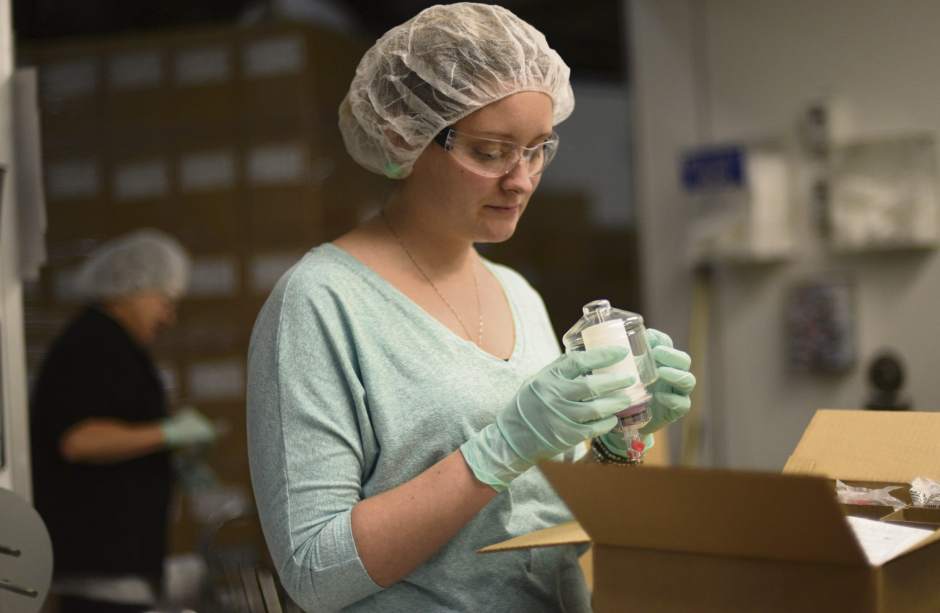






Machines are running constantly at Haemonetics in Leetsdale, pumping out a blood collection bowl every second, 24 hours a day, seven days a week.
The blood business has been a boon for the company, which started adding weekend shifts to its production schedule in August to keep up with demand from commercial plasma centers. It had operated five days a week.
Increased production at Haemonetics is being driven by the pharmaceutical industry, which buys plasma, the liquid portion of blood, for use as a raw material for drugs and other treatments for people with immune system deficiencies.
“We're lucky,” Timothy Spang, director of operations at Haemonetics' Leetsdale plant, said during a recent tour. “The Pittsburgh site supports some of our highest growth areas.”
The Leetsdale site is one of two U.S. operations where Massachusetts-based Haemonetics Corp. makes disposable plastic bowls and bottles used each time one of the company's commercial plasma customers draws blood. The company makes equipment used by more than 70 percent of the nation's plasma centers to collect and process the valuable blood component.
“Our customers are collecting more and more plasma,” he said.
About 230 people work at the plant, which has been open for 25 years. Haemonetics has manufacturing operations in five other states and overseas. The company, which is publicly traded and had $910 million in revenue in its most recent fiscal year, said its global plasma business grew 11 percent last year.
An estimated 29.4 million liters of blood plasma was collected in the United States in 2013, according to market research firm Kalorama Information. That's enough to fill nearly 12 Olympic-sized swimming pools.
Production of plasma-derived products is expected to increase by 6 percent a year through 2018, Kalorama said.
As promising as the plasma business is for Haemonetics and the Leetsdale plant, Spang said, products that his facility recently began manufacturing have even more potential for growth.
A year and a half ago, the company moved production of diagnostic devices used to test how well a patient's blood clots to Leetsdale. It's a test that's becoming common before surgeries because more patients take blood thinners, which can reduce the blood's ability to clot, Spang said.
Haemonetics increased sales of the diagnostics devices 24 percent last year. Sales of the devices totaled $40 million, or about 4 percent of the company's annual revenue. But, Spang said, “it's a big growth area for Haemonetics.”
The Leetsdale plant received the production work because of efforts to distinguish itself as a “center of excellence” among the company's manufacturing facilities, Spang said. The devices originally were going to be assembled at a Haemonetics plant in Illinois by using components made by an outside supplier.
But the Leetsdale plant showed that it could be more cost-effective if it produced the components and assembled the devices in-house, Spang said.
The plant has become more efficient by investing in technology that has allowed it to increase production capacity 15 percent without expanding its physical space, he said.
“We'll continue to do that,” he said. “Ultimately, you can only be as viable as you are competitive.”
Alex Nixon is a Trib Total Media staff writer. Reach him at 412-320-7928 or anixon@tribweb.com.
