

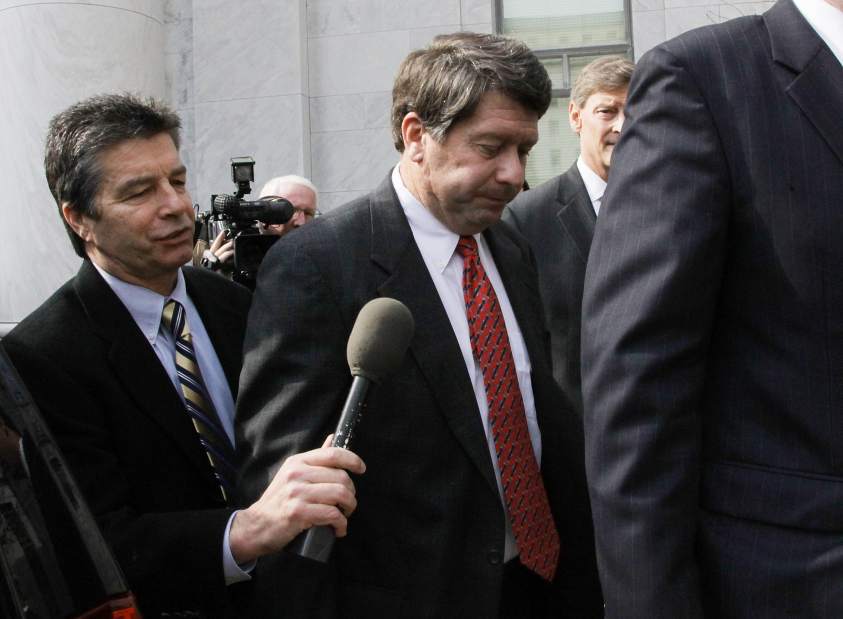
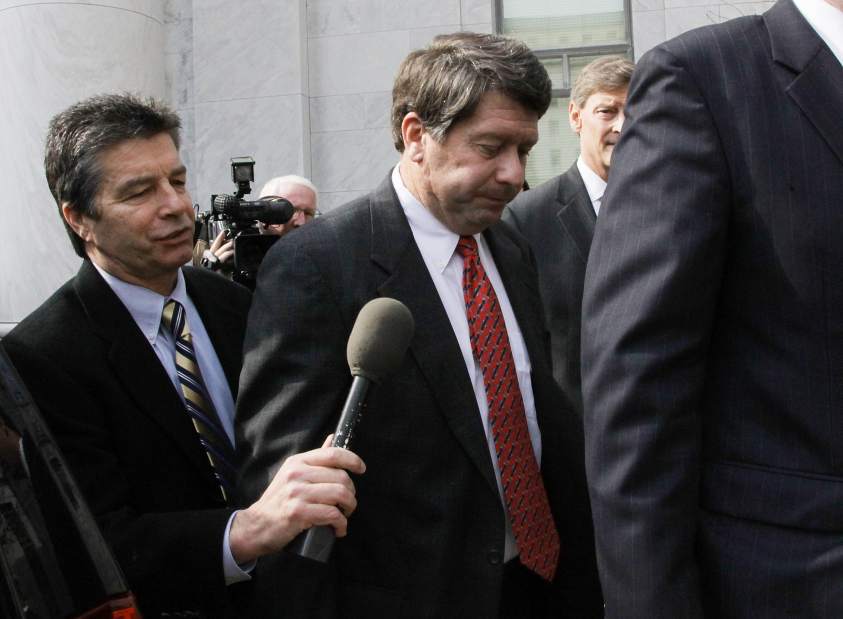


Federal prosecutors delivered a stern warning to America's corporate boardrooms in winning a conviction and 28-year sentence against the former owner of a Georgia peanut company for his role in a deadly salmonella outbreak: Executives will be held accountable and face severe punishment for corporate wrongdoing.
The case against Stewart Parnell, who knowingly shipped salmonella-tainted peanut products when he was CEO of the now-defunct Peanut Corporation of America, underscores a shift in how federal prosecutors deal with fraud and white-collar cases. They are no longer content to levy large civil penalties on companies accused of wrongdoing and allow individuals who lead them to escape blame.
“We're finally figuring out that CEOs are going to be held more and more accountable,” said Jim Weber, a professor of business ethics and management at Duquesne University. “And this is another step along the way.”
The government is cracking down on food safety issues and financial fraud but in many cases companies have paid civil penalties and executives have been charged with misdemeanors, if they'd been targeted at all. The Justice Department recently said it would focus on prosecuting employees and not just seek hefty financial settlements from companies. The new rules pressure corporations to hand over evidence against their executives in negotiating settlements.
Parnell's actions, which led to the deaths of nine people and sickened more than 700, are an extreme example of executive malfeasance and it is unlikely that there will be a cascade of other felony cases brought against top CEOs, business and legal experts say. The case was exceptional because Parnell was aware that peanut butter being shipped was contaminated with a potentially deadly bacteria, and because consumers died from eating it.
“The lesson here is that if the federal government has got the facts, they're going to go after you on felonies, not just misdemeanors,” said David Tungate, associate teaching professor of law at Carnegie Mellon University's Tepper School of Business.
There have been other high-profile cases of food-safety violations and white-collar crimes, but few if any executives were treated as harshly as Parnell, whose punishment Monday essentially amounts to a life sentence for the 61-year-old.
In April, the owner of an Iowa egg producer and his son were sentenced to three months in prison for their involvement in a 2010 salmonella outbreak linked to more than 1,900 illnesses. In May, ConAgra Foods agreed to pay $11.2 million to settle federal charges that it shipped salmonella-tainted Peter Pan peanut butter that sickened at least 625 people across the country in 2007. No company executives were charged in that case.
Former Tyco executive Dennis Kozlowski, who was convicted in 2005 of looting more than $100 million from the company, served only 6e_Snnb 1⁄2 years. The poster child for corporate fraud, former Enron CEO Jeff Skilling, is serving a 14-year sentence and is scheduled to be released from minimum-security federal prison in less than four years.
More recent scandals — Wall Street lending practices that led to the mortgage crisis, an effort at General Motors to hide problems with ignition switches and this week's revelation that Volkswagen installed software in diesel vehicles so they could pass emissions tests — are unlikely to result in felony convictions for top executives for a variety of reasons, business and legal experts said.
Proving a CEO intentionally broke the law is extremely difficult, said Barry Mitnick, a professor of business administration at University of Pittsburgh's Katz Graduate School of Business. There are layers of decision makers between the top ranks, and prosecutors would need proof that an executive not only had direct knowledge of a crime, but intended to commit it.
“(JPMorgan CEO) Jamie Dimon — how do you show his intent of defrauding buyers of mortgage securities?” Mitnick said. “How do you prove that?”
Prosecutors with limited resources must pick their battles, Mitnick said. Felony prosecutions can drag on for years longer than civil complaints and be much more expensive without the guarantee of any reward. Without hard evidence that proves a intent to break the law, the risk of losing for prosecutors is too great.
“It can take a very long time; it is very risky,” Mitnick said. “If you're a prosecutor looking at this, you're like, ‘Well, I can't do everything.' ”
Emails, cellphone records and other digital communications could aid prosecutors' efforts, Weber said. Indeed, it is what led to Parnell's undoing.
In emails, he acknowledged the salmonella-tainted products and ordered that they be shipped anyway from plants where they were found to be partially covered with dust and rat feces.
That his crimes resulted in deaths likely invited the harsher prosecution and sentence, Weber said. But so did Parnell's response, which was to deny guilt and refuse to accept responsibility. Prosecutors might have been more lenient had he acted as Volkswagen CEO Martin Winterkorn did this week, Weber said, which was to accept responsibility and resign.
The scandals enveloping General Motors and Volkswagen may not invite the same kind of felony prosecutions against their executives as Parnell received, Weber said. But the lesson for those and other companies is that federal prosecutors are upping the ante, hoping that the threat is enough to discourage misbehavior.
“Basic to our nature when we're 7 years old is the avoidance of punishment,” Weber said. “This might motivate some CEOs to say, ‘I don't want this to happen to me,' and take some measures to prevent it.”
Chris Fleisher is a staff writer for Trib Total Media. He can be reached at 412-320-7854 or cfleisher@tribweb.com.
