

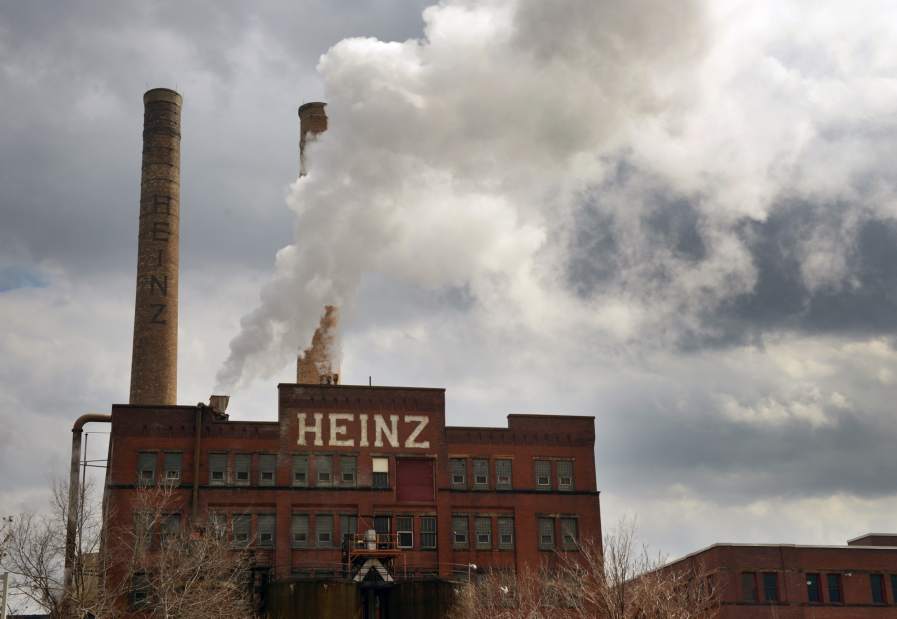
A promise to keep headquarters in two cities when H.J. Heinz and Kraft Foods combine is seemingly out of sync with 3G Capital's reputation for being lean and efficient.
And with Pittsburgh's history of losing corporations to bigger cities, it's no wonder officials here are not being complacent.
Pittsburgh Mayor Bill Peduto, Allegheny County Executive Rich Fitzgerald and Gov. Tom Wolf said Thursday that they plan to meet with Heinz's leadership to ensure Kraft Heinz Co. keeps its headquarters in Pittsburgh after the merger is finalized this year.
“The governor had reached out to me and the mayor to make sure we keep Heinz as a Pittsburgh company,” Fitzgerald said, a day after the deal was announced. “He wants to reach out to meet with them, to make sure the state is behind what they're doing.”
Bernardo Hees, the Heinz chief executive who will keep the top job at Kraft Heinz, said Wednesday that the merged company would operate co-headquarters between Pittsburgh and the Chicago suburb of Northfield, Ill., where Kraft is based.
But Jim Weber, a professor of business ethics and management at Duquesne University, said few if any companies have dual home offices.
“It makes little sense from an efficiency standpoint to have dual sets of operations,” he said, “Most companies, when they merge, scale down and jobs collapse.”
Brazilian-run 3G Capital, an investment firm that shares ownership of Heinz with Warren Buffett's Berkshire Hathaway, is known for its relentless focus on cost-cutting. Since taking the reins at Heinz in June 2013, Hees has overseen the closure of five factories and the elimination of 7,400 jobs, including about 400 in Pittsburgh. The company vacated offices it leased Downtown in the Heinz 57 Center and consolidated workers to its headquarters in PPG Place.
Kraft and Heinz have long histories in their homes. And each offers advantages for being the sole headquarters for the combined company.
Chicago, a city nine times larger than Pittsburgh, boasts a bigger airport with more direct flights. It also has more international flights, including to Brazil, an attraction for a company with global markets.
But Duquesne's Weber said a global company's headquarters do not necessarily have to be in the biggest city with the most infrastructure and resources. He pointed to Pittsburgh's lower cost of living and good schools as advantages over Chicago.
Kraft Foods has been based in the Chicago area since its founding in 1909. The company has called the village of Northfield, about 20 miles north of downtown Chicago, home for more than 20 years, said Fred Gougler, president of Northfield's board of trustees.
Gougler declined to discuss whether he and other officials there were concerned about losing the Kraft headquarters. Cook County officials also declined to discuss whether they were developing plans to keep Kraft near Chicago.
“It's really too early to tell,” Gougler said. “We haven't been in formal contact with Kraft yet.”
Kraft employs more than 2,000 workers at its offices in the village of about 5,500 residents, Gougler said.
Heinz's ties to Pittsburgh run deep. The company, founded in Sharpsburg in 1869, has given name to public buildings such as the Steelers' home field. Heinz employs about 800 workers in Pittsburgh, including about 250 at its research and development center in Marshall. It sold its factory in Pittsburgh's North Side in 2002.
Losing the storied ketchup maker would be another blow to a city burned over the years by big home-grown companies that have relocated their headquarters elsewhere because of mergers and acquisitions.
Westinghouse's presence here was drastically cut after a 1995 merger with CBS, in which the company moved its headquarters to New York a few years later.
Aluminum maker Alcoa Inc. moved its headquarters to New York in 2006, though it still employs about 2,000 people in a North Shore corporate center and an Upper Burrell research operation.
Mellon Financial's merger with Bank of New York in 2006 did not have the devastating impact that many feared. The combined company moved its headquarters to New York City but has added 1,000 workers since the deal and now employs 7,300 workers in Pittsburgh.
BNY Mellon spokeswoman Lane Cigna cited the “region's availability of talent, quality of life, affordable cost of living” as reasons for the company's growth here.
The decision ultimately may come down to which side — Kraft or Heinz — has the deepest roots in its city, Weber said.
“Corporations are much more transient. They're global in nature,” he said. “How much commitment does Heinz continue to have to the city, to the community?”
Alex Nixon and Chris Fleisher are staff writers for Trib Total Media. Nixon can be reached at 412-320-7928 or anixon@tribweb.com. Fleisher can be reached at 412-320-7854 or cfleisher@tribweb.com.
