
Teen inventors vie at Pittsburgh science fair

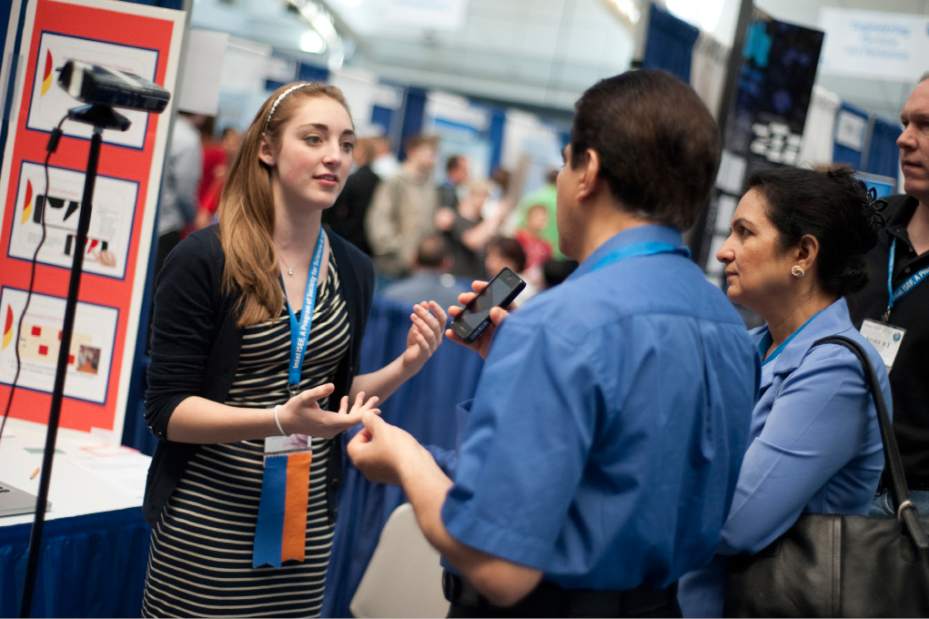
Natalie Nash patiently showed strangers how her invention worked on Thursday.
The teenager gently swiped her fingers across an iPhone screen on which black arrows and vibrations indicated that an object was in front of her.
"I wrote an iPhone application to be able to help blind people navigate in an unfamiliar environment," said Nash, 17, who lives in Shaler.
She is one of about 1,500 high school students, representing 68 countries, who are competing this week in the Intel International Science & Engineering Fair 2012 at the David L. Lawrence Convention Center, Downtown. The fair's sponsor, Intel Corp., based in Santa Clara, Calif., is the world's largest semiconductor chip maker.
The annual international fair began in 1950, and Intel started sponsoring it in 1997, Intel spokeswoman Allison Kubota said.
As the technological sophistication of projects has advanced over the years, so has competitors' frequency in creating projects that they hope will one day solve real-world problems, Kubota said.
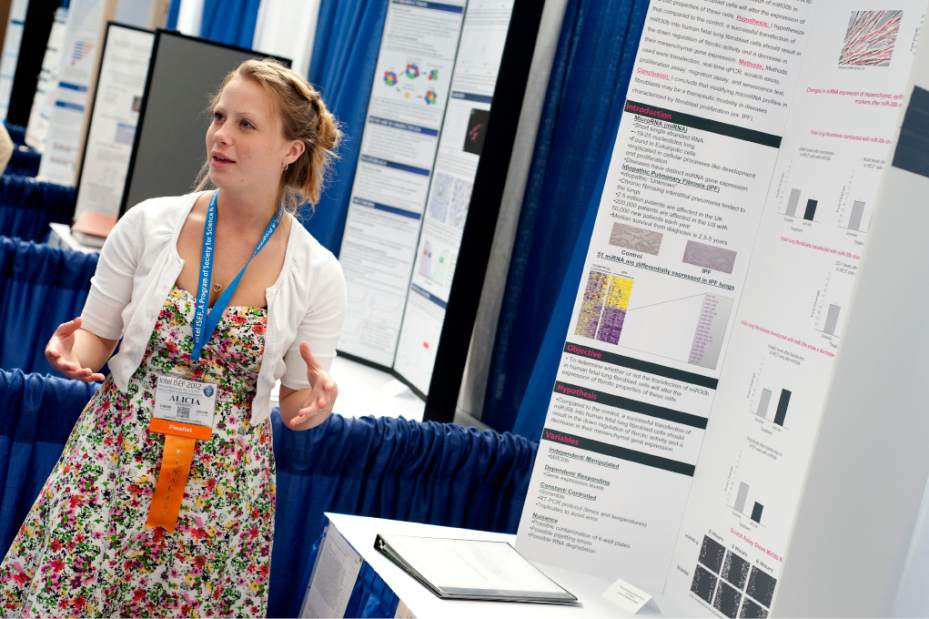
"The research I can contribute to will benefit other people. ... That is my ultimate goal," said Alicia Grabiec, 17, a Sarver resident whose project involved studying an incurable lung disease, idiopathic pulmonary fibrosis, and suggesting possible ways to deliver therapy.
Grabiec's research involved manipulating cells in a lab at UPMC's Simmons Center for Interstitial Lung Disease, to which she reached out on her own to conduct research typically performed by post-graduate students, she said.
The project's entry in other science fairs this year has won her $70,000 in scholarships from several colleges, said the Freeport Area Senior High School junior.
Grabiec has not decided which college she will attend, but wherever she ends up, she'll be majoring in biomedical engineering, she said.
Behind the technology and presentation boards displayed at booths stretching across the exhibition floor this week were teens with personal stories to tell about how they became interested in science.
Nash credits her participation in school science fairs to the influence of her former sixth- and seventh-grade science teacher, Linda Cessar, at Providence Heights Alpha School in McCandless.
"She was probably the one who got me interested in doing these projects for competition," said Nash, a senior at Vincentian Academy in McCandless who plans to major in computer and biomedical engineering at Penn State University.
Her science project was based on a computer software program she wrote to connect an XBox 360 Kinect sensor system to an iPhone.
The project is a "proof of concept" study, which means the project would not be applied in the real world now but could be used with a company's more sophisticated technology, she said.
The Intel fair is the largest pre-college science fair in the world, Kubota said.
"You could call it the Olympics of science fairs," she said.
Students were able to compete for more than $3 million in awards and prizes this week because they qualified in affiliated fairs at the local, regional or national level. Winners will be announced today.
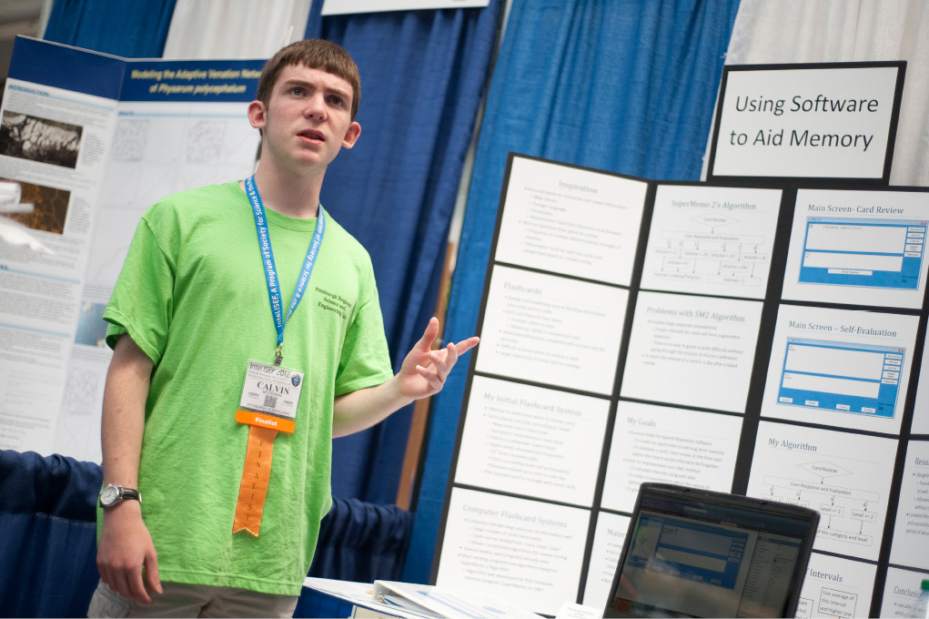
For his Intel fair project, Franklin Park resident Calvin Beideman, 15, a home-schooled sophomore, wrote a software program that creates computerized flashcards, "Using Software to Aid Memory."
"The idea is the better you remember something, the less frequently you review it," said Beideman, who showcased his project on a laptop computer in his booth at the fair.
Beideman is no stranger to computer programming, having taken programming classes at a community college and Carnegie Mellon University, and he interned last year as a programmer at a company for which his father works.
Science fair competitors
The Intel International Science & Engineering Fair 2012 winners will be announced Friday.
One Grand Award winner will receive $75,000; two second-place winners will receive $50,000 each; and 17 category winners will receive $5,000 each.
In addition, third parties, such as companies and colleges, were scheduled to present Special Awards, including scholarships, on Thursday night.
The following are Pittsburgh-area competitors:
• Calvin Beideman, 15, sophomore, home-schooled, project: "Using Software to Aid Memory"
• Alicia Grabiec, 17, junior, Freeport Area Senior High School, project: "Does the over-expression of miRNA in the fibroblasts cell line modify their fibrotic properties?"
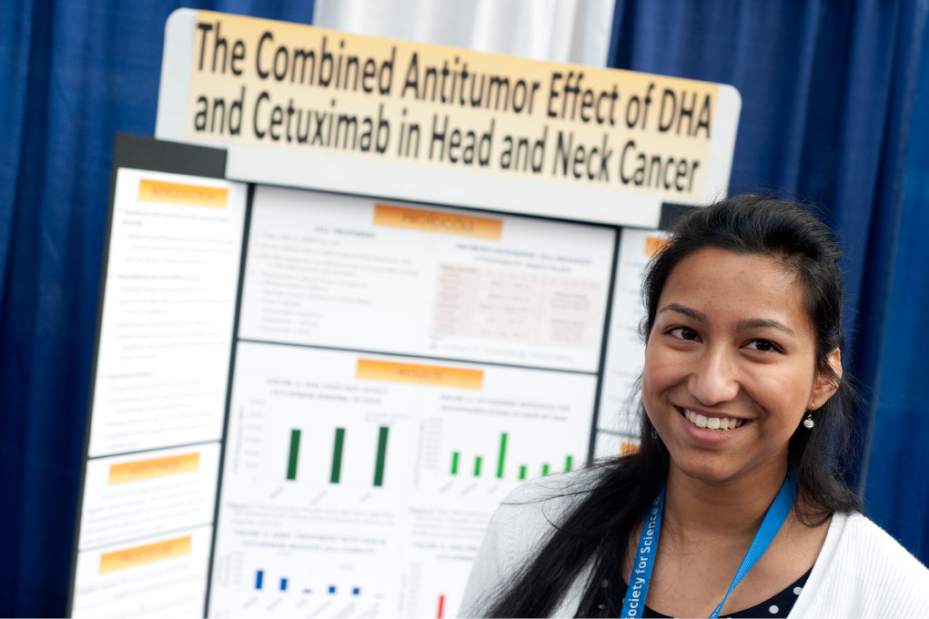
• Chareeni Kurukulasuriya, 17, senior, Pittsburgh Allderdice High School, project: "Cetuximab-DHA Antitumor Effect"
• Andrew Lingenfelter, 14, freshman, Seneca Valley Intermediate High School, project: "Designing a Low-Cost Versatile Military Robot"
• Natalie Nash, 17, senior, Vincentian Academy, project: "Creating a Navigation Device for the Visually Impaired"
• Elizabeth Posney, 17, junior, Freeport Area Senior High School, project: "Turnout Effect on Knee Ligament Tension"
• Robert Vaerewyck, 16, sophomore, St. Joseph High School, project: "A Zero Fuel Car"
