
Study: Just breathing in Downtown Pittsburgh can be like smoking most of a cigarette

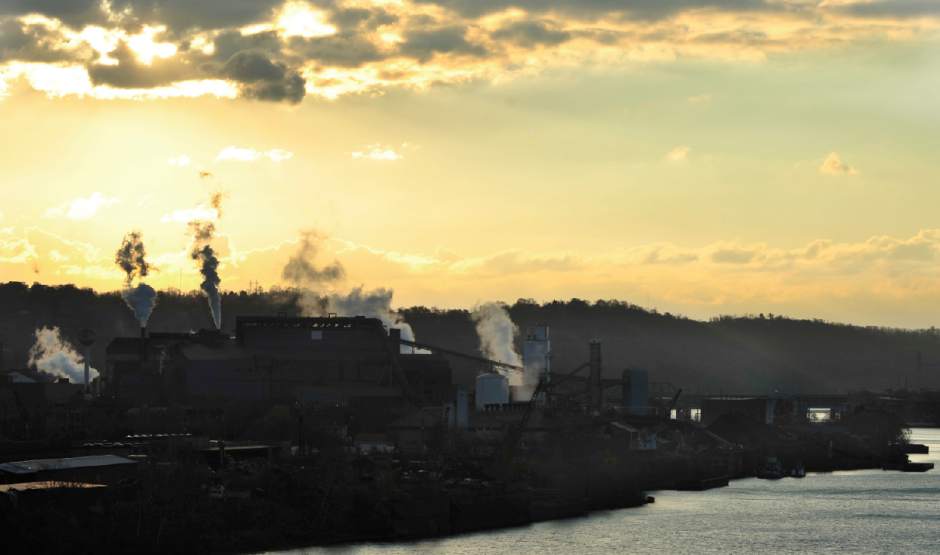
Spending the day breathing the air in Downtown Pittsburgh on Thursday would have the same effect on your health as smoking three-quarters of a cigarette, according to a Berkeley study and a new app.
Downtown Greensburg on Thursday was equivalent to half a cigarette per day; North Braddock, overlooking U.S. Steel's Edgar Thompson Works and down the Mon Valley from the Clairton Coke Works, was like a smoke and a half.
The free app, called “(Expletive)! I smoke,” grabs the nearest publicly shared air-quality monitor data based on a device's GPS coordinates, then runs it through a formula developed by University of California-Berkeley scientists Richard and Elizabeth Muller that compared the health impacts of air pollution to the health impacts of smoking.
The Berkeley study found that smoking one cigarette was roughly equivalent to one day of breathing air with 22 micrograms per cubic meter of the tiniest, most harmful particles generated by sources such as diesel engines or industrial processes. So a day with 44 micrograms per cubic meter of those particles in the air would be like smoking two cigarettes; the average air quality in Beijing, 85 micrograms, would be roughly four a day.
“For the United States and Europe, air pollution is equivalent in detrimental health effects to smoking 0.4 to 1.6 cigarettes per day,” the study's authors wrote. “In China. the numbers are far worse; on bad days the health effects of air pollution are comparable to the harm done smoking three packs per day (60 cigarettes) by every man, woman and child.”
Paris-based app developer Amaury Martiny and product designer Marcelo Coelho told CityLab they created the app using the Mullers' formula to hammer home the local effects of air quality in a form most people could understand.
“These air-quality monitoring stations are just numbers, numbers that are very specific to professionals who work in environmental issues,” Martiny told the website. “So when you make this conversion to cigarettes, it makes it easier to understand what people are dealing with and the consequences air quality has in their daily lives.”
The American Lung Association says the Pittsburgh region, which also includes parts of Ohio and West Virginia, is the nation's 10th-worst for short-term particle pollution.
The app is strictly tied to one's GPS location and the nearest air-quality monitor — there's no option to type in a different location — so one has to move around to compare the cigarette equivalents from one spot to another, though the developers told CityLab that was a feature they'd look to add soon.
Matthew Santoni is a Tribune-Review staff writer. Reach him at 724 836 6660, msantoni@tribweb.com or via Twitter @msantoni.
