


Streaming, high-definition, 360-degree video is coming to a moon near you.
Astrobotic , a Pittsburgh-based lunar payload delivery company aiming for a mission to the moon in 2019, and ATLAS Space Operations Inc. , a satellite communications company in Michigan, plan to bring laser communication to the moon.
The laser communication terminal scheduled to go on Astrobotic's first mission would stream back to Earth 4K video that would allow people to experience the moon in real-time, virtual reality for the first time.
“It's going to bring the moon closer to all of us,” said John Thornton, Astrobotic's CEO.
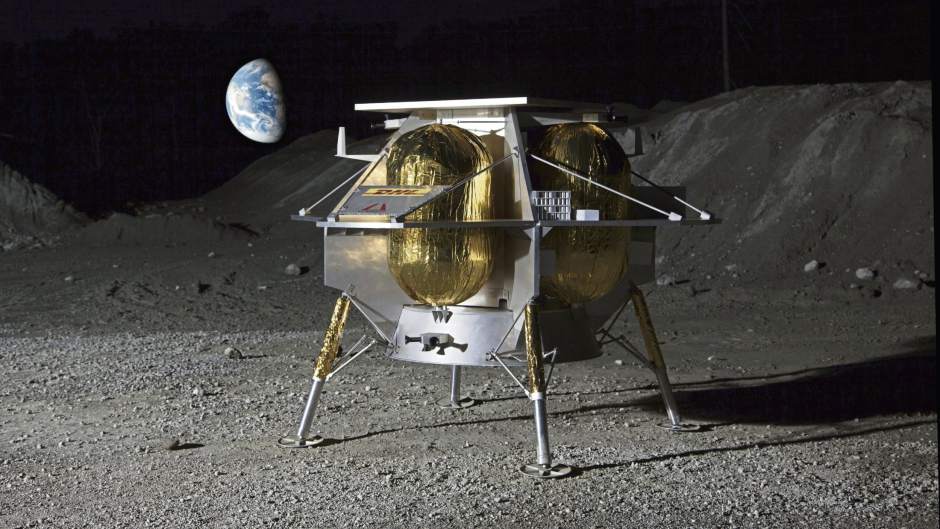
The pair announced the partnership at the Paris Air Show last week. Astrobotic, headquartered in the Strip District, also unveiled its Peregrine Lander, slated for the first mission, at the show.
Customers on Astrobotic's first mission will also have access to the communication terminal, allowing them to send back photos, videos and data about 1,000 times faster than previously possible, Thornton said.
“Everyone wants more data, whether it's just a rover with cameras or just better imagery,” Thornton said of the 10 other clients signed up for the first mission.
Sean McDaniel, CEO of ATLAS, said traditional communication between the Earth and the moon, about 239,000 miles away, crawls along at 30 to 40 kilobits per second.
“Like 1990s dial-up speeds,” McDaniel said. “It's really hard to transfer high-def images and videos back.”
A low-watt laser like the one ATLAS plans to use could enable 1-gigabit-per-second speed. A decent home internet connection offers data transfer speeds of 25 to 50 megabytes per second. ATLAS will be communicating with the moon 20 to 40 times faster than that.
NASA first proved the technology in 2013 when the Lunar Atmosphere Dust Environment Explorer demonstrated two-way laser communication from the lunar orbiter. NASA achieved speeds of 622 megabits-per-second , about six times faster than state-of-the-art radio communication systems at the time.
McDaniel said he and Astrobotic are working to line up more customers for the mission who may want to take advantage of fast communication, including gaming companies, virtual- and augmented-reality companies and major commercial brands.
“There's just a cool factor to it,” McDaniel said.
Astrobotic, once a front-runner in the Google Lunar XPRIZE , is hoping to land on the moon in late 2019. The Carnegie Mellon University spinoff company is offering space on its mission for $1.2 million per kilogram, a cost it calls an “industry defining low price.”
Aaron Aupperlee is a Tribune-Review staff writer. Reach him at aaupperlee@tribweb.com, 412-336-8448 or via Twitter @tinynotebook.
