




A soft breeze ripples through the leaves of young beech trees, which hold on to their light-tan foliage through the winter. This grove of seedlings is dwarfed by huge specimens, towering over their offspring at the Pleasant Hills Arboretum.
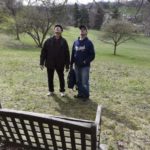
As a bright cardinal sings loudly in hopes of finding a mate, Greg Smith and Paul Beck discuss what to do about invasive plants growing along the border of the woodlands.
Smith is president of the arboretum board and Beck serves as vice president. Both hope to bring more attention to the green space, which was founded by A.W. Robertson in 1950. The first eight acres of the arboretum were officially dedicated in 1953, and another eight acres were added soon after.
Robertson's “understanding was this original eight acres was old-growth forest, a section of woods that was never cut, never developed, never farmed, and they wanted to preserve it,” Smith says.
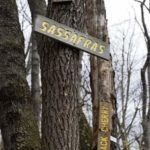
No one knows for sure if it was virgin forest, but Robertson was convinced it was so. There are now 76 species of trees growing throughout the arboretum; the oldest is a red oak about 220 years old.
The trees are the perfect home for the birds. More than 100 species have been observed there.
“It's a little gem, and a jewel that even people who live in Pleasant Hills don't really all know about,” says Smith, who is looking for some assistance to keep up with this historic space. “We'd like more people to be aware of it; we'd like folks to volunteer. Our board alone cannot take care of this place. Sixteen acres is a lot of space and a lot of work. Pruning, trimming, planting, putting mulch on the trails — all of us cannot do it. We need more help.”
A TreeVitalize grant of 18 trees has helped Smith continue the goal of planting more specimens in the arboretum.
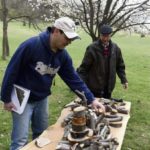
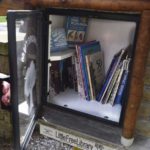
Other additions include a block table and the Little Free Library, both constructed by volunteer Denny Kunkel, who serves as the borough's public works superintendent. The block table is a place for children to take cut pieces of wood from the arboretum and use their imaginations to build all sorts of things.
“They can actually feel natural pieces of wood and use their creativity, and the kids like it,” Beck says.
The legs of the table were made from the trunk of a black cherry tree that fell along the main trail.
“To me, it's always kind of a sad thing to see a big tree come down,” he says. “A lot of the trees here have been around a lot longer than we've been around.”
Beck, a lifelong Pleasant Hills resident, has been fascinated by trees since childhood, and the arboretum has always been a part of his life.
“When I was a kid, my mom used to walk us to the library, and we'd cut through the arboretum,” he says with a laugh. “Every time I come here, I see something I haven't seen before.”
Visitors who walk the trail through the arboretum are welcomed by a plaque with the poem “Fallen Leaves,” by founder Robertson, who was chairman of the board and president of Westinghouse. The last three lines are both poignant and beautiful: “To heavy feet and troubled mind. Come walk ankle-deep and forget the years. Come walk in leaves and find youth's dream.”
The arboretum is open to the public seven days a week and can be accessed by two entrances. Many people visit to hike the woodland trail and enjoy the six-acre meadow.
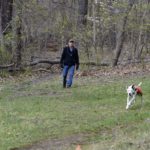
Mike Bauer and his dog, Petey, are regular visitors.
“We come over here two or three days a week,” Bauer says. “It's just nice and quiet after a hard day of work, and I know it's going to be here tomorrow. They're not going to develop it.”
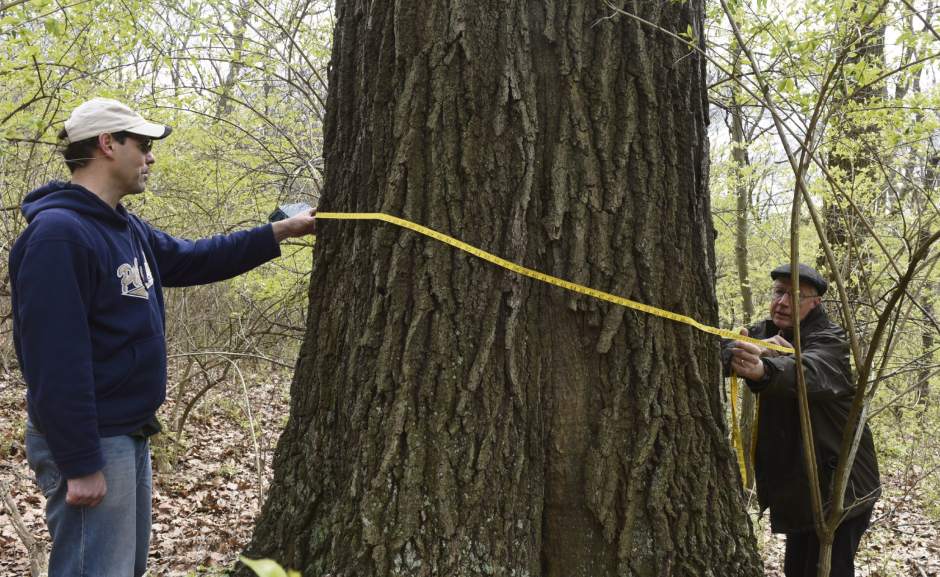
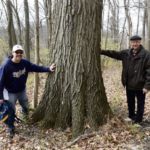
Standing under a giant oak estimated to be more than 100 years old, Smith explains what he loves about these trees.
“Just the sheer size,” he says. “When you see something that's 3, 4, 5 feet wide, 100 feet tall, it's impressive. It's God's creation; it's his world, and it's all here.”
At the base of some of the trees lay carved stone markers set in place when the specimens were planted on Arbor Day over the years by schools and organizations since the mid-'60s.
“I think it's important for children to see how important trees are for our environment,” Beck says. “Trees have a lot of value for us, and I think more and more people are starting to recognize that fact. At a place like the arboretum, where we can study different species of trees, it's like a living museum.”
Details: pleasanthillsarboretum.org
Doug Oster is the Tribune-Review home and garden editor. Reach him at 412-965-3278 or doster@tribweb.com. See other stories, blogs, videos and more at triblive.com/lifestyles/dougoster.

