


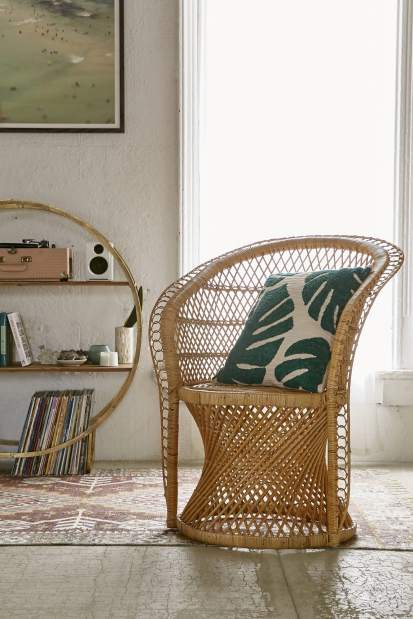

Have you been bitten by the boho bug? The style has gone viral, spreading from retail and trendy restaurants into our homes, and suddenly it's hard to go a day without encountering a fiddle-leaf fig or macramé tapestry.
Design bloggers, eager to embrace their inner free spirit, have filled Instagram with pictures of rooms decked in rich jewel tones, tribal prints, quirky trinkets and more plants than a treehouse in Topanga Canyon.
The look is almost obnoxiously omnipresent, and yet it's somehow still hard to define. What exactly is contemporary bohemian design? And what makes it so appealing?
To start, it's more than a revival of '70s hippie chic. Back then, the look was quite literal, marked by a casual, affordable assembly of mismatched Moroccan lanterns, patchwork quilts and mattresses placed cozily on top of layered varicolored rugs.
Today, the look is more polished and dialed down, with an emphasis on curation and editing — less like a scrapbook and more like a magazine. In her book “The New Bohemians,” designer Justina Blakeney attributes the boho craze to the fact that today's creative professionals have “little distinction between work and play” and want homes that reflect their lives and their lifestyle.
“When it's done well, it's a catch-all term for a home that looks collected and personal. It highlights your adventures, experiences, the things that make you unique,” says designer Alex Deringer, 45, who co-owns Ivy Lane Living in Alexandria, Va. “When it's done poorly, it can look cluttered or kitschy, or, worst of all, inauthentic. That's when eyes start rolling.”
So what are the tricks to pulling off a bohemian look without seeming like a phony?
First and foremost, exercise restraint. Avoid anything too obvious unless it speaks to you personally, says Victoria Smith, 56, who runs the popular design blog SF Girl by Bay and lives in Los Angeles. Although it can be tempting to follow a playbook that tells you exactly what to buy — dream catchers, paper lanterns, a bunch of area rugs — she encourages readers to do the opposite.
“You wouldn't fill your closet with only pieces from one designer's collection, would you?” she says. “Shop patiently. Be willing to wait for pieces that mean something to you.”
Balance is important, so try to juxtapose bright patterns and colors with clean, modern elements such as concrete floors, whitewashed walls and minimalist art. And resist the urge to arrange everything in pairs.
“With small accessories like candles, souvenirs and picture frames, stick to odd numbers,” Deringer says. “They're more pleasing to the eye.”
Not everyone has closets full of pieces from flea markets in Paris and Marrakesh, but that's not a problem. Chain stores are a reality for most people and can be a great place to find foundational pieces, or what Deringer calls “fillers.” For example, an Ikea couch is a fine place to display pillows hand-sewn by a relative, and a sleek bookcase from Crate & Barrel, such as the $799 Beckett 3-High Shelf, provides a nice framework for photographs and favorite books.
Many mass retailers are embracing the bohemian trend by scouring art markets around the world for pieces that would do well in their stores. West Elm's North American retail stores dedicate a “Local” section to artists from the surrounding community. The company also offers products — such as honeycomb vases from the Philippines or wood-carved kitchenware from Foxwood Co., an Annapolis, Md., studio — labeled “fair trade certified,” meaning they promote sustainable livelihoods.
“It's all about handcrafted,” said Nancy Soriano, an editorial director at West Elm. “We want pieces that tell a story.” Earlier this year, the company began posting short docu-style videos on its website about the artisans, how the pieces are made and where they come from.
Smith says today's design industry works so quickly that it's only a matter of time before treasures found in the world's premier flea markets end up at chain stores, anyway.
“No joke, I just bought a rattan daybed at the Alameda flea market a few months ago,” she said. “I'd never seen anything like it, I fell in love with it, and I bought it for $500.”
Sure enough, she said, Urban Outfitters now sells an Amira Carved Wood Daybed, available in two color combinations, for $429. The product description reads: “Crafted from natural Mango wood in a simple and rustic design. Complete with intricate carved detailing for a boho touch we love.”
