

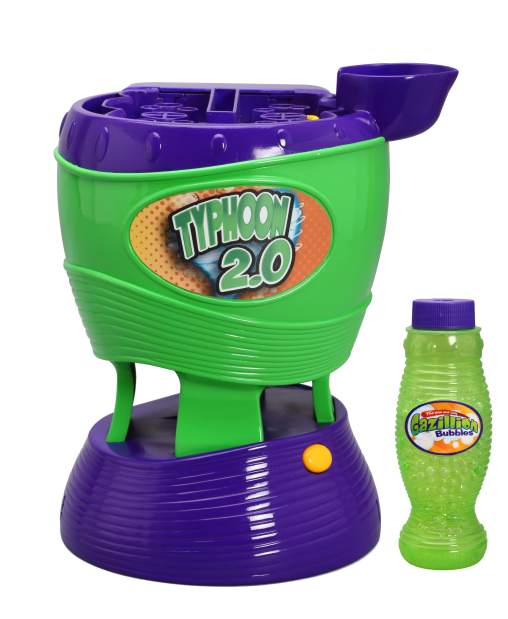
Kids can instantly create a storm of bubbles with Gazillion Bubbles Typhoon 2.0. This bubble fountain sends out more than 5,000 bubbles per minute. To operate the fountain, replace the solution top with the auto feed cap, insert the bottle to fill the machine with solution, push the button and watch the rise of colorful bubbles.
The Gazillion Bubbles operates on four AA batteries. The price, including an 8-ounce bottle of bubble solution, costs $19.99. Additional solution can be purchased for $3.99 for 8 ounces or $4.99 for a 1-liter bottle.
Book encourages talk about sports numbers
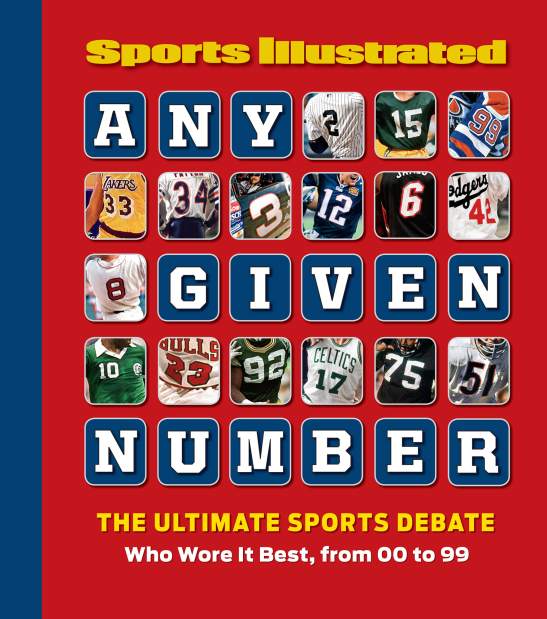
For any kid who has a favorite sports number: “Any Given Number: Who Wore It Best, From 00 to 99.”
The editors of Sports Illustrated decided which athletes were the best to wear a particular uniform number. The fun comes from the lists of great players and all the arguments — contained in a section for each number labeled “The Debate” — about the players.
Some players own a number: Babe Ruth was number 3; Michael Jordan, 23; and Wayne Gretsky, 99.
But other numbers are competitive. Take number 4. Who's the best to wear that number? Boston Bruins hockey great Bobby Orr? He scored more than 100 points in six consecutive seasons ... as a defenseman. Or, was it quarterback Bret Favre, who threw for a record 71,838 yards and 508 touchdowns?
Baseball Hall of Famer Rickey Henderson wore six numbers — 14, 22, 24, 25, 35 and 39 — during his 25-year career.
Maybe Henderson understood that a number is not that important. One night, Michael Jordan's regular shirt was stolen before the game. Jordan wore number 12 that night, and what happened? He scored 49 points.
Find the book, sit down with your little sports fan and start talking sports — and numbers.
If your child is vaccinated, don't worry about measles
Parents can rest assured that fully vaccinated children almost certainly won't contract measles during an outbreak, says Dr. Sunil Sood, chairman of pediatrics at Southside Hospital in Bay Shore and attending physician in infectious diseases at Cohen Children's Medical Center in New York.
Usually, a child is inoculated at 12 months and receives a second dose between ages 4 and 6. Those two doses protect for life, Sood says. “No vaccine is 100 percent protective, but if you've had two doses, almost no one will get the measles,” he says. And, if a vaccinated child did contract measles, it would be a milder case, he says.
The susceptible childhood population is babies younger than 12 months, and children whose parents have chosen not to immunize them, Sood says. “It is a very dangerous infection to get,” Sood says. “It can produce pneumonia; it can produce encephalitis in the brain.”
There is a possible serious late side effect, Sood adds. In rare cases, a child who had measles can, years later, develop a type of encephalitis known as subacute sclerosing panencephalitis, or SSPE, which can cause seizures and bizarre behavior.
When a tween wants to stop piano lessons
A tween is entering early adolescence, a stage when pushing can be counterproductive, says Cynthia Ulrich Tobias, author of “You Can't Make Me (But I Can Be Persuaded): Strategies for Bringing Out the Best in Your Strong-Willed Child” (WaterBrook Press).
Tobias recommends asking questions: Why do you want to quit? What would you do instead? What could we do to make piano more appealing? If the answer to that last question is “Nothing, I just don't want to do it,” you may want to suspend lessons for three months, with the proviso that your child will think about remedies and alternative activities.
If resistance is stronger — “I hate it and it's ruining my life” — it's time to pick your battles, she says.
“If you really think you have a budding concert pianist, and his talent is so extraordinary that you don't want to let it go, then I would say, ‘Let's give you a break for a few months and revisit it.'”
Does a high school grad need a curfew?
An 18-year-old high-school grad should be asking for freedom, says psychologist Carl Pickhardt, author of “Surviving Your Child's Adolescence: How to Understand, and Even Enjoy, the Rocky Road to Independence” (Jossey-Bass).
“However, so long as the kid lives at home, they do have to respect the tolerances of parents, at least in terms of what the schedule is going to be,” Pickhardt says.
This isn't so much about control as it is courtesy. If, rightly or wrongly, you get stressed out about your child's safety when she's out at 2 a.m., you might say, “We can only tolerate you being out until X hour, and then we need to have you home, and that's not a distrust of you, it's our own comfort (level).”
Generally, at this stage, what works best is a flexible curfew, Pickhardt says, with room for exceptions as long as they're discussed ahead of time.
“To me, a curfew is a prohibition of adolescence,” he says. “You always want to give your kids the protection of your prohibitions, and you want to give your kid the protection of your curfew because, a lot of times, their friends are saying, ‘Come on, let's stay out until 4 a.m.,' and the kid doesn't have the social courage to say, ‘I'm not really comfortable with that.' But the kid can say, ‘Yeah, I'd really like to, but my parents make me come home by (midnight).'”
Send family news to tribliving@tribweb.com.
