
https://archive.triblive.com/lifestyles/more-lifestyles/fixer-upper-sauer-designed-home-in-ohara-awaits-a-new-family/
Fixer-upper, Sauer-designed home in O'Hara awaits a new family

Joyce Hanz
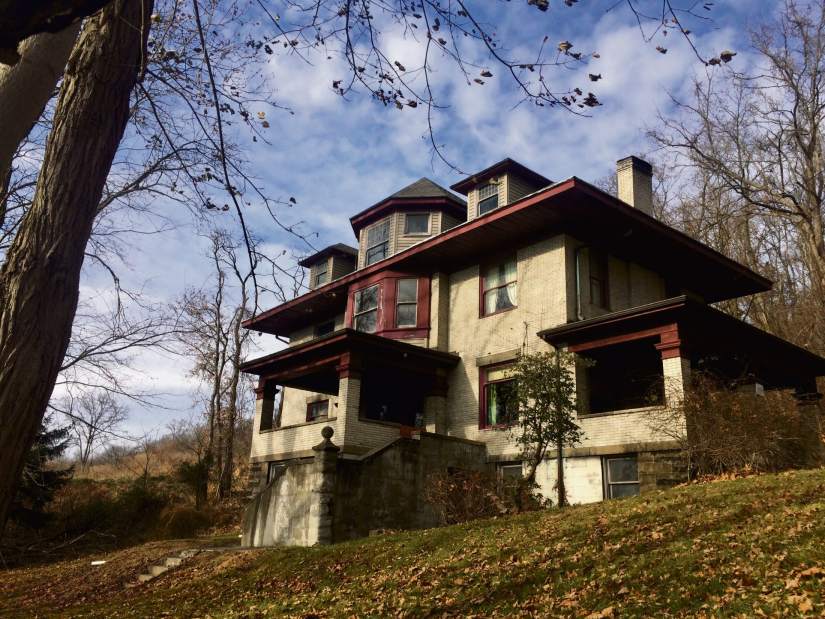
The stately house at 311 Highland Terrace in O’Hara was designed by and constructed for architect Frederick Sauer in 1910.
A piece of Pittsburgh history is for sale.
Famed Pittsburgh architect Frederick Sauer designed his own home in 1910 in O'Hara and had it constructed on a hillside tract of land.
He didn't get to enjoy the view from his Colonial Revival-style brick home overlooking Aspinwall very long.
Local lore says Sauer's wife fussed about living “up on the hill” and wanted to be closer to Aspinwall, so the couple sold the stately brick home to local business owner Harry Loresch and wife Anna in 1920.
Loresch paid $24,000 — in cash. He made his money inventing the first steel reinforced concrete burial vault and securing the patent. He owned and operated Loresch Bros. Vault Co. in Lawrenceville.
The home at 311 Highland Terrace in O'Hara is currently listed for $299,900 with Garrett Freund of Piatt Sotheby's International Realty.
The current owners are granddaughters of the late Harry Loresch — sisters Mary Ann Olsen and Lori Blakely, who reside in North Carolina and Tennessee respectively.
A lack of relatives residing in the Pittsburgh area has necessitated the sale, Blakely says. The last resident of the home, their beloved aunt Betty Ann Loresch, affectionately nicknamed “Peepo” by relatives, died in 2014.
“It's sad to sell in some ways because it holds so much of our history,” says Blakely, whose mother lived in the home until about 1940. “But we can't keep it up. It needs updating and all new plumbing.”
Realtor Freund estimates renovation expenses will hover in the $300,000 range. “This home has tremendous potential,” he says.
An ornate fixer-upper, the right buyer can customize the more than 3,600-square-foot home to its former glory.
All about family
Harry Loresch and his wife raised five children in the home — employing a full-time, live-in maid and groundskeeper to tend to the then several acres property that boasted apple, pear and grape orchards, gardens and manicured grounds.
“I would gorge myself on pears,” Olsen recalls. “My grandfather was German and he grew grapes and made his own wine and kept it in his wine cellar.”
The property is now a little more than a half-acre.
This was well before PennDOT constructed Route 28, slicing a path through the property line that originally extended to Sixth Street in Aspinwall.
There was no road back then, Olsen recalls, and steps from the house leading down to Virginia Avenue in Aspinwall were the way everyone would walk to school.
“We lived in a small house back home in North Carolina,” Olsen says. “This was a mansion to us (when we visited) with so many areas to explore, full of history, old pictures, family trunks with treasures; and the attic on the third floor was a favorite place for me. Grandmother ran that house like a hotel — everything had to be just so.”
Blakely always admired and loved the foyer and staircase — earning pocket money by washing the area and walls at the request of her grandmother.
“I could only use this big bar of Ivory soap,” Blakely says. “It took me about a week and I would clean the white wood.”
The home is almost all original, except for updates to the butler pantry, which underwent a remodel to accommodate Betty Ann during her later years when she couldn't navigate the numerous stairs.
“The home was untouched all of those years, never updated,” Olsen says. “The family was frugal and practical that way.”
The right buyer will need to update the 12-room home which includes a terrace, grand entrance with hand carved staircase, a huge stained glass window, five fireplaces, ornate moldings, pocket doors, original hardware and hardwood floors.
A loving history
Both granddaughters recall large family dinners and gatherings during summer visits.
“They had big parties,” Olsen says. “And we loved going to Kennywood in the summer.”
The family has worked to empty out the home and in the process have discovered long forgotten keepsakes.
“We sold off things (of Betty Ann's) that had been in trunks for 60 years untouched,” Olsen says. “She was a model and traveled the world modeling, living in Istanbul and Italy before moving back to Pittsburgh in 1960. She had vintage children's clothes, her own clothes from modeling, hats, hundreds of pairs of shoes, gloves and more.”
An angel cherub lamp imported from Austria was a foyer fixture — holding dear memories for Olsen. She relocated it to her home in North Carolina.
“That lamp was the first thing my grandmother bought for the house,” Olsen says. “The lamp showcases an angel writing in the Book of Life and it always sat at the bottom of the stairwell. My granddad would always say, ‘That is the angel writing down that you were a good girl today.' That lamp sat there for 95 years and didn't move and now it is placed in my living room.”
Sauer name a bonus
The granddaughters hope the Sauer pedigree attached to the home will entice the right buyer.
Sauer was a busy German-American Pittsburgh architect up until his death in 1942. He moved to Pittsburgh from Germany in 1880, building about a dozen churches in the area.
His best known works include designing numerous Catholic churches such as St. Nicholas Croatian Church in Millvale, St. Mary of the Mount on Mt. Washington and St. Stanislaus Kostka Church in the Strip District.
The Sauer Buildings Historic District in Aspinwall, listed on the National Register of Historic Places, is a section of homes and structures along 607-717 Center Ave.
Commercial developers are interested in the home, but Olsen and Blakely won't have it.
They refuse to sell to anyone who wishes to develop condos — they want the home to remain a single dwelling.
“We want a family to enjoy it,” Olsen says. “Aspinwall is a nice community for children.”
Joyce Hanz is a Tribune-Review contributing writer.
Copyright ©2026— Trib Total Media, LLC (TribLIVE.com)