
As Bridgeville residents recover from June's flood, officials look to prevent the next one

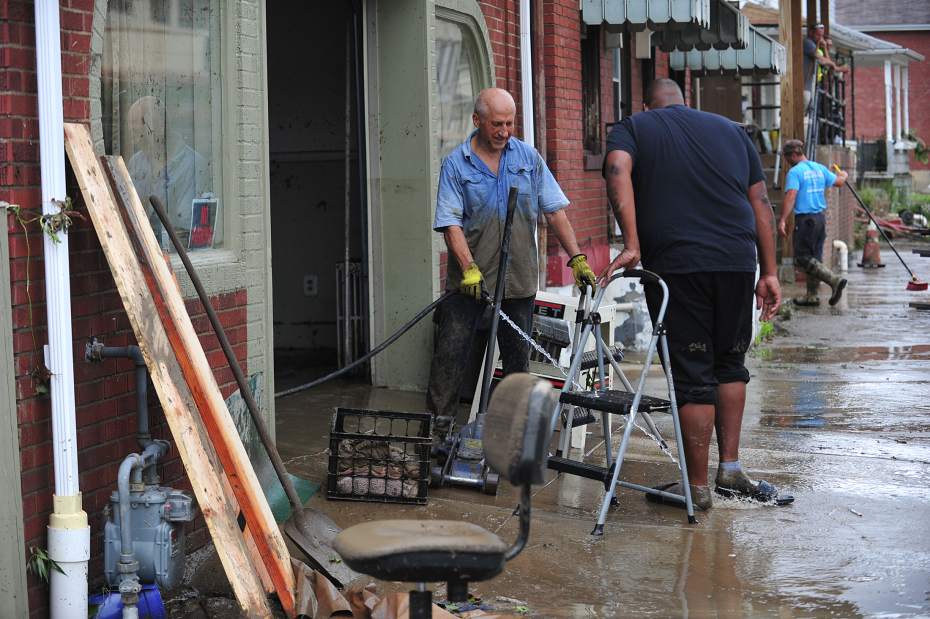
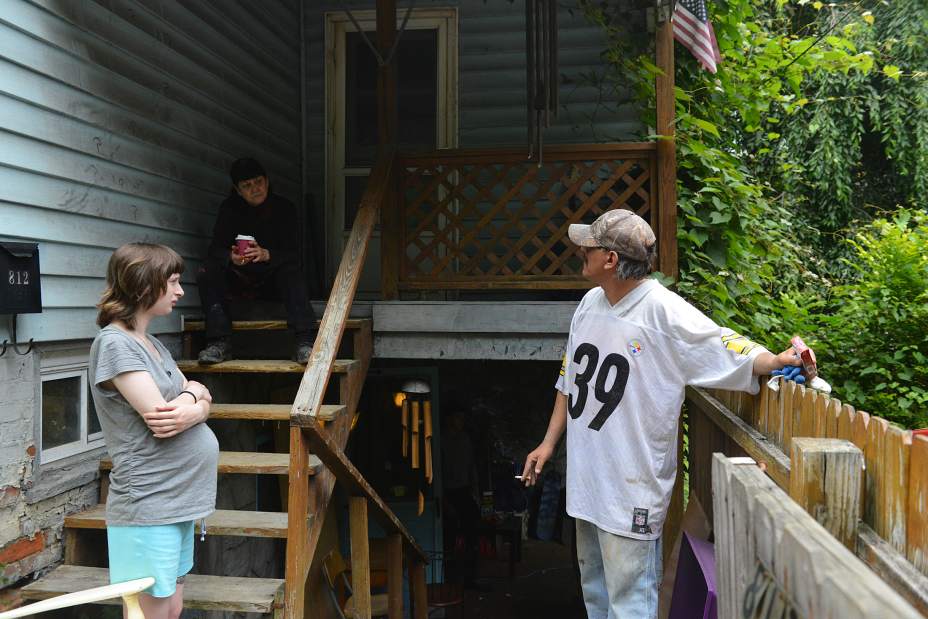

It’s leaked before, but Cindy Steck’s basement never filled to the brim with water until June 20. Floodwaters climbed nearly to the first floor of her Maple Street, Bridgeville, home that night, submerging several electrical outlets and almost sparking a fire.
Steck and her husband, Jay, then little more than two weeks out of knee surgery, had to be evacuated from their home by boat. Theirs was among 30 swift water rescues carried out that night.
In the days following the flood, volunteers from regional religious service organizations scrubbed clean the couple’s basement and moved its contents into the yard. Despite the help, the two said the flood cost them thousands of dollars in damage — not all of which their insurance covers.
Among their belongings claimed by the flood were a washing machine, a dryer and a furnace — appliances the couple said they’ve repeatedly replaced because of flooding. Incredibly, the table saw on Jay Steck’s downstairs workbench still functions.
But as bad as the flood was to the Stecks, both said they know it was worse to residents living nearby on Baldwin Street. And even though the two worry their home could flood again, they don’t want to move.
“This is my grandparents’ house,” Cindy Steck said. “They bought it in 1929 and we just always wanted to keep it in the family. We moved in here in 1991 and never thought there was going to be an issue.”
Yet in the past year, the Stecks said their home has taken on water on four separate occasions. Other residents living along McLaughlin Run have shared similar stories, many of whom said the June 20 flood was the worst they’ve experienced.
In total, borough Manager Lori Collins estimated 126 homes and 48 businesses were affected by it in some way.
“I have talked to people who have … lived in those areas their whole lives, and they’ve never seen anything like that,” she said of the June 20 flood.
Bridgeville flood
Frequent flooding
McLaughlin Run is, per the Federal Emergency Management Agency, a 100-year floodplain. Collins said it has flooded more frequently in the years since remnants of Hurricane Ivan struck in 2004, something she attributed to an increase in severe weather occurrences.
Residents and other officials have said much the same thing. The National Weather Service itself does not keep data on Bridgeville specifically, but does receive reports from trained volunteer weather observers based at a station 1 mile south of Bridgeville.
Citing the observers’ findings, weather service meteorologist Shannon Hefferan said more rain fell over the area in June than had fallen in any June in the past decade: 8.68 inches fell that month, compared to 7.52 inches in June 2015; 5.44 inches reportedly fell on the area in June 2008.
Some residents who attended a Bridgeville Council meeting in July said they think the uptick in flooding is the result of real estate developments upstream in Upper St. Clair. Collins said she did not rule out that possibility, but cautioned that land development alone is not to blame.
“Baldwin Street flooded in the ’50s and there wasn’t any development,” she said.
Collins said the borough has attempted to address the issue in the past but said the municipality’s options are limited. Dredging or widening the creek, as she said some have suggested to her, would not be permitted under state Department of Environmental Protection regulations.
“I understand where the DEP’s coming from,” Collins said, “but when you’re a person who lives in that area, and everything that you own and love is there and you lose it, and you look at us and say, ‘why didn’t you take that debris out of the stream?’ They don’t want that answer.”
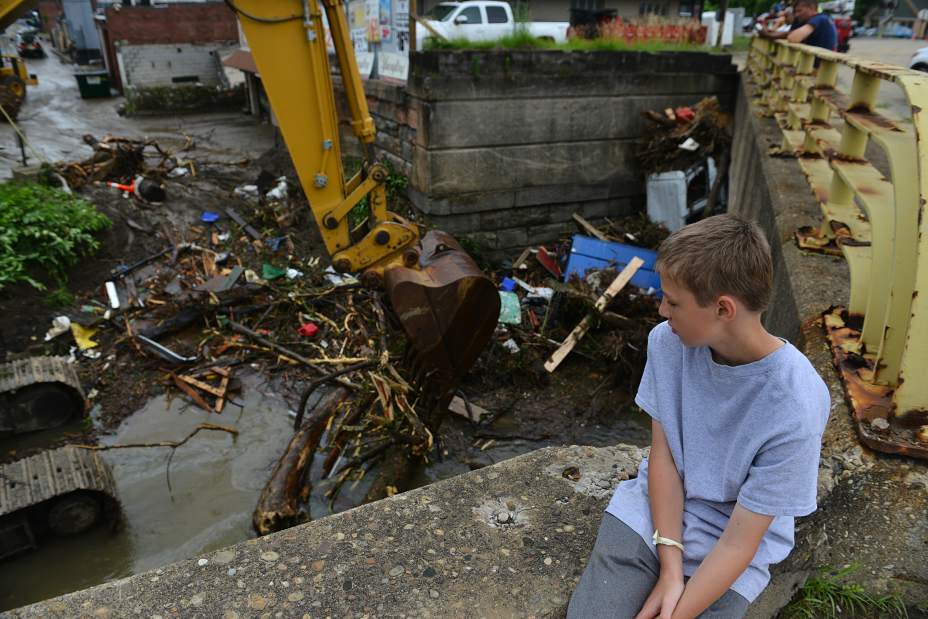
The borough also lacks the authority to alter the makeup of the Bower Hill Road bridge — where the body of 64-year-old Upper St. Clair resident Wendy Abbott was found following the flood — as it is owned and maintained by Allegheny County. The bridge, which runs over McLaughlin Run, became clogged with debris the night of June 20.
County Public Works Director Stephen Shanley acknowledged the tendency of debris to collect on the bridge’s centermost pier. Across the county, he said, other communities are experiencing more frequent incidences of severe weather as well.
Shanley said his department and Bridgeville officials still are in the early stages of assessing what can be done to mitigate future flooding in the area. He said the Bower Hill Road bridge is one piece of the puzzle.
Even if it were modified in some way, he said, debris could collect at another structure downstream and create issues for neighboring municipalities. And there’s no guarantee, he said, that the county can prevent another flood of the same magnitude.
“I understand that people are frustrated. I’m sure every time it rains you cringe,” he said. “We’re trying to work with Bridgeville and see how we can help, and they’re very much concerned. So are we.”
Looking forward
The U.S. Army Corps of Engineers completed a study in 2015 that determined Bridgeville’s eligibility for a flood damage reduction project, according to Corps documents. Corps officials surveyed different sites throughout the borough and spoke with leaders to determine where, when and how flooding occurred.
About 65 percent of any construction and design costs deemed necessary for a flood damage reduction project are federally funded, with the remainder being made up by a non-federal project sponsor. But the study found that a project in Bridgeville would not meet Corps cost standards, said Corps planning chief Marc Glowczewski.
The Corps since 2016 has been studying McLaughlin Run, Robinson Run and Millers Run through its floodplain management service, per agency documents. The study is being carried in conjunction with the Robinson Run-Chartiers Creek Municipal Watershed Alliance, which is composed of Bridgeville and several surrounding municipalities.
The goal of floodplain management services, which are entirely federally funded, is to provide the detailed plans for future flood mitigation to local partners, said Corps community planner Andrea Carson. The program does not provide funding for design and construction.
Carson said the Corps intends to submit the results of the study to Watershed Alliance members in early 2019.
“We’ve been in conversation with (the Watershed) for quite some time,” Carson said.
More immediate steps also are being taken at the local level. Collins said the borough is working with the Allegheny County Conservation District in hopes of installing a trash rack in McLaughlin Run by McLaughlin Park to prevent debris from obstructing the creek.
Some financial aid for flood victims also has been made available: Brentwood Bank is offering “micro-loans” for private residents, and Collins said the Pennsylvania Emergency Management Agency will soon offer low-interest loans for affected small business owners financed by the Small Business Administration.
PEMA however does not provide disaster relief funds. FEMA, which does provide for relief, has not yet accepted the area’s disaster declaration. To qualify for relief, damage costs would have to amount to a minimum of $18.1 million. Collins said the amount of damage done to the borough would be combined with damage done to other declaring regions nearby.
It is not known what the cost of damage done to the borough is. Collins estimated the cost of damage to municipal-owned property — roads, retaining walls and parks — to be $70,000.
“With the amount of damage that we sustained on our Bower Hill Road and on our Maple Street walls, and in our McLaughlin Park, budget-wise we do not have the funds to fix those things at this time,” she said. “If FEMA doesn’t come through, they will be long-term projects for us as far as planning and budgeting for them. So I’m crossing my fingers for everyone.”
Matthew Guerry is a Tribune-Review contributing writer.
