
https://archive.triblive.com/local/hampton-shaler/mars-train-station-houses-a-centurys-worth-of-history/
Mars train station houses a century’s worth of history

• |
Phil Norton
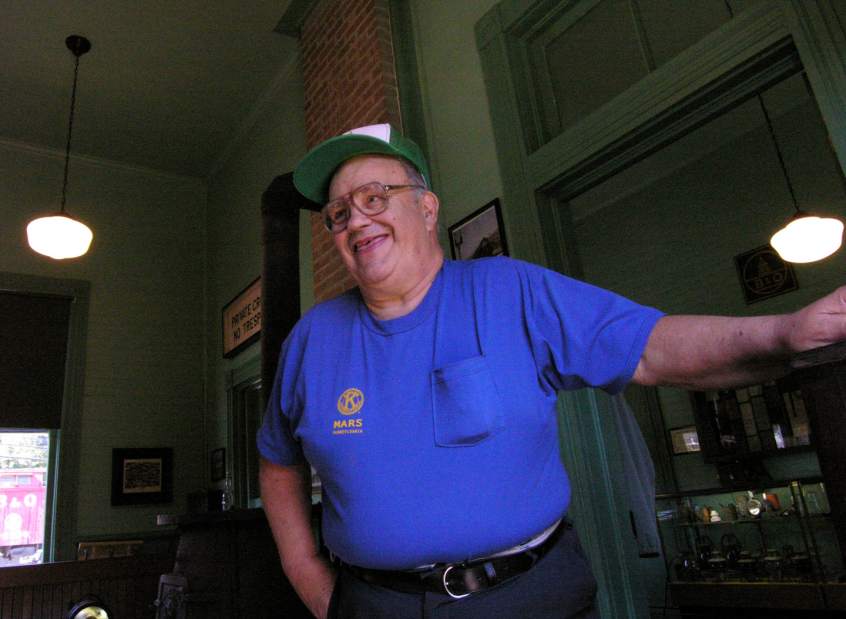
Bill Swaney, a longtime member of the Mars Historical Society, is one of the men responsible for moving the Adams Station building from a farmer's field only hours before a tornado touched down in 1985 and would have destroyed it.
With more than a century of history contained inside the fully-restored building that now doubles as a museum of sorts, the Mars Train Station houses artifacts from the early days of the railroads as well as the Butler County town during its infancy.
The contents include photos, tools, equipment, documents, stories and even a friendly feline phantom said to still roam the building.
Originally built in 1897 by the Pittsburgh and Western Railroad, the station provided the people of Mars with the ability to travel as never before.
“In the early 1900s, Mars was one of the first areas to have running public water. And that, along with a train stop and trolley, was a big draw for a lot of people,” said John Watson, president of the Mars Area History and Landmark Society, speaking about the growth of the town.
The Mars location is the only train station from the Pittsburgh and Western Railroad still standing. Over the years, the railways became a casualty of the booming automobile industry and the station closed in the early 1960s.
“We were lucky because the Mars station had a lead, tin roof, which didn’t leak at all over the years,” said Watson.
“That was why we were able to save the station.”
In 2000, thanks to fundraising and donations, the historical society purchased the station and moved it 150 yards south to its current location on land owned by the group.
“The roof had to be removed and then the building was moved in sections using a crane and a flatbed,” said Rich Ellis, a member of the historical society. “A new footer was poured and a block foundation was built and then the pieces were put back in place.”
During that move, a mummified cat was unearthed, which has been named Chessie. The name is derived from the Chessie System, which later merged with other railroads to become CSX Corporation. The railroad’s “Ches-C” logo incorporated the outline of the member Chesapeake & Ohio Railway’s famous “Chessie” the kitten on all locomotives.
The feline at the Mars station is thought to have been a pet that lived there during its operation as a mascot of sorts and likely went underneath the building where it ultimately died, but was preserved. Over the years, several people have claimed to have seen or heard Chessie. Workers tell tales of locking up and leaving for the night during renovations only to return in the morning to find cat footprints in the sawdust.
“The cat is in a clear glass case in the station,” said Ellis. “The kids get a pretty big kick out of that story.”
Mars Historical Society members are always searching for ways to get people excited about the history of the region. Recently, it was decided to put in the Mars Short Line. Pulled by a miniature train engine, guests can ride small train cars around the circular track that surrounds the building.
“It was put in for the children, but to be honest, the older people are just as excited as the kids to ride,” Ellis said.
Volunteers are usually at the station on Friday mornings and are always willing to show people around. Weather permitting, rides on the short line can be arranged.
“It’s great to see the younger people get excited about our history,” said Bill Swaney, a historical society member.
Anybody with interest in learning more about the train station is encouraged to contact the group.
For details, call Watson at 724-272-9588. Or for more information, go to mars history.org or go to www.facebook/marshistory.com.
David McElhinny is the North Bureau Chief with Trib Total Media. He can be reached at 724-772-6362 or at dmcelhinny@tribweb.com.
Copyright ©2026— Trib Total Media, LLC (TribLIVE.com)