
https://archive.triblive.com/local/local-news/firecracker-100-remains-tough-task-for-lernerville-regulars/
Firecracker 100 remains tough task for Lernerville regulars

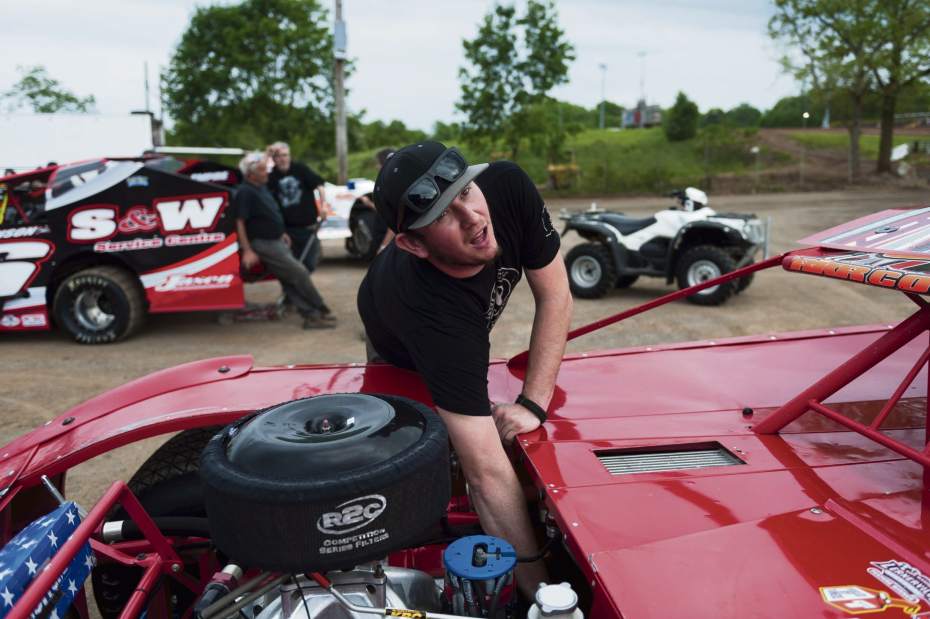
Michael Swensen | Tribune-Review
Russell King, the #56 Late Model driver, works on his vehicle before a race at the Lernerville Speedway track on Friday, May 19, 2017.
Lernerville Speedway's Late Model drivers have run out of time to prepare for next week's World of Outlaws Firecracker 100 for Late Models.
Now in its 11th year, the three-day event has evolved into one of the biggest Late Model shows east of the Mississippi River and sometimes serves as a stark reminder to local drivers that no matter how well they do in the tri-state area, the touring drivers are all too often in a league of their own.
The event, which will take place June 22-24, has not been kind to local drivers, or to drivers who cut their teeth racing at Lernerville.
Since the first Firecracker in 2007, the top finishes by a local driver have come from South Park's Jared Miley, who finished eighth in the inaugural event and third in 2015.
Gregg Satterlee of Rochester Mills finished fourth in '13 and, like Miley, has become more of a touring driver, picking and choosing which big-money events to attend. Satterlee finished seventh in '15 and ninth, the top local finish, last year.
Alex Ferree of Saxonburg, a six-time Lernerville champion, scored his top finish, 12th, in '15.
Russell King of Bristolville, Ohio, finished 18th in last year's main event. Twice he has won the Uncle Sam 30 for those who don't qualify for the 100-lap main event.
“I like the new format,” said King, the 2016 Lernerville champion and 2009 World of Outlaws Late Model Series Rookie of the Year. “We led that first race Thursday night, the 30-lap race. We qualified good, won our heat and led that race even though we put on the wrong tire for that early in the race and then all of a sudden I let down a little bit by trying not to make mistakes and then they are by you.
“One of us locals can win one of those 30s. No question in my mind. If the track is similar to that, I think we have a bit of an advantage from running here so much. But that 100-lap race, it isn't going to happen. I'd like to come and race Thursday and Friday and then come Saturday and sit in the stands.”
King was speaking of the preliminary 30-lap features, Friday and Saturday, before Saturday's main event, which pays $30,000 to win.
Matt Lux of Franklin won the Uncle Sam 30 in 2011. For him, that race is much more of a reality than the 100-lap main event.
“You don't have much of a chance (in the 100), you just don't,” Lux said. “You know those guys are going to come in and have better equipment and have raced more often. It's your race against them. Occasionally, you'll have a local guy get up there. But for the most part those guys will be up front.
“You have to go out and just try to have fun and expose the car to a wider group of people. But you know you are going to take your lumps.”
Track conditions are always an issue. And in an event like this with three straight days of racing, the track takes a beating. In the 2015 main event, which had 26 cars start the feature, the top 15 drivers accounted for 1,492 green-flag laps.
That doesn't count formation laps, laps under caution, laps in any of the four heat races, the B-Mains, or the Uncle Sam 30.
“I can't speak for the fans, but as a driver I really like it on the second and third day of the Firecracker,” said Mike Pegher Jr. of Cranberry. “When it gets hard and slippery, it makes a driver. I might not be any good at it but that track is not an engine track, the driver in you has to come out.”
Lux concurred with Pegher's view.
“For me, if you don't make the feature race, I really like the Uncle Sam,” Lux said. “That is a fun race. By that time in the week the track is so nice and slick and it's a driver's track. The slicker the track the more fun it is for us because the cars don't get beaten up as much when the track is like that.”
Even if track conditions were perfect Ferree gave a good summation of just what local drivers are dealing with for the Firecracker.
“I don't think people have an idea of just how much time and money we put into this on a local level,” Ferree said. “Then you have the touring guys. I run 30 or 40 times a season, and they run about 110. Even if we run the same number of years they run three years to my one in that season.”
Thomas Zuck is a freelance writer.
Copyright ©2026— Trib Total Media, LLC (TribLIVE.com)