


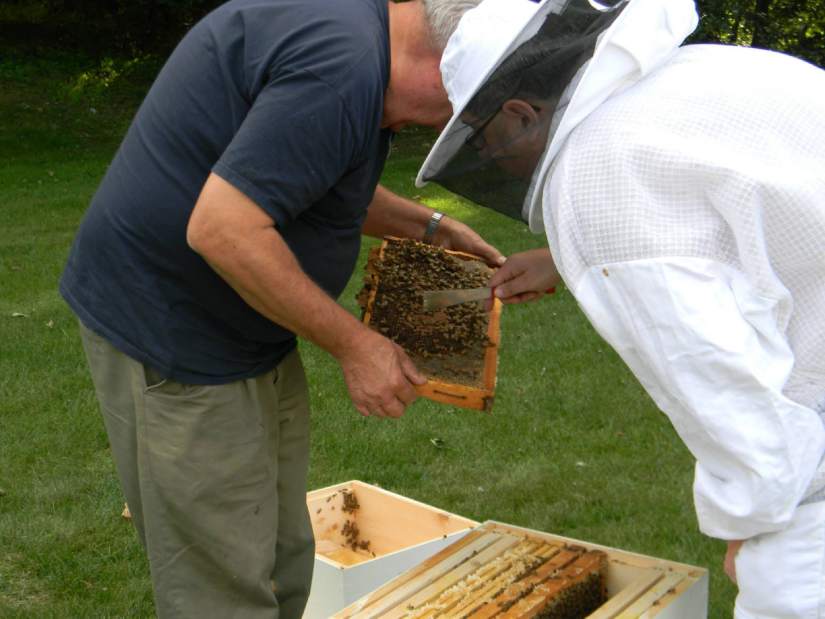
Beekeeping in the backyard can take some persuading.
Take for example Monroeville resident John Yakim, who described his wife's reaction to the idea.
“She thought I was crazy,” Yakim said.
But as the colony grew over the past two months, she started to come around.
“Almost every day she's down there checking on the bees,” he said. “She realized there were worse hobbies I could start.”
There's a buzz about beekeeping throughout Pennsylvania, as the demographics of beekeepers have shifted, and hives are managed in more urban and suburban settings.
They include the rooftop of the Duquesne Club in downtown Pittsburgh and the backyard of a beekeeper in Verona, where Yakim purchased his first queen, eggs and larvae.
About 3,000 people registered with the Pennsylvania Department of Agriculture last year to manage beehives, Pennsylvania's state apiarist, Karen Roccasecca, said.
Among those registered are young men and women who live in urban and suburban neighborhoods, which wasn't always the case, Roccasecca said.
“We're definitely seeing increases every year in new beekeepers,” she said. “I think there's a lot of people who are worried about the bees.”
A decline of the world's bee population has made national news in recent years, as scientists continue to investigate potential causes for the decline. It could be insecticides, parasites, disease or a combination of factors.
“There are so many variables, it's tough to pinpoint one thing that's causing it,” Roccasecca said.
Yakim said his interest with bees was sparked during a discussion with a friend looking for local honey to ease his allergy symptoms.
“Exposure to pollen causes allergies, so if you eat local honey with pollen still in the honey, it helps,” Yakim said. “ It's a desensitization process.”
Yakim said he wanted to know more and spent two months reading books and researching online the complexities of the honeybee world and their importance to the environment.
He purchased the beginnings of a colony in July and learned quickly that honeybees are docile creatures.
“Most of the time, when people think they were stung by a bee, it actually was a wasp,” he said. “And only a tiny fraction of the population have a severe bee allergy.”
Yakim was one of 400 people over the past five years who sought to learn more about bees via Country Barn Farm in O'Hara, where second-generation beekeeper and stay-at-home dad Joseph Zgurzynski teaches a class.
Zgurzynski said his students have gotten younger over the years, and there are more women showing interest.
“The average demographic used to be white men, at least 55 years old with a master's degree,” he said. “It's nice to get people outside of that demographic.”
The timing couldn't be better for enthusiastic young people — or anyone for that matter — to get involved.
The total number of registered honeybee colonies in the U.S. has decreased from 5 million in the 1940s to only 2.5 million today, according to the United States Department of Agriculture website.
Colony Collapse Disorder is a “serious problem threatening the health of honey bees and the economic stability of commercial beekeeping and pollination operations in the United States,” according to the website.
The pollination process directly affects many of the foods humans eat every day and is vital to the environment. It's another aspect of the honeybee world that intrigued Yakim.
“Bees are the only animal that don't cause any harm to the environment. They only make it better,” he said. “The flower gives the pollen willingly, and in exchange, the bees pollinate another plant.”
Kyle Lawson is a contributing writer for Trib Total Media.
