
https://archive.triblive.com/local/pittsburgh-allegheny/50-of-57-buildings-rated-high-risk-for-fire-in-pittsburgh-called-for-help/
50 of 57 buildings rated 'high risk' for fire in Pittsburgh called for help

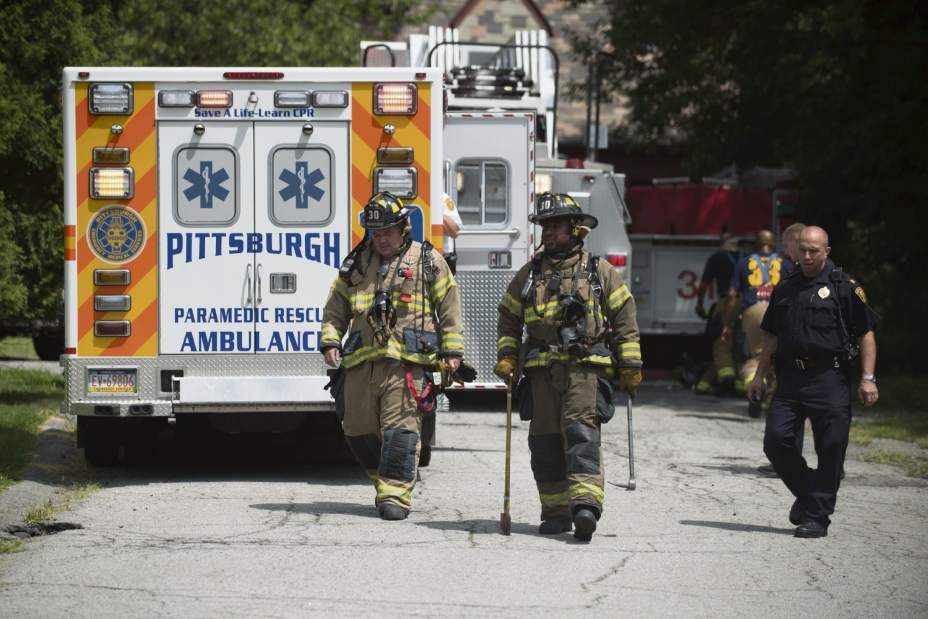
Justin Merriman | Tribune Review
Firefighters respond to a fire at a home along Willett Street in Crafton on Thursday afternoon, Aug. 25, 2016.
Pittsburgh and Carnegie Mellon University have devised a way to analyze data about commercial buildings to determine which ones are most susceptible to a fire.
A team from CMU's Metro 21 Smart Cities Institute mined data about the city's estimated 22,000 commercial buildings and assigned a fire risk score to each one. Over the past six months, the city received fire calls from 50 of the 57 buildings that were determined to be most at risk, Mayor Bill Peduto said.
“What if you could use technology in order to be able to determine the next building that would catch on fire?” Peduto said. “It's happening today in the city of Pittsburgh because of an effort between Carnegie Mellon University and the Pittsburgh Public Safety Department.”
Pittsburgh officials refused to identify the 57 highest-risk buildings, citing privacy concerns and potential legal liability. Most of the 50 fire calls were because of smoke alarms, electrical short circuits and cooking fires. Six turned out to be actual fires in the building.
Fire Chief Darryl Jones said the department would use the information to target high-risk buildings and inspect them to be sure fire suppression systems are working. He said the department has created plans for extinguishing a fire in each of the buildings and educating inhabitants on fire safety and prevention.
“If the building is in violation of the International Fire Code, which we've adopted by ordinance ... we give the property owner or manager some time to clean up the violations, usually about 10 days,” Jones said. “If there's some resistance or it's not cleaned up at that time, then we will start issuing citations. Fines for us start out at $1,000 per violation per day.”
Michael Madaio, a CMU doctoral student and member of Metro 21 institute, said the Pittsburgh Department of Innovation and Performance was able to connect them to different data sets from the fire bureau and Department of Permits Licenses and Inspections to make the risk assessments. The information includes fire history and building code violations.
“We update our model every week with new data in order to ensure that these estimates stay up to date,” he said.
Bob Bauder is a Tribune-Review staff writer. Reach him at 412-765-2312, bbauder@tribweb.com or on Twitter @bobbauder.
Copyright ©2026— Trib Total Media, LLC (TribLIVE.com)