

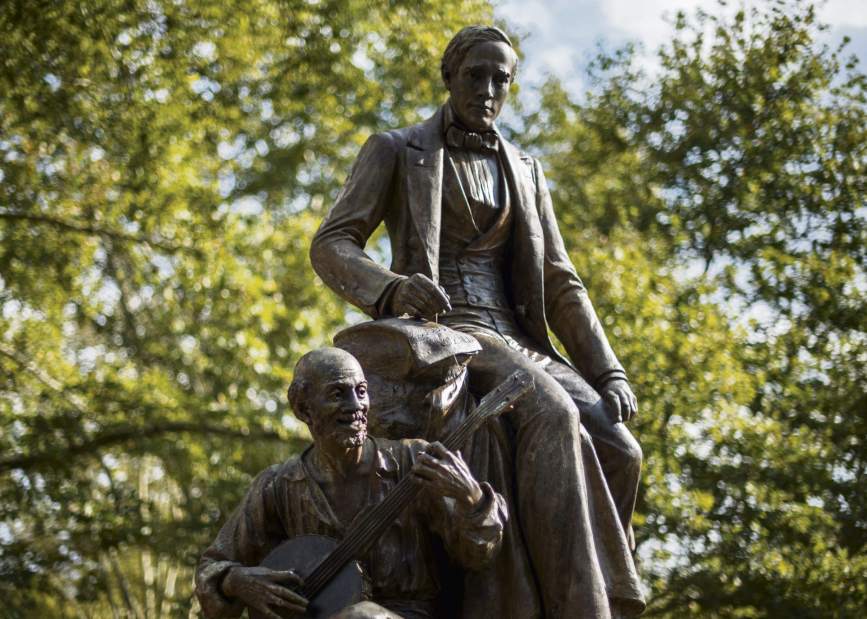
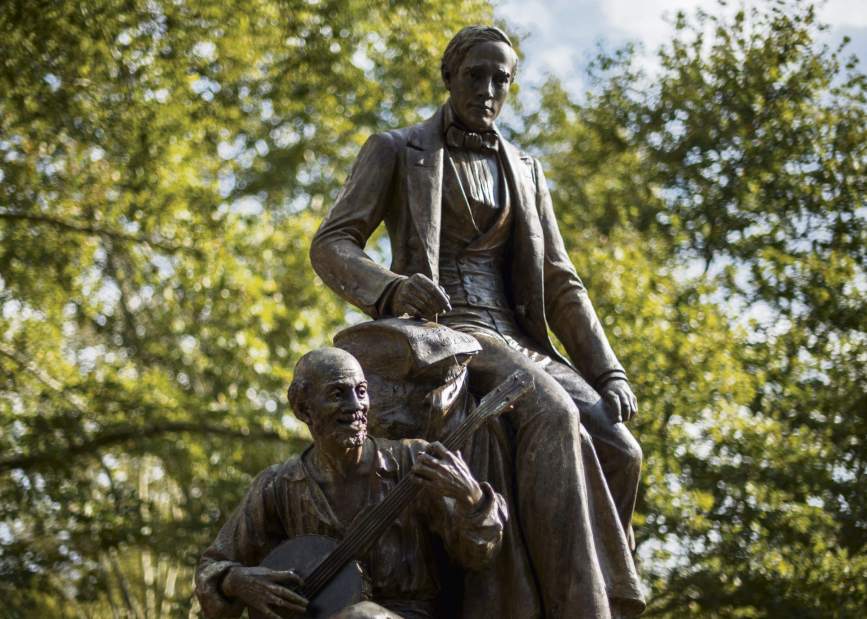
A statue of Stephen Foster is stirring controversy in Pittsburgh because of its depiction of a black slave in ragged clothing playing a banjo at the feet of a white man, but what do we know about that man?
1. Life and death
Stephen Collins Foster was born in Pittsburgh on July 4, 1826, and died at age 37 on Jan. 13, 1864, in New York City with 38 cents in his pockets. He is buried in Allegheny Cemetery.
2. A common misconception
Many in Pittsburgh believe that a house at 3600 Penn Ave. in Lawrenceville is the Foster homestead. Not so, Lawrenceville historian Jim Wudarczyk said. Foster was born on that site, but his birthplace — a house built by his father, William, in 1814 and referred to as the White Cottage — burned during the Civil War. The house that stands on the property was built several years after Foster's death by industrialist Andrew Kloman, a partner of Andrew Carnegie. A Pennsylvania historical marker on the site says Foster "was born nearby."
3. Was Foster a lifelong resident of Pittsburgh?
Foster spent much of his time in Pittsburgh but also lived in Cincinnati and New York City. In Pittsburgh, Foster and family lived in various boarding houses, including on the North Side, then Allegheny City.
4. Did he own slaves?
No.
5. Was Foster a racist?
There is no evidence of that and plenty to suggest otherwise. One of his childhood friends and a musical collaborator was Pittsburgh's leading abolitionist, Charles Shiras. While some of Foster's songs contain graphic, derogatory depictions of slaves, he is credited with being among the first musicians to dignify and humanize blacks through his songs. A biography on the University of Pittsburgh's Stephen Foster Memorial website notes that Foster was "a product of a society in which derogatory images of African-Americans pervaded almost every aspect of social discourse" and that fewer than 20 of his songs "fall in the blackface category." It also notes that some of Foster's lyrics are "troubling."
[embed width="350" height="450"] https://twitter.com/BethSkw/status/912080197276618752 [/embed]
[embed width="350" height="450"] https://twitter.com/BethSkw/status/912077622779289600 [/embed]
6. The statue
Pittsburgh attorney A.V.D. Watterson in 1895 began a campaign to erect a memorial to Foster, Pittsburgh historical archivist Nick Hartley said. Former Pittsburgh Press editor T.J. Keenan Jr. took up the cause, and a committee of leading Pittsburghers, including Keenan, headed a committee to supervise design of the statue. They included Andrew Mellon, Robert Pitcairn, Edward Bigelow, W.N. Frew, Christopher Magee and John Beatty. Foster's older brother, Morrison, provided guidance. The statue was sculpted by Giuseppe Moretti and dedicated in September 1900. Originally in Highland Park, it was moved to a more prominent spot in Oakland in 1944 to prevent vandalism.
[embed width="350" height="450"] https://twitter.com/jdlaing/status/912088274008723457 [/embed]
