
https://archive.triblive.com/local/pittsburgh-allegheny/al-gore-brings-global-warming-message-to-pittsburgh-warns-of-its-effect-on-pennsylvania/
Al Gore brings global warming message to Pittsburgh, warns of its effect on Pennsylvania

Nate Smallwood | Tribune-Review
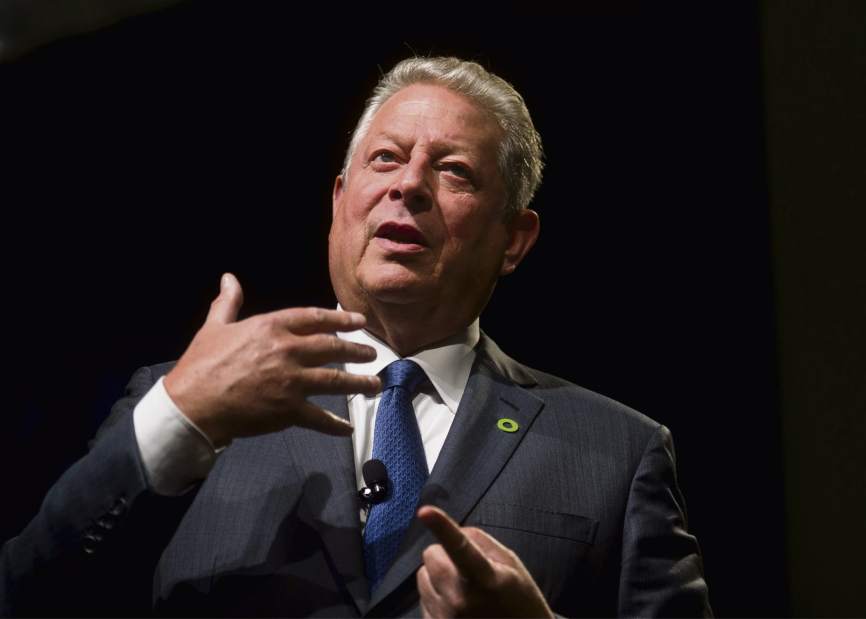
Al Gore, former vice president and Climate Reality founder speaks at the 36th Climate Reality Leadership Corps training at the David L. Lawrence Convention Center in Pittsburgh on Tuesday, Oct. 17, 2017.
Climate change is impacting life in Pennsylvania, and its effects will become increasingly obvious as the century progresses, former vice president Al Gore told a room of 1,300 people at the David L. Lawrence Convention Center in Pittsburgh on Tuesday.
Gore tucked state-specific stats into a two-hour presentation peppered with images of melting roads, collapsing glaciers, flooded cities and other dramatic weather events scientists have linked to climate change.
The presentation was part of a Climate Reality Leadership Corps meeting, the 36th in a series in which Gore trains attendees to advocate for changes that could help slow global warming.
The warming, linked to greenhouse gases that linger in Earth's atmosphere and impede the planet's release of heat, could raise Pennsylvania's average temperatures by 5.4 degrees by 2050 if emissions continue at present rates, Gore told the crowd.
With higher temperatures come more days when extreme heat can be linked to deaths, he said.
Pittsburgh, which recorded five so-called “excessive heat events” per year from 1975 to 1995, could experience 45 of them per year between 2020 and 2029, Gore said, and even more toward the end of the century.
The presentation drew on parts of Gore's new documentary, “An Inconvenient Sequel: Truth to Power,” a follow-up to his 2006 documentary, “An Inconvenient Truth.”
The documentary's release follows three years in a row that each ranked as the hottest on record and comes amid worsening fire seasons in the western United States and intensifying hurricanes in the Southeast.
“The pattern is really painfully clear now,” Gore said.
Gore, who has been vocal about his disappointment in President Trump's lack of urgency on climate issues, avoided politics in his speech, encouraging people to take action on their own. He told talk show host Bill Maher in August that he had met with Trump before and after the election and thought “there was a chance he might come to his senses. ... But I was wrong.”
Much of the heat trapped in the atmosphere makes its way into the oceans, he said. Cool water in the Gulf of Mexico that had weakened hurricanes approaching the United States has warmed, making it more likely that stronger storms will make landfall, he said.
Hurricane Harvey crossed waters that are 7 degrees warmer than normal up to 200 meters beneath the surface. The warmer water helped Harvey quickly morph from a tropical storm to a hurricane and drop a record-setting 60 inches of rain in parts of Texas —- rainfall records for the United States, according to The Weather Channel.
Warmer temperatures allow storm systems to carry more water across land, intensifying inland rainstorms.
Gore referenced a July 28-29 rainstorm that dropped 3 to 5 inches of rain in 24 hours around Pittsburgh.
“Every storm is different now,” Gore said.
The added heat also draws moisture from the ground, fueling droughts in the Midwest and intensifying record-setting fires in California and other western states, where the fire season is 105 days longer than it was in the 1970s, he said.
Pennsylvania faces damaging changes in storm runoff, flooding and changes in crop planting cycles. Production in the state's dairy industry could drop by a quarter by the end of the century, and northern tree species such as black cherry, sugar maple and yellow birch could die out, he said.
The state's mosquito season has lengthened, from 81 days in the years 1980 to 1989 to 111 days in the years 2006 to 2015, he said.
Not everyone who attended was impressed with the figures.
William Northy, 68, of Moon Township said he stopped in for the presentation since he had to be in Pittsburgh anyway for a doctor's appointment.
“I think it's overly hyped,” said Northy, a retired airline pilot. He said he was skeptical of the barrage of statistics Gore presented. While he believes the climate is changing, he doesn't believe humans' contributions are very significant.
“Every time you belch or fart, it affects the climate in a minuscule way,” he said, adding that he feels there are few “tangible” things people can do to change the trends.
Still, he thinks people should try to conserve energy in their own lives: “Turn the lights off, carpool, don't drive when you don't have to.”
Hsiang-Yi Lin, 37, of San Francisco said Gore's sequel inspired her to attend the training session.
Lin, a business strategist and consultant, said the Trump administration's policies aimed at rolling back environmental protections make it more important for individuals to get involved in climate efforts.
“It makes it even more important for people to form a web and commit to moving things forward rather than relying on policies,” she said.
While many Californians might think that climate change is making fires worse or impacting global warming, fewer have the data to understand the connections, she said. She aims to bring some of that back from the training.
“Beyond the sentiment, I suspect we can use some enrichment there,” she said.
Gore shared some positive data along with the gloomy projections.
Solar and wind energy are growing much more quickly than expected around the world, he said.
The state's wind towers supply 321,000 homes with power, he said, and the state could produce 10 times its electricity consumption with solar power.
In Pennsylvania, twice as many people had renewable-energy jobs in 2016 than had fossil fuel-industry jobs, he said.
Correction: The story has been updated to show that the numbers of “excessive heat days” listed are per-year figures, rather than the number of the days from 1975 to 1995 and from 2020 to 2029.
Wes Venteicher is a Tribune-Review staff writer. Reach him at 412-380-5676, wventeicher@tribweb.com or via Twitter @wesventeicher.
Copyright ©2026— Trib Total Media, LLC (TribLIVE.com)