
Astrobotic drops out of Google competition to land on moon

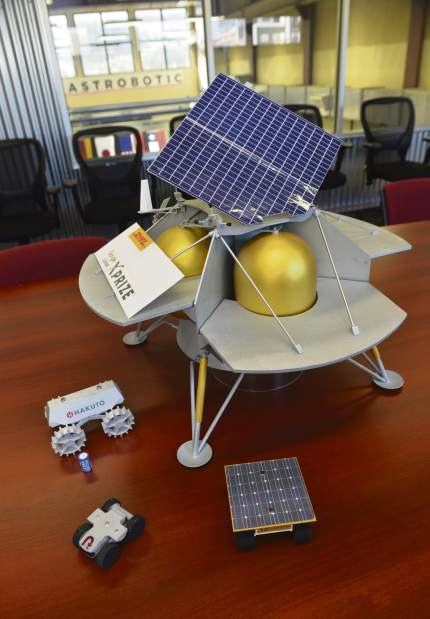

Astrobotic, a Pittsburgh-based space delivery company in the running for Google's Lunar XPrize, has pulled out of the competition.
The company did not secure a launch contract for next year — one of the requirements of the $20 million competition — and the firm's technology and customers won't be ready for a 2017 voyage, said John Thornton, Astrobotic's CEO.
“That would require us to accelerate our program in a way that would not be responsible,” Thornton said Tuesday. “It would just not be ready in time.”
He said Astrobotic now has its sights set on a 2019 lunar landing.
Thornton wrote an op-ed for the aerospace industry publication SpaceNews that detailed the company's decision.
Astrobotic was seen as one of the favorites to win the Lunar XPrize as the first commercial operation to land on the moon, travel 500 meters across its surface and send high-definition video and images back to Earth. The company was the only team to win all three of the competition's milestone prizes — netting $1.75 million in the process — for demonstrating success in landing, mobility and imaging.
Google, which announced the prize in 2007, required teams to have launch contracts signed by the end of 2016 and land on the moon in 2017. Five teams — the Israeli SpaceIL, Florida-based Moon Express, India's Team Indus, Japan's Team Hakuto and an international collaboration known as Synergy Moon — have contracts in place for next year.
Thornton doesn't think any of them will fly in 2017.
“I think they are trying to accelerate their programs too much,” he said. “I think they are going to have problems with the technology and with the launch.”
Thornton said some of the teams haven't started testing their landers as would a company a year away from launch. SpaceIL has a contract to launch on SpaceX's Falcon 9 rocket, but SpaceX has delayed launches following an explosion in September. Two teams have contracts to launch with companies that never have launched before: Moon Express and Synergy Moon. Moon Express plans to catch a ride on Rocket Lab's Electron rocket. Synergy Moon hopes to launch on Interorbital Systems Corp.'s NEPTUNE rocket. Team Indus is set to launch on a rocket from the government-funded Indian Space Research Organisation.
Thornton doesn't expect Google to extend the XPrize past 2017. Google did not respond to an email seeking comment.
Dropping out of the competition hasn't slowed Astrobotic. The Strip District company recently finished an internal review of its lander and software. Thornton said Astrobotic has 15 full-time employees and several part-time workers. He expects to grow the company 25 to 50 percent in 2017.
This month, Astrobotic completed field testing of software that will allow a rover to explore near the moon's poles, where there is little light and temperatures can drop to minus 454 degrees Fahrenheit. The company tested the software on rovers in the middle of night at the Lafarge-Duquesne Slag heaps in West Mifflin.
While the XPrize has been Astrobotic's public face, work for NASA and other contractors has gone on quietly for years, said Fraser Kitchell, program manager of the company's Future Missions and Technology Group.
Astrobotic hasn't lost partners, sponsors or customers since dropping out of the XPrize, Thornton said. Japan's Hakuto had signed a deal with Astrobotic to ride on its lander but announced a new deal Tuesday with Indus. Thornton said Hakuto is committed to flying on Astrobotic's lander when it is ready.
Hakuto did not respond to an email seeking comment.
Astrobotic is charging $1.2 million per kilogram to send payloads to the moon and has agreements to carry rovers from Carnegie Mellon University and a few countries. The company announced a partnership with NASA last month to provide the space agency up to $12 million in free deliveries. In June, the company unveiled its newest lander, Peregrine, a smaller version of its Griffin lander, and announced partnerships with the French aerospace company Airbus Defence and Space and the German shipping and logistics company DHL. Astrobotic secured $2.5 million from investors in May.
Dropping out of the XPrize didn't hurt the company financially, Thornton said.
“We are no farther from the moon than we were three weeks ago when we were still in the prize,” he said.
Aaron Aupperlee is a Tribune-Review staff writer. Reach Aupperlee at aaupperlee@tribweb.com or 412-336-8448.
Editor's note: A previous version of this story incorrectly stated the company Team Indus was launching with.
