

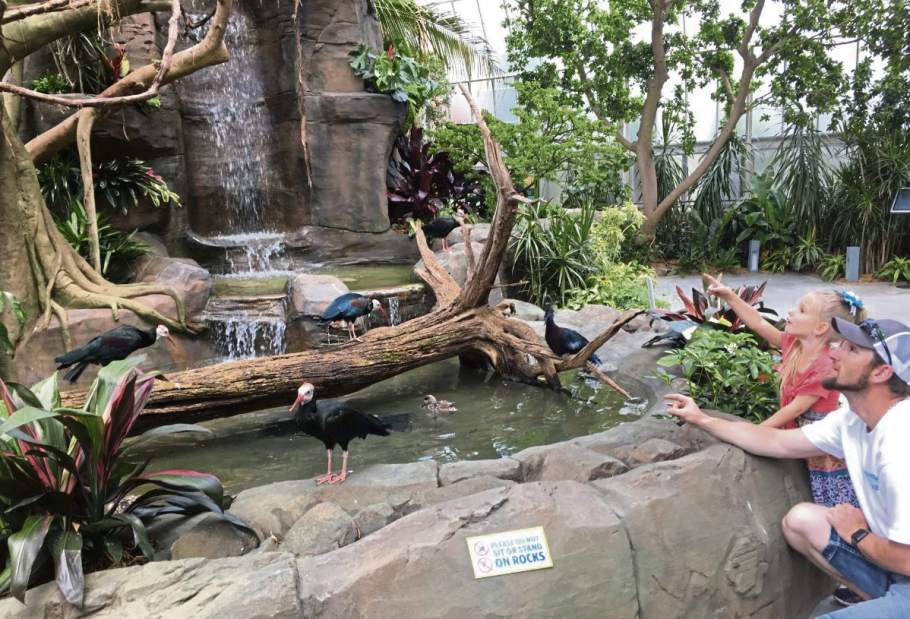
The National Aviary's newly renovated $1.2 million tropical rainforest is indeed a room with a view.
The room's centerpiece is a new, 15-foot, tiered waterfall that looks like a secret spot where multiple avian species flock and perch close but just out of touch of visitors.
The viewing experience was calculated. The waterfall is an appealing place for birds to congregate in the wild, and Aviary staff made sure there were trees with perches, even in waterfall itself, to accommodate the many bird species that might stop by during the day.
“It's a more immersive experience,” said Cheryl Tracy, executive director of the National Aviary.
The Aviary on Pittsburgh's North Side reopened the tropical rainforest Friday.
“It's always nice for the kids to get close. You can see the different markings and patterns of something that is out in the wild,” said one visitor, Chris Funk, 34, of North Huntingdon, who brought his daughter Leyla, 5.
The oldest room in the Aviary, the tropical rainforest was saddled with growing maintenance problems causing officials to consider demolishing the room and starting over.
But the domed, glassed room originally built as a conservatory 66 years ago had good bones. The foundation and the room's structure were in sound shape allowing the Aviary to change out the 3,146 panes of glass for more bird friendly glass to prevent bird collisions from inside and outside the building.
Renovations started three months ago.
The specialty glass, manufactured Vitro Architectural Glass, lets the UV rays in, creating a truer rainforest habitat allowing the birds and trees to live in unfiltered sunlight.
It is not a just fanciful room offering a montage of rainforest flora, but one that is built solely for the birds, giving them many options for places to fly and perch. The Aviary staff applied their expertise in knowing where, say, its endangered hyacinth macaws would like to relax.
The staff designed two perching trees with branch angles and thicknesses custom built for perfect perching, said Kurt Hundgen, director of the Aviary's Animal Collections. The staff guided a contractor in creating the realistic looking tree trunks, molding Styrofoam and fiberglass plastic and painting it to look like just another tree among the wild ones.
The aviary started to release birds into their new home earlier this week. About 72 birds have been released so far. About a dozen or more will be added. The staggered release of the birds gives them time to adjust, Hundgen said.
“The birds are settling in really well,” said Hundgen. “There's open areas for them to fly and lots of perches.”
One of the facility's three sloths even got in on the action.
Wookiee, an adult Linnaeus two-toed sloth now calls the tropical rainforest room its home. It may be hard to see. Timing will dictate the views available to visitors as sloths do like to sleep, and in the tropical rainforest room, this sloth likes to huddle among the leaves in the tree tops.
Cacao and coffee are among 74 varieties of trees and plants included to replicate the rainforest ecosystem. The variety provides greater educational opportunities on the many assets of the rainforest.
The project was funded by the Colcom Foundation, the Allegheny Regional Asset Districts and others including Trib Total Media.
