
Blind & Vision Rehabilitation Services moving Uptown


The first time Sarah Lucas took a stroll along a noisy, bustling Downtown street, it felt a bit intimidating.
At 33, Lucas — who boasted 20/20 vision throughout childhood — was legally blind.
Hoping to retain her job as assistant controller at a trucking company in Kentucky, Lucas came to Pittsburgh in 2010 on a workforce development grant to learn new skills at the nonprofit Blind & Vision Rehabilitation Services of Pittsburgh.
“People think you can't do stuff just because you can't see,” said Lucas, shocked to learn in her early 20s she had inherited Stargardt's disease, a degenerative eye condition that affects about one in 10,000 people. The 114-pound woman became determined to pursue activities others told her she no longer should, from her career in accounting to a passion for martial arts. “I'm probably weird, because when someone tells me I can't do something, it pushes me.
“I wanted to continue to be me.”
Lucas, now 39, not only received training from Blind & Vision Rehabilitation Services, but a long-term job as one of its accounting clerks. She's eager to join dozens of community leaders and supporters Friday in celebrating the grand opening of the nonprofit's new location in Uptown.
The organization — whose roots date to supporting workers blinded in industrial accidents in 1910 — has moved from spaces in Homestead and the Strip District into a renovated five-story brick warehouse on Locust Street overlooking the Downtown skyline.
Blind & Vision Rehabilitation Services has a roughly $5 million annual budget and 85 employees, 14 of whom are blind or vision-impaired and work for the nonprofit's manufacturing arm, making aprons for the Army, charcoal filters for Navy submarines, towels for prisons and most of Pennsylvania's road signs. Last year, the nonprofit served more than 1,200 blind or visually impaired individuals and did vision screenings for almost 14,000 children.
Recent assessments have found that “there's definitely greater need, but our biggest barrier was logistics, getting people to us,” said Erika Arbogast, the organization's executive director.
“We built for growth,” said Arbogast, who began planning the Uptown renovation project three years ago. “We needed at least 80,000 square feet on a bus line in a good location — because, of course, the people we serve don't have the ability to drive.”
The 87,000-square-foot location aims to ease transportation woes and elevate available services through features such as a pediatric exam room, upgraded optical equipment and a soon-to-come enclosed rooftop training course. The landscaped rooftop will include a sensory garden lined with benches and wind chimes, area to navigate various textured terrains, and a grassy corner specifically for guide dogs to do their dirty business.
“It'll be a safe area, especially for those who live in rural areas who might be a little leery of coming to the big city,” said Spero Pipakis, 64, of Carnegie, a 24-year worker at the nonprofit who teaches technology skills.
“Then once they feel comfortable, we'll take them out to the streets,” Arbogast said.
Pipakis was born blind, but many of the nonprofits' clients were not. About 500 participate in its low-vision rehabilitation program, which is for those who have significant visual deficits but have retained some level of vision.
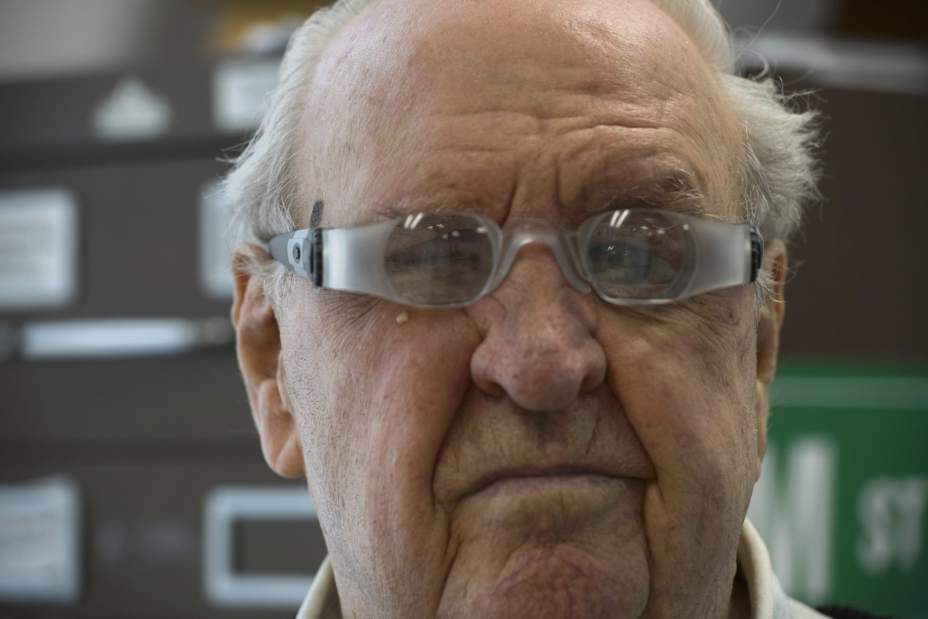
“It's a God-given outfit,” said new client Donald Sherred, 84, of Munhall while meeting Tuesday afternoon with the facility's occupational therapist about his new distance glasses, which magnify what he sees by 2.5 times.
Age-related vision impairment is on the rise nationally, data from Prevent Blindness America and the National Eye Institute show.
With Western Pennsylvania home to a higher proportion of older residents, the number of people with sight problems could more than double in 30 years, Arbogast said.
Cost of the nonprofit's new headquarters totaled about $17 million, including $2.5 million to acquire the building, Arbogast said.
Financing comes from the nonprofit's endowment income, a $6.5 million private loan, $2.9 million through a capital fundraising campaign and about $2.2 million in federal tax credits. Its employees pitched in $35,000.
Work on the rooftop garden is on hold while the nonprofit awaits Gov. Tom Wolf's decision on when to release the next round of grants through the Redevelopment Assistance Capital Program, a backlogged funding source whose next disbursement date remains unclear.
Natasha Lindstrom is a Tribune-Review staff writer. Reach her at 412-380-8514 or nlindstrom@tribweb.com.
