

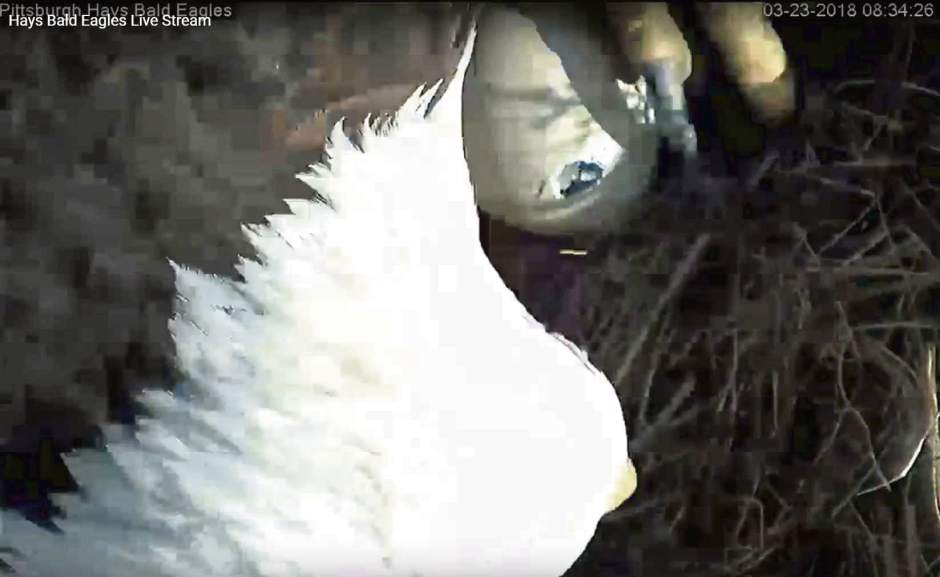
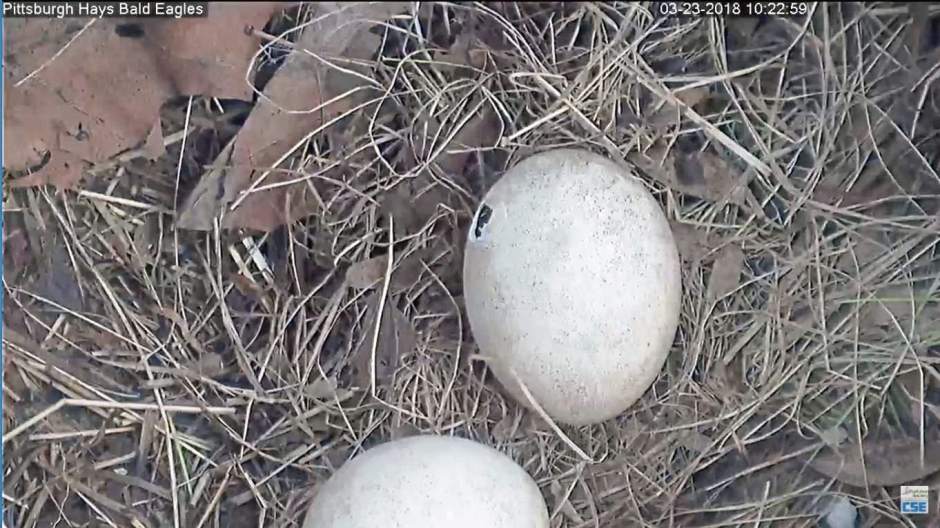
A pip is in progress at the Pittsburgh Hays bald eagle nest, where one of the chicks started to break out of one of the eggs just before 9 a.m. Friday.
A pip is a perforation of the egg shell caused by the chick using a special egg tooth to break out of the shell.
From pip to hatch can take up to 24 hours. Then, within several more days, the Hays birds' second and final egg is expected to hatch.
While still inside the egg, the chick will poke a small hole about two-thirds of the way up the side and then chip around in a small circle for the top of the egg to come off, according to the Audubon Society of Western Pennsylvania.
This is the sixth nesting season of a pair of bald eagles who live year-round on a steep hillside above the Monongahela River. They are the first eagles to breed within the city limits in more than 150 years.
The new chick will be the couples' sixth eaglet since they started nesting.
A live webcam on the Hays and Harmar bald eagle nests, along with a legion of webcam watchers, have been noting every roll of the egg as the parents have been taking turns on incubating duty for more than a month.
All webcams were set up by the Audubon Society of Pennsylvania and CSE Corp. of Murrysville.
After the chick hatches, the mother and father eagle will still sit tight on their nest to brood their remaining egg and keep a newly hatched chick warm, according to Patricia Barber, endangered bird biologist for the Pennsylvania Game Commission.
“The chick will start to make noise in the egg, so sometimes you will see the adult look underneath them,” Barber said “It's subtle, but you might be able to notice.”
The parents will not help the chicks hatch, Barber said.
“They will look at the hatching egg pretty quickly and sometimes remove a part of the egg shell,” she said.
The newly hatched bird is extremely vulnerable because it cannot warm nor cool its body for about 20 days. It needs that blanket of protection from its brooding parents to survive.
“The chicks are wet, and if it's cold, they could really get chilled,” Barber said. “That's why the adult has to get back on their nest to keep the chicks toasty warm.”
Conversely, if it's too hot, the heat could kill the birds without a parent brooding over them.
Mary Ann Thomas is a Tribune-Review staff writer. Reach her at 724-226-4691, mthomas@tribweb.com or via Twitter @MaThomas_Trib.
