
High school scientists take on big challenges at 2018 Intel science fair in Pittsburgh

When Thomas Kim's high school English teacher was diagnosed with breast cancer, he felt there was no way to help.
“‘I'm just a high schooler. How can I help my teacher?'” Kim said he thought to himself. “I wasn't in the position to do that.”
He decided to teach himself computational biology and reached out to Pittsburgh-area labs. He drew on the curiosity and imagination his father — a researcher who studies breast cancer — instilled in him from a young age. Kim had a burning question he wanted to answer.
“Why is it then that we haven't found what we call this ‘magic bullet' to be able to solve this issue of breast cancer?” he said.
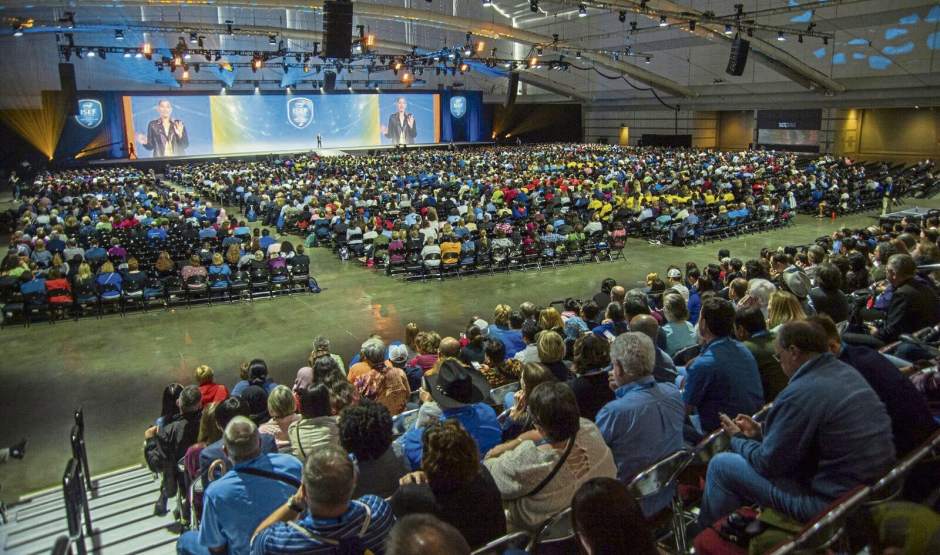
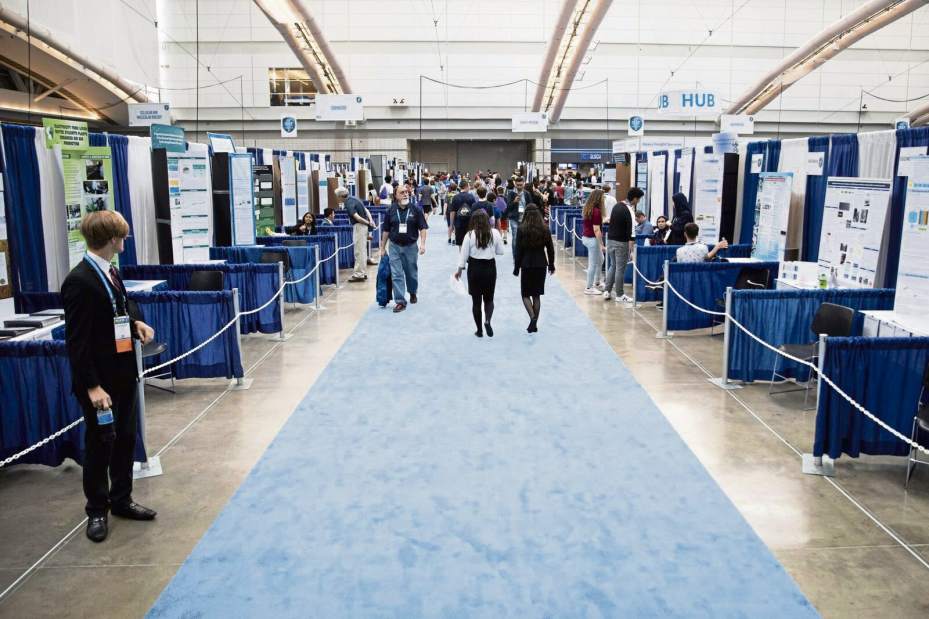
Four years later, rhe Vincentian Academy senior, of Wexford, has made progress with contributing to research that examines how cells develop into different forms of breast cancer. Kim presented his findings alongside three other Pittsburgh-area finalists at the 2018 Intel International Science and Engineering Fair at the David L. Lawrence Convention Center in Pittsburgh this week.
The roughly 1,800 students featured at the Intel fair were selected from 420 affiliate science fairs across 80 countries.
These aren't typical science fair projects: Many took over a year to complete, build on mountains of academic research and data and were conducted in professional science labs. The students are competing for top prizes of up to $75,000, which will be announced Friday.
Kim's project is titled: “Gene Methylation is a Driver of Cellular Differentiation for Intrinsic Subtype of Breast Cancer During Carcinogenesis.” He plans to attend Johns Hopkins University in the fall to study computational biology and continue his research on rare diseases and cancer.
But the competition is about more than showcasing students' scientific prowess, the Pittsburgh finalists said. It's about using science to connect with people — throughout the project design and research process, but especially after projects are completed. “While I do like more theoretical stuff, personally I click more when I learn something I can see every day, things that impact peoples' lives,” said Nicole Munne, a senior at Peters Township High School who will attend the Massachusetts Institute of Technology this fall to begin studying chemical engineering.
Her project, “Development of an in-vitro Human Liver Model for Non-alcoholic Fatty Liver Disease,” created a model that screened for non-alcoholic fatty liver disease. It's one of the most-common forms of liver disease, affecting one in three adults, according to the American Liver Foundation.
Munne said that she was inspired to pursue science by a high school chemistry teacher whose passion for the subject was contagious, and who worked to make the concepts they studied in the classroom applicable to the real world.
Munne went on to complete her Intel competition project at the Pitt Drug Discovery Institute last summer.
“I honestly didn't know it was possible for students so young to get involved in such high-level research,” she said.
Mia Pellegrini, a junior at Allderdice High School, was also motivated to consider science as a career path after connecting with her biology teacher. She joined an after-school program at Pitt, where she started to build more confidence in her abilities as a scientist.
“I would largely attribute that to having a lot of amazing people supporting me throughout the process,” she said. “There were a lot of people that really challenged me to ask questions, and were really curious about what I had to say.”
Now, she said she hopes to work towards addressing the world's biggest challenges: climate change, pollution, cancer.
“That's where research comes in, to find the answers to those problems,” Pellegrini said.
Her project, “Developing an Optimal Florescent Protein Tag,” developed a tool that makes proteins visible in order to observe how they work and to develop treatments for diseases, for example.
Benjamin Cummings, also an Allderdice junior, is a theater buff. Though he dreams of pursuing drama in college, Cummings got involved with science research in his early high school years after meeting upperclassmen involved in the Intel competition.
He wasn't confident in his skills at first. But he said making friends who were passionate about science motivated him to pursue it.
“Science, it has a really important role in just solving problems, and I think a lot of people need to connect with it, and kids need to be inspired,” he said.
Cummings went on to work in a chemistry lab at Pitt, where he completed the project he presented this week, which focused on developing sensors that detect the flu. It was titled “Immunology Interfaces with Nanotechnology: The Development of a Sensitive Carbon Nanotube-Based Biosensor for the Detection of Influenza A (H1N1).
He was inspired by the graduate students he met at Pitt to push his research further.
“Connecting with these people and hearing their stories, it's driven me so far,” Cummings said.
Jamie Martines is a Tribune-Review staff writer. Reach her at jmartines@tribweb.com, 724-850-2867 or on Twitter @Jamie_Martines.
