


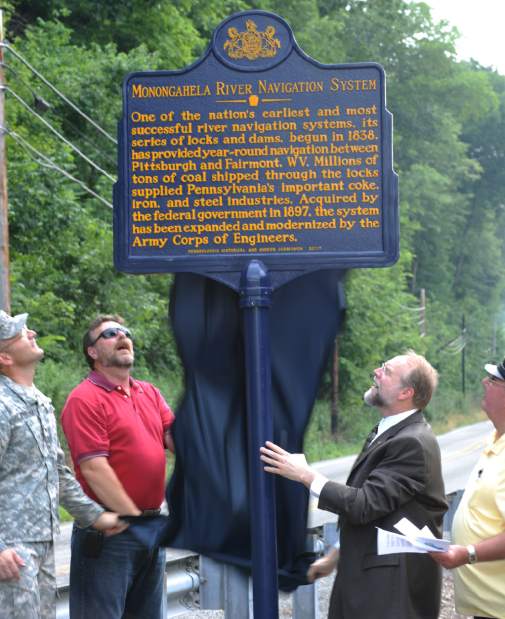
The Monongahela River's aging system of locks and dams is destined for an overhaul, but state officials on Monday officially marked and recognized its historical value.
Pennsylvania Historical and Museum Commission showed a new a historical marker near Lock and Dam 3 on the Monongahela River in Elizabeth Borough. Lock and Dam 3 is destined for removal by 2025, leaving 30 miles of open river between Charleroi and Braddock.
“It's an acknowledgment of decades, if not centuries, of service by those that have worked on the river, locks and boats in Elizabeth since before the turn of the 19th century,” said Elizabeth Mayor David Householder.
Pittsburgh has the oldest waterway infrastructure in the nation. Designed to last 50 years, about half the locks in the United States are 50 years or older, according to statistics from the Army Corps of Engineers. In Western Pennsylvania, 66 percent are 50 years or older.
The condition of the locks are critical to industry. U.S. Steel, for example, depends on the Monongahela-Ohio River system for transporting raw materials and finished steel to and from its Clairton, Irvin and Edgar Thomson plants in the Mon Valley.
The Monongahela Navigation Co. began to install locks and dams on the river in 1838 to improve navigation on a waterway that sometimes dried up in the summer. The government took over the system in 1897, and it is now managed by the corps.
Lock and Dam 3 was built in 1905.
“Because it's an old lock, older than 50 years, it is deemed historic,” said Bruce Kish, an Army Corps environmental protection specialist. “And it was built with engineering styles that are no longer used.”
The ongoing Lower Monongahela River project to replace the lock and dam started in 1994 and was to be a $750 million, 10-year effort. A nearly century-old dam near Braddock was replaced with a gated dam in 2004, and Lock and Dam 4 in North Charleroi is being rehabilitated as part of the Lower Monongahela River Project.
However, costs ballooned to $1.7 billion because of funding problems and delays, pushing completion of work to 2025. Change necessitates creating a snapshot for history like the one the marker provides, said Col. William H. Graham, Pittsburgh district engineer for the Army Corps.
“It's a wonderful example of where we've been and points toward the future,” he said. “It's up to us in the here and now so that the future continues to serve the national economy.”
Megan Guza is a news intern for Trib Total Media. She can be reached at 412-380-5644 or mguza@tribweb.com.
