
https://archive.triblive.com/local/pittsburgh-allegheny/phipps-previews-greenest-building/
Phipps previews ‘greenest building’

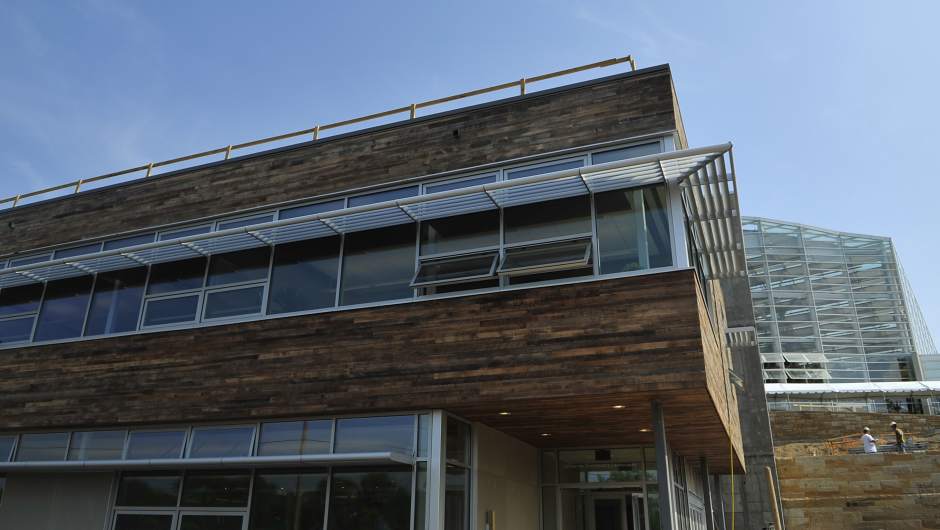
A new building at Phipps Conservatory & Botanical Gardens will guide Pittsburgh toward leading the way in a new industrial revolution, the group’s executive director said.
“Just as Pittsburgh led the industrial revolution 100 years ago, this building, created with local talent, will let Pittsburgh take a leading role in the green industrial revolution,” Richard V. Piacentini said on Wednesday as he led a preview of the $15 million Center for Sustainable Landscapes, which he called the “greenest building in the world.”
The 24,350-square-foot building in Oakland will be used for education programs and have space for 53 administrators and research staff, he said. A move-in date has not been set, but probably will be in June. Several spots in the building, including the plant-filled rooftop and an atrium with a retractable roof, likely will open in July.
“We hope the building will connect people with the outdoors,” said Molly Steinwald, director of science education at the conservatory.
The building is nearly ready, with staff cubicles and offices spaces awaiting furniture. But the grounds around the site overlooking Panther Hollow still are torn up as construction crews finish work that will include a lagoon, wetlands and 1,700-gallon cisterns that will collect water to be purified and eventually used to watering orchids.
The modern, angular center is on an old brownfield site behind the glass castle of a conservatory that dates to 1893. It is being built to acquire the highest rating in the Leadership in Energy and Environmental Design rating system set up by the U.S. Green Building Council.
It also is being designed to match the landscaping demands of the Sustainable Sites Initiative.
More important, Piacentini said, is meeting the Living Building Challenge of the International Living Future Institute. To reach that status, he said, the building will be measured in its first year of operation to see if it creates more energy than it uses, puts no fouled water into the municipal system and creates its own heat and cooling.
Piacentini described the various features that will make the building “net-zero,” meaning it uses no more energy, heat or water than it produces or collects:
• A collection of 125 solar collectors that will produce energy equivalent to the amount used by 10 homes in a year.
• A closed loop of storm water it collects, which will be used for sanitary purposes, purified and redirected to watering.
• Fourteen geothermal tubes and a wind turbine for heating and cooling.
• Above the efficient, triple-paned windows, shades will block out sun in the warmer months but allow warmth when it is cooler. On the inside, “sun shelfs” will reflect light up to the ceiling to be bounced back into office space. Piacentini said the goal is to operate the building with 20 percent of the energy used in a normal office space.
Copyright ©2026— Trib Total Media, LLC (TribLIVE.com)