
Pittsburgh mayor favors moving controversial Stephen Foster statue


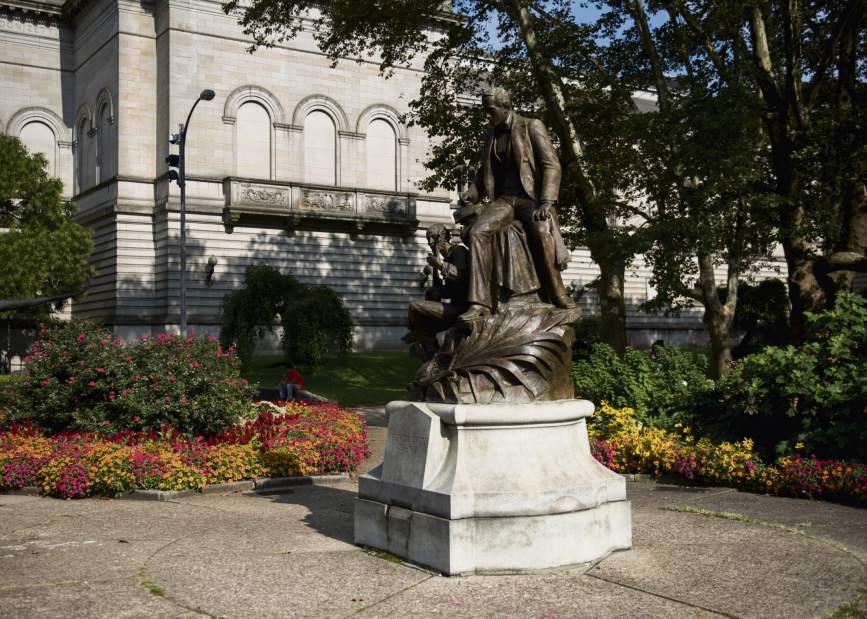
Pittsburgh Mayor Bill Peduto said Friday that he thinks the city's Stephen Foster statue should be displayed somewhere other than the publicly owned entrance to Schenley Park because it offends some residents.
The mayor was quick to add that he was conveying his personal opinion and the fate of the 117-year-old landmark that has stirred controversy for years would be decided only after a thorough examination of its history and meaning.
“I think that right now as we look at it there would be a more appropriate location for it ... than being in a public park,” Peduto said. “Saying that, my judgment will be based upon the facts around it and not around just what my opinion is.”
The Pittsburgh Art Commission and Historical Review Commission are researching all aspects of the statue that stands along Forbes Avenue next to the Carnegie Museums of Art and Natural History. The Art Commission could finish its report as early as September.
Critics believe the statue of the famous songwriter Foster standing with a black slave strumming a banjo at his feet is demeaning for many, particularly blacks.
Others view it as Foster being inspired by a black musician and say the statue should be preserved where it stands.
“Foster was not a racist,” said Jim Wudarczyk, 65, a local historian from Lawrenceville where Foster was born. “The statue represents a white man who is listening to a downtrodden slave singing. He's learning from the slave, not only from the words but his humility. It's the white man who is learning a lesson from a black man.”
Pittsburgh was reviewing the statue even before violence in Charlottesville, Va., broke out two weeks ago over the planned removal of a statue of Confederate General Robert E. Lee, according to Peduto spokesman Tim McNulty.
Cities around the country have been removing monuments honoring the Confederacy since 2015, when a white racist fatally shot nine black parishioners at a church in Charleston, S.C.
Statues honoring such figures as Christopher Columbus, who some consider a symbol of oppression for Native Americans, also have come under fire in recent years.
New York Mayor Bill de Blasio has ordered a 90-day review of “symbols of hate” in the city, and Philadelphia activists are advocating for the removal of a statue of former Philadelphia Mayor Frank Rizzo because they view him as a racist.
Peduto, a history aficionado, doesn't want the Foster statue destroyed. He said he favors moving it because some of his constituents are offended by it.
“It is more important how others view it ... and how it makes them feel when they see that statue,” he said. “To them and to those who see it and view it, it is demeaning, and I have to consider that as part of the decision.”
Jo Ellen Parker, president and CEO of Carnegie Museums, agrees. Parker said the statue should be in a place where it can be studied, debated and appropriately interpreted.
“I think that it should be in a place where it can be accessible to the public and be contextualized in sort of an educational sense,” she said. “I would not agree with people who advocated that it should be destroyed or removed from public access.”
Artist Giuseppe Moretti was commissioned by a group of leading Pittsburghers, including Andrew Mellon, to sculpt the bronze monument in 1900, according to the book “Discovering Pittsburgh Sculpture.” The group suggested the design.
It was originally located at the entrance to Highland Park. Nearly 50,000 people attended its dedication ceremony, including 3,000 children singing Foster songs.
Mayor Cornelius Scully had it moved to its current location after a series of acts of vandalism because he felt it would be safer and more visible.
The Associated Press contributed. Bob Bauder is a Tribune-Review staff writer. Reach him at 412-765-2312 or bbauder@tribweb.com.
