
Pittsburgh region's air pollution worsening, report says

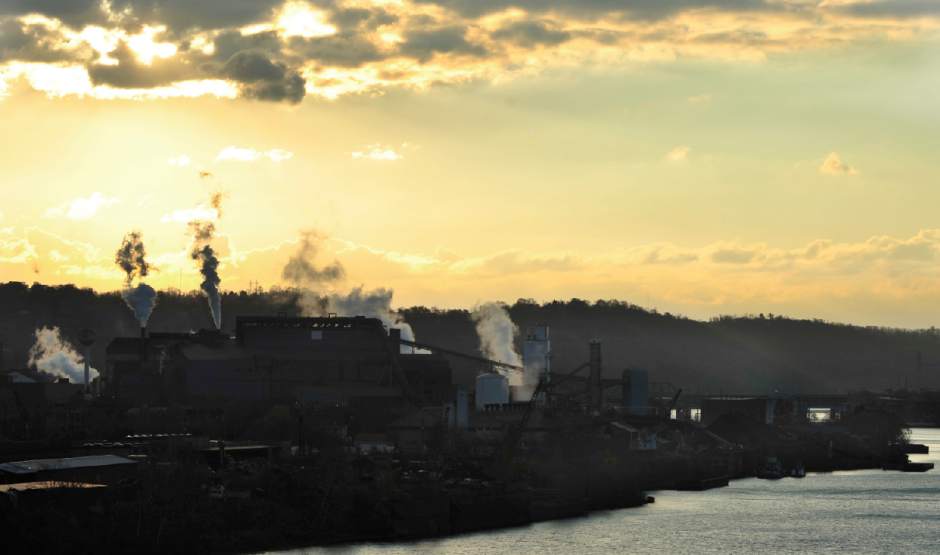
Pittsburgh ranks as the nation's 10th-worst region for short-term particle pollution, according to a new report.
The Pittsburgh region, which includes parts of Ohio and West Virginia, dropped seven places from last year's 17th ranking in the latest American Lung Association State of the Air report.
The report also ranks Allegheny County as 20th worst for short-term particle pollution. The county was not included in the 25 worst counties for that category in last year's report .
For year-round particle pollution, the county dropped one place — from 13th to 12th worst in the country.
For both of those rankings, the association included the number of people in the county estimated to have various medical conditions that could be related to air quality.
Allegheny County, which has a population of about 1.2 million, had an estimated 20,388 children younger than 18 diagnosed with asthma in 2016, 105,401 adults with asthma in 2016 and 789 new cases of lung cancer diagnosed in 2014, the report found.
Particle pollution is caused by mechanical and chemical processes, said Kevin Stewart, director of environmental health for the American Lung Association of the Mid-Atlantic, in a statement.
Mechanical processes that can create the particles include dust storms, construction, demolition, mining and agriculture, Stewart said. Chemical processes include gases emitted by burning fuels, burning fossil fuels in factories, power plants, diesel and gasoline-powered vehicles, and equipment.
The county has about 30 facilities that are listed as "significant sources" on the county health department's air quality website, which was last updated in January. Of those, seven facilities are not compliant with air quality standards.
The department and the Environmental Protection Agency in November issued a notice of violation for air pollution at U.S. Steel's Edgar Thompson plant in Braddock. The department said at the time the notice marked the start of stricter enforcement at such facilities, by getting the EPA involved.
The report also gave the county Fs for high-ozone days and high-particle pollution days for data collected in 2014 through 2016, the report said.
During that timeframe, the county had 21 "orange" ozone days, 21 "orange" high-particle pollution days and three "red" particle pollution days, the report said.
The Pittsburgh region was praised in last year's report for experiencing the fewest number of unhealthy days ever in the 2013-15 data.
In the new report, the region was one of four that had more spikes in particles in the 2014-15 data than previously, along with two California cities and Seattle.
Theresa Clift is a Tribune-Review staff writer. Reach her at 412-380-5669, tclift@tribweb.com or via Twitter @tclift.
