
https://archive.triblive.com/local/pittsburgh-allegheny/second-african-penguin-hatches-at-national-aviary-in-pittsburgh/
Second African penguin hatches at National Aviary in Pittsburgh

• |
National Aviary
Bette, an African Penguin at the National Aviary. Two chicks were born to parents Bette and Sidney on Saturday, Dec. 16, 2017.
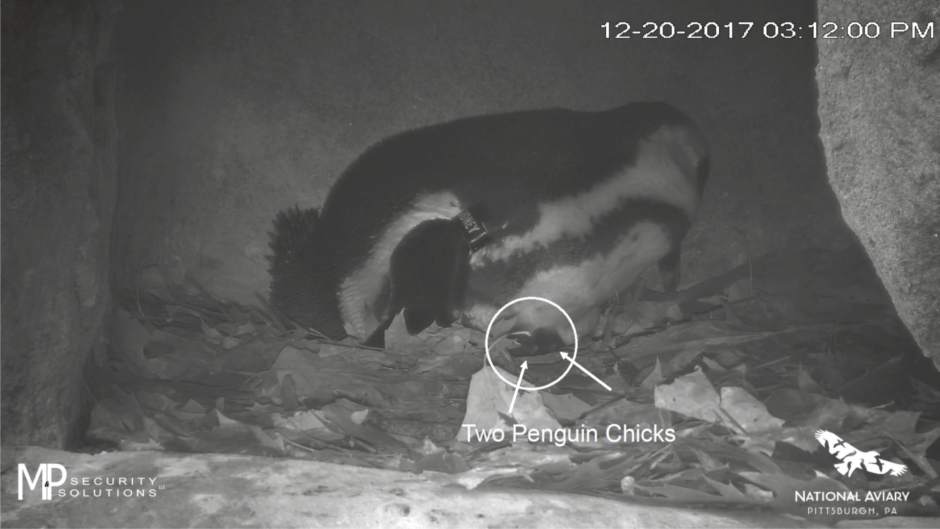
The second of two African penguin eggs at the National Aviary on Pittsburgh’s North Side, hatched Dec. 20. Viewers around the world can get a close up view of both chicks and their parents, Bette and Sidney, via a newly installed high-resolution, infrared camera called a “nest cam” that allows viewers to see inside the nesting cave without any disruption to the growing penguin family.
The eggs were laid on Nov. 7 and 11 in the aviary’s Penguin Point exhibit. Sidney and Bette are parents to three other sets of penguins hatched there in 2012, 2013 and 2015.
A newly hatched African penguin chick is slightly larger than a golf ball, so viewers may not easily see them right away. When a chick is hatched, the yolk sac is still attached to provide initial nutrition. After the yolk sac is absorbed, the chick will start begging for food, and parents will feed it a diet of partially digested fish several times a day.
If all goes as anticipated, the penguin chicks will remain in the nest for the first three to four weeks. Then they will be moved inside to be cared for by the aviary experts until they are old enough to return to their colony in Penguin Point, where they will join 20 other African penguins.
African penguins are an endangered species, with less than 25,000 pairs remaining in the wild. As part of the Association of Zoos and Aquariums Species Survival Plan, the aviary’s penguins are part of an important breeding program to ensure a healthy population of African penguins for future generations.
The camera and installation services were donated by M&P Security Solutions, a veteran-owned business serving the Pittsburgh area.
Details: penguinnestcam.org
JoAnne Klimovich Harrop is a Tribune-Review staff writer. Reach her at 724-853-5062 or jharrop@tribweb.com or via Twitter @Jharrop_Trib.