
Wilkinsburg headlines belie plummeting crime rate





Exhaling into the evening drizzle, Wilkinsburg police Sgt. Mike Adams wonders if his shift has gone to the dogs.
He's staring at a pair of barking Shih Tzus, the second call about canines he's gotten over the radio during an otherwise slow night shift.
He's already arbitrated a dispute over a pooping pit bull in a scruffier section of town, but now he faces a scrum of affluent neighbors on Horace Way who are unsure what to do about the mop-like stray pooches.
“It's actually pretty quiet tonight,” says Adams, 53, a sex crimes detective with more than two decades of experience in Wilkinsburg who works occasional night shifts as an acting sergeant. “Sometimes, it gets so freakin' busy that you don't have a moment to eat.
“But not tonight. It's not alarm-domestic-another domestic-another alarm.
“It's dogs.”
Three squad cars arrive — plus a plainclothes cop scouting for some teenagers who set fire to some trash in a garage. A few minutes of detective work, and they discover the pets got loose from the fenced home in front of them. The dogs aren't lost, just wet and hungry.
Five minutes later, their fence mended, they're back inside the yard. Neighbors are relieved, problem solved. Until they escape seconds later, sending Adams scurrying back to fix the fence again.
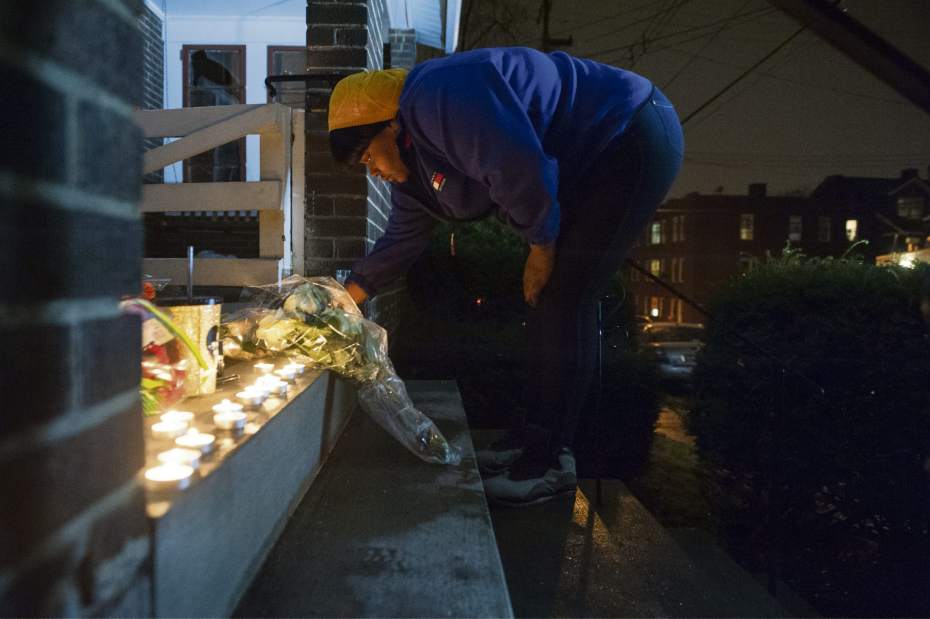
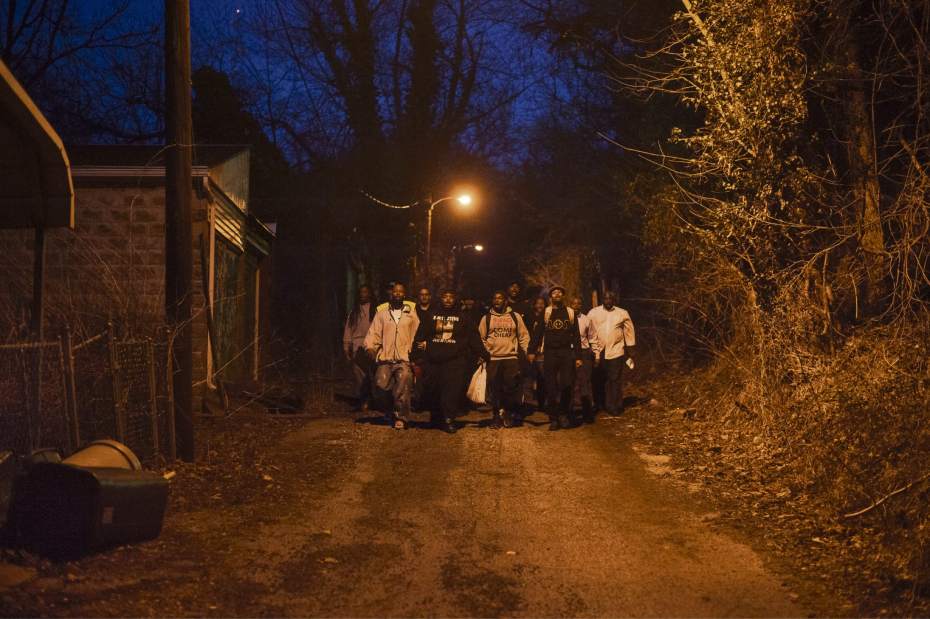
Nearly four months earlier, his shift was very different. The core of the dog-corralling team — Adams, his boss Sgt. Dan Cuiffi and Officer Don Hamlin — were the first responders to the March 9 massacre at a backyard barbecue on Franklin Avenue.
“It was like something I'd never seen before,” said Cuiffi, 47. “It was a slaughter. Like combat.”
Allegheny County police charged Cheron Lamont “C-Wiz” Shelton, 29, and Robert James “Milhouse” Thomas, 27, in the shooting deaths of siblings Brittany Powell, 27, the host of the gathering; Chanetta Powell, 25, and her unborn son; Jerry Shelton, 35; their cousin, Tina Shelton, 37; and family friend Shada Mahone, 26.
None of the dead Sheltons is related to accused triggerman Cheron Shelton. Except for Brittany — who only weeks before began renting a room in the house — none of the slain victims resided in Wilkinsburg.
Investigators believe the gunmen targeted Brittany's brother, LaMont “Murder” Powell, 24, as payback for his alleged role in the unsolved 2013 homicide of Calvin “Calio” Doswell, 30, near the same Homewood North housing project where Powell and the alleged shooters once lived.
“These people had no real connections to Wilkinsburg,” said Wilkinsburg police Chief Ophelia “Cookie” Coleman, 64. “They didn't live in Wilkinsburg. Whatever caused these killings, the motive, didn't start in Wilkinsburg.”
To Coleman, media reporting about the backyard slayings reinforced an image of Wilkinsburg as a dangerous community — something that doesn't match the rapidly falling crime rate there.
Wilkinsburg's violent crime rate — the number of reported homicides, aggravated assaults, robberies and rapes per 100,000 people — plummeted 74 percent between its 2005 peak and 2014, according to a Tribune-Review analysis of the latest available FBI data. That's a decline about 2 1⁄2 times as drastic as what the United States as a whole experienced during the same time span.
By comparison, Pittsburgh's violent crime rate fell 43 percent in that period.
It's not that violence has disappeared completely from Wilkinsburg, only that there's a lot less of it than people imagine, Coleman said. In 2005, officers investigated a violent crime nearly every shift. Today, they take a report about once every three days, the FBI data show.
Dispatch calls to officers on patrol dwindled, too. In 2014, Wilkinsburg police received 14,840 calls for service. That's one-third less than in 2005, when Wilkinsburg ranked sixth statewide in the rate for combined violent and property crimes.
By 2014, there were 88 municipalities in Pennsylvania where residents were more likely to have a violent crime or property crime, including Pittsburgh, New Kensington, North Belle Vernon, Verona and Whitehall.
In addition, Wilkinsburg's crimes are committed disproportionately by outsiders. An ongoing Wilkinsburg police review of arrest records begun in 2008 and repeatedly annually shows that four out of every five criminals caught there live in another community. That partly explains why Wilkinsburg records more armed robberies than aggravated assaults, the opposite of what most other communities experience.
Coleman points to Wilkinsburg's easy access to the Parkway East, East Street busway and other major thoroughfares for getaway car drivers.
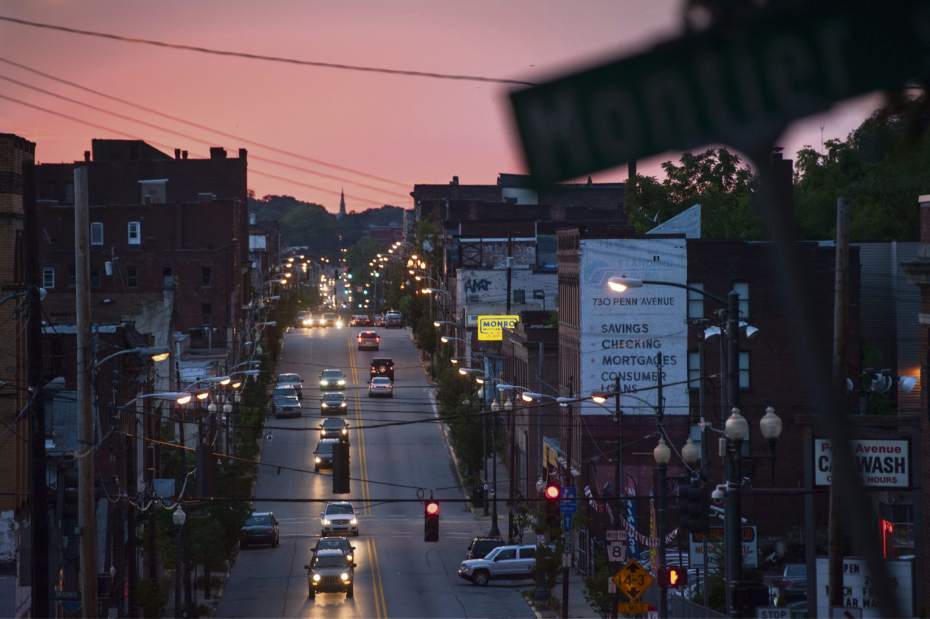
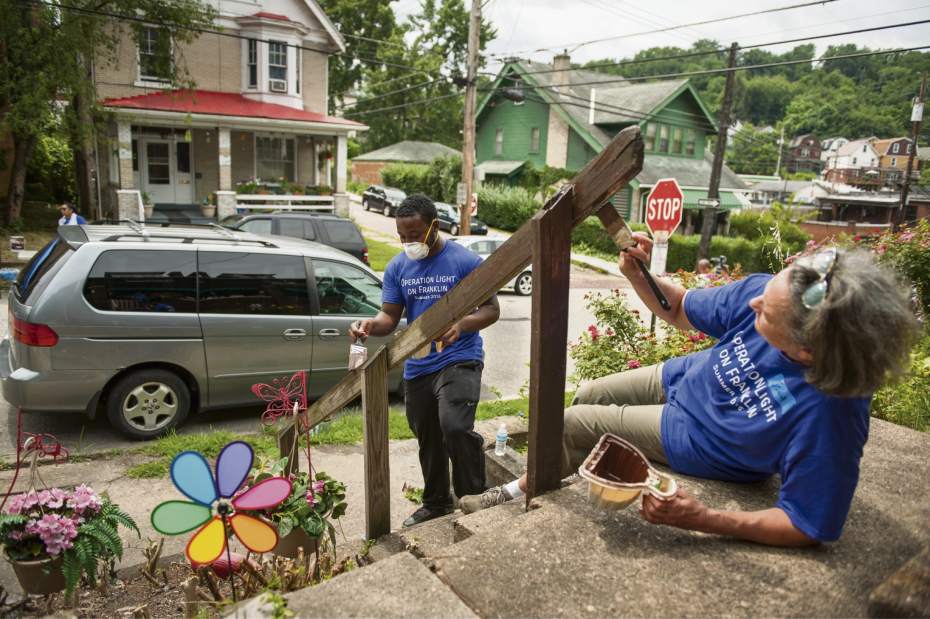
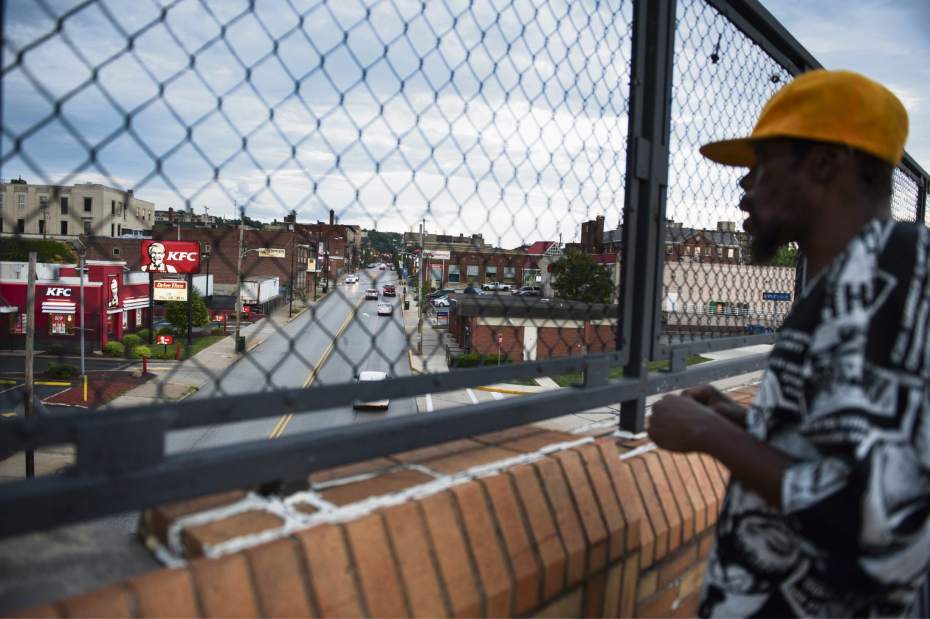
She predicted that robberies would continue dropping because of increased development along the Penn Avenue corridor, the borough's main thoroughfare that connects with Pittsburgh and Monroeville. Increasingly, retail shops and restaurants are reclaiming blighted buildings in Wilkinsburg's core — partly because the municipality is no longer a dry town, and partly because an influx of Asian, Russian and local black entrepreneurs are opening businesses as gentrification creeps eastward from East Liberty and Larimer.
Their inspiration is Louis Ou, a Taiwanese immigrant who remained in Wilkinsburg for more than three decades, despite hard times including the rise of violent crime there in the early 1990s.
He told the Trib that 70 percent of his Asian World grocery business comes from Ohio, northern Pennsylvania and other communities outside of Allegheny County, drawn to his shop by low prices and the easy access off the Parkway East.
Shoplifters and armed robbers leaving the parkway learned a long time ago not to mess with him. He can press a button when they exit so that the double doors lock, trapping them. “The police come to catch them,” Ou said.
Wilkinsburg's dwindling crime follows a national trend. The country's violent crime rate is half of what it was at its height in the early 1990s, just as property crimes dipped 43 percent nationwide over the past quarter-century, according to the FBI.
Social scientists continue to debate the causes for the nationwide phenomenon: the very high incarceration rate compared with other countries, larger and increasingly professional police forces armed with advanced software to target pockets of wrongdoing, an aging and more affluent population, decreased alcohol consumption and more.
But Coleman sees more local reasons for Wilkinsburg's drop in crime. Before she took the helm in late 2006 after a career as a Pittsburgh police detective and administrator, Wilkinsburg's force lacked stability and direction to fight crime. The community had 10 chiefs over the span of a decade and spent only $1,500 annually to train its officers.
Coleman got the money to boost the training budget to $50,000 and ensured that officers had the firepower to fight back on the street if necessary. Shotguns. Taser stun guns and AR-15 semiautomatic rifles are now standard gear, along with pistols and body armor.
A one-time questionnaire sent to more than 1,000 residents in 2007 found that many citizens didn't feel safe in the community or trust the police. Over the next nine years, Coleman hired officers who more closely mirrored the municipality they policed.
Wilkinsburg today is about 66 percent black. It's served by eight black male officers who work alongside 14 white male cops; their bosses are women: Chief Coleman, who's black, and her lieutenant, who's white.
Body cameras are on the way to aid authorities probing misuse of force allegations and to defuse the kinds of controversies that have roiled other communities, Coleman said.
A night patrolling Wilkinsburg's 2.2 square miles of densely packed people (about 7,100 per mile) found that Coleman's officers spend equal time in affluent sections such as Blackridge as they do in the poorer parts of town, like the Paul Court public housing complex.
Four years ago, Paul Court was one of the most dangerous places in Pennsylvania. In 2012, a gunman killed a 19-year-old resident and wounded another along nearby Princeton Avenue, spraying more than 20 bullets. More shootings continued throughout the summer.
Today, it's “pretty quiet,” said James Williams, 43, a mechanic who recently moved there from Homewood. He pointed to a row of surveillance cameras mounted on roofs as a big reason why.
Coleman said that's by design. High-crime areas are increasingly monitored by video cameras connected to the Wilkinsburg station, which capture video of criminals in the act. That lets officers spend more time on community-oriented policing, forging relationships with the public so that citizens will tip off authorities about budding crimes before they occur.
A former bicycle cop who has watched a generation of Wilkinsburg youths grow up, Adams concedes that much of policing seems boring to civilians, sort of like armed social work, helping residents talk out their disputes before they flare into violence.
Coleman said that's what 21st-century law enforcement is becoming — even if a lot of patrolmen don't like to admit it.
“You have police officers who don't look at it like that. They look at me and say, ‘Chief, I'm not a social worker. I'm not a baby sitter,' ” she said. “But all crime is social. And you're the first line of defense to protect that social order.”
Carl Prine is a Tribune-Review investigative reporter. Reach him at cprine@tribweb.com or 412-320-7826.
