
https://archive.triblive.com/local/plum/plum-expresses-opposition-to-injection-well/
Plum expresses opposition to injection well

DILLON CARR | Tribune-Review
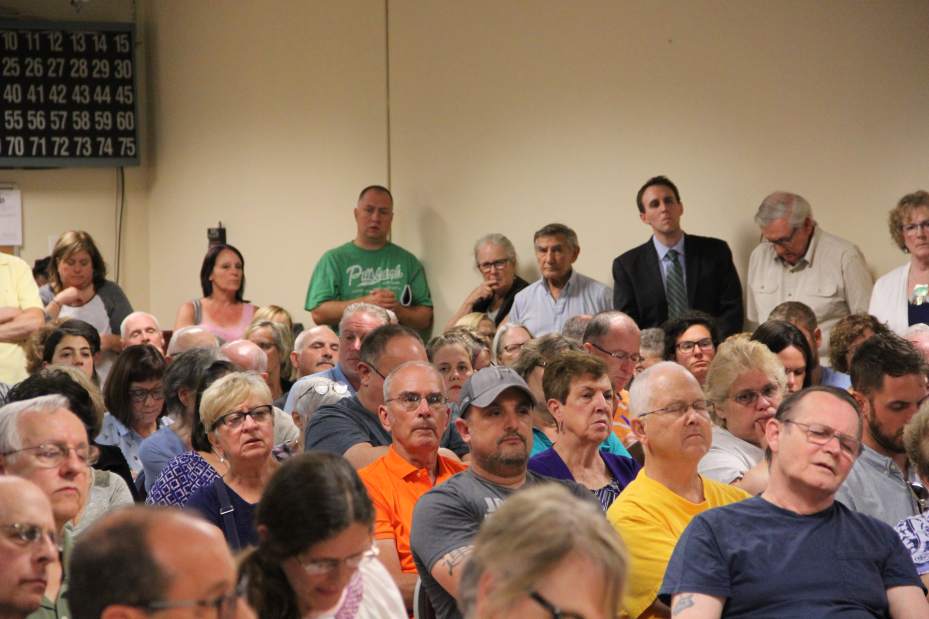
About 200 concerned citizens filled the Plum Senior Center to capacity on July 26, 2017, for a public hearing on a proposed injection well in Plum.
The audience sentiment was unanimous during a public hearing last week for a proposed injection well in Plum: “We don't want it.”
Plum Mayor Richard Hrivnak began the meeting by expressing his, and the borough's, opposition to the proposed injection well.
“I come before you today, as an elected official entrusted with the welfare of these residents, to state my opposition,” Hrivnak said, receiving applause.
Every person who testified before the four-member federal Environmental Protection Agency panel shared that sentiment. Around 200 attended the three-hour meeting, among them Plum council members, activists and residents.
Doug Shields, Food & Water Watch's Western Pennsylvania outreach liaison, urged the EPA to deny the permit that Penneco is seeking. He said one reason to consider is the number of violations the company has accrued.
“The applicant has a very poor compliance record. They get permits, they violate the conditions of the permits, they pay the fines, they move on and they do it again,” Shields said, adding the company has been fined $123,900 by the state Department of Environmental Protection since 2005.
Penneco Chief Operating Officer Ben Wallace questioned that figure in an interview after the meeting. Wallace and two other Penneco representatives were at the meeting, but didn't address the EPA.
Penneco Environmental Solutions is seeking permits to dispose of fracking water and other fluids from oil and gas drilling operations at a site off Old Leechburg Road near the border with Murrysville and Upper Burrell.
Wallace didn't deny that the company has received violations, and some have resulted in fines. But when oil and gas wells are inspected, “If they're not compliant it results in a notice of violation. Those may or may not result in a violation and a fine,” he said, and with 900 wells, “there's bound to be something.”
Penneco first submitted a permit application to the EPA in March 2016.
An EPA notice was published in July that said the agency plans to issue the permit pending the public hearing. Once the EPA issues a permit, Penneco must obtain state Department of Environmental Protection approval.
According to DEP, disposal injection wells are used in the oil and gas industry to permanently get rid of flowback water and brine, both by-products of Marcellus shale drilling.
Several studies have connected earthquakes to underground injection wells in Ohio and Oklahoma. In February, a DEP study linked low-magnitude earthquakes in April 2016 in Lawrence County to fracking.
Wallace said earthquakes are highly unlikely at the proposed injection well because it checks out regarding four factors:
• The injection formation, the Murrysville sandstone, is porous, which will allow for a “soaking” phenomenon.
• Tectonic tension doesn't exist in the area, like it does on the western side of the country.
• The depth at which the fluid will be injected, between 1,800 and 1,900 feet, is well below the water table, where drinking water is present.
• The volume of fluid being injected will not have enough pressure to cause seismic activity.
Plus, “There are wells already there. We operate hundreds of wells regionally. We've drilled many wells in mined-out areas,” Wallace said, adding that wells drilled in areas with old coal mines have three layers of casing made of steel, with cement in between.
Many residents at the meeting cited a study by ProPublica, a nonprofit, online news organization, that reported “federal environment officials have failed to adequately oversee hundreds of thousands of wells used to inject toxic oil and gas drilling waste deep underground.”
Many also talked about injection wells in Youngstown causing multiple earthquakes over the past several years.
One resident, Robert Ressler, asked the panel plainly, “Would you trade places with me?”
The panel, made up of four EPA representatives from the Mid-Atlantic region, did not give an answer because the public hearing was not a discussion. The representatives were available to address questions one-on-one after the hearing.
If approved, the injection well will allow Penneco to dispose of as many as 54,000 barrels per month. EPA documents say the injection well is a conversion of the company's Sedat No. 3 well, a nonshale well that first was drilled in 1989 to a depth of 4,300 feet. It extracted natural gas at three depths until it was plugged to a depth of 1,900 feet in 2015.
Penneco's website says it operates more than 900 oil and gas wells throughout the Appalachian Basin. It also operates a disposal well in Wyoming and another in West Virginia. The company currently is not drilling new wells.
James Bennett, an EPA spokesperson at the meeting, extended the public comment period to Wednesday, Aug. 9. Those wishing to submit written statements are encouraged to send them to his email at bennett.james@epa.gov or mail them to the EPA building in Philadelphia — 1650 Arch St., Philadelphia, PA 19103-2029 — marked with his name: James Bennett.
Dillon Carr is a Tribune-Review staff writer. Reach him at 412-871-2325, dcarr@tribweb.com or via Twitter @dillonswriting.
Copyright ©2026— Trib Total Media, LLC (TribLIVE.com)