
Pittsburgh derailment put spotlight on train safety


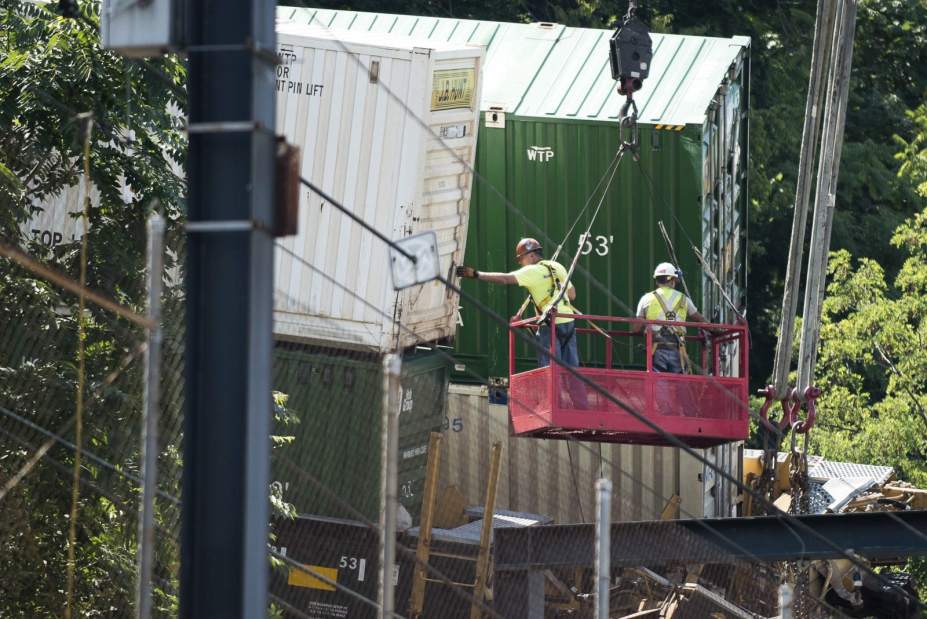
The derailment at Station Square in Pittsburgh was more severe than most train accidents, but it isn’t particularly unusual for trains to jump the tracks.
There are, on average, 226 “accidents or incidents” involving a freight train in Pennsylvania every year, including about 41 derailments, according to data from the Federal Rail Administration. However, less than 1 percent of train accidents are serious enough to warrant an investigation by the administration.
Last Sunday’s derailment is one of those rare instances, as both the FRA and the Pennsylvania Public Utility Commission are investigating, said PUC spokesman Nils Hagen-Frederiksen.
Investigators haven’t determined what caused the derailment. The most common cause of train accidents is human error, followed closely by problems with the track, according to FRA data.
Pennsylvania is a freight rail hub. It has 64 operating railroads, the most in the country, and more than 5,600 miles of track, according to PennDOT.
There are several layers in place to ensure the state’s tracks remain safe, Hagen-Frederiksen said.
Railroads inspect their tracks several times a week, and the FRA and PUC conduct additional inspections, focused on areas with high traffic or high risk, he said.
The PUC inspects about 2,000 miles of track a year, sometimes using a high-tech train car that can scan the track as it moves, looking for rails that are broken, bent or kinked, along with defective railroad ties and natural hazards like landslides.
Despite the precautions, accidents still happen by the score.
The Norfolk-Southern train that jumped the tracks in Pittsburgh sent seven railroad cars and 42 storage containers tumbling onto the hillside above Station Square. The containers were double-stacked on the train, carrying mouthwash, pet food, diapers, laundry detergent and appliances.
It took first-responders days to clear the containers and debris off the tracks.
“Of course, there are going to be accidents that will occur whether it’s by car, or rail or airplane,” Norfolk Southern spokesman Jonathan Glass told the Tribune-Review. “What we want to do is minimize those and make sure that our tracks are as safe as possible and allow commerce to happen, but at the same time being able to recognize the dangers. Had that been a different container other than Listerine, we would be dealing with a different situation.”
First-responders are given access to an online database that allows them to look up the cargo of any freight train, said Brock Kerchner, Pennsylvania coordinator of Operation Lifesaver, a national organization devoted to railroad safety.
“They do have the information, to know what is in the manifest of any train that they come upon,” he said.
Railroads and public safety officials don’t want information about cargo falling into the wrong hands, so train manifests are not made available to the public.
“You wouldn’t want someone to know whether a train is carrying hazardous materials or not,” Kerchner said.
Pittsburgh Mayor Bill Peduto told the Tribune-Review he’s long been concerned about the types of cargo coming through the city. Flammable materials come through every day, he said.
The city has no legal jurisdiction over what trains carry, though Peduto said he plans to talk to Norfolk Southern in the hopes of limiting double-stacked storage containers like the ones being carried by the train that derailed.
The vast majority of serious train crashes are the result of people or vehicles on the tracks, Kerchner said.
There have been several such cases in Southwestern Pennsylvania this year:
- A train hit a tractor-trailer carrying hydrocholoric acid in Centerville, Washington County, in March. The truck driver was injured, and residents were evacuated from their homes because of an acid spill. Gov. Tom Wolf declared a state of emergency.
- A train hit a tanker on a railroad crossing in Springdale in March. The tanker was carrying a non-hazardous resin, and nobody was hurt, though it took a crane to clear the wreckage.
- A car collided with a train in West Newton in June. One person suffered a “very minor” injury, according to officials.
- Also in June, a Norfolk Southern train struck and killed Reid J. Gadagno, 21, of Manor, in Jeannette. Gadagno was walking on the tracks at night. Though the train used its emergency brakes, it could not stop in time.
Train safety was put into the national spotlight this year after a string of fatal accidents, including Amtrak passenger trains.
A February collision in South Carolina injured 116 people and killed two Amtrak employees. The passenger train collided with a CSK freight train after being improperly diverted onto a rail siding.
In January, an Amtrak train carrying members of Congress, including House Speaker Paul Ryan, crashed into a truck that drove onto the tracks. A passenger in the truck was killed.
Despite these incidents, Kerchner said trains are still one of the safest ways to travel.
“Rail travel is still safer than driving down the street,” he said. “It’s just, unfortunately, there’s been a lot of high profile situations that have kind of brought rail travel and safety into the forefront.”
Jacob Tierney is a Tribune-Review staff writer. You can contact Jacob at 724-836-6646, jtierney@tribweb.com or via Twitter @Soolseem.
