
Allegheny Valley Hospital shows off expansion

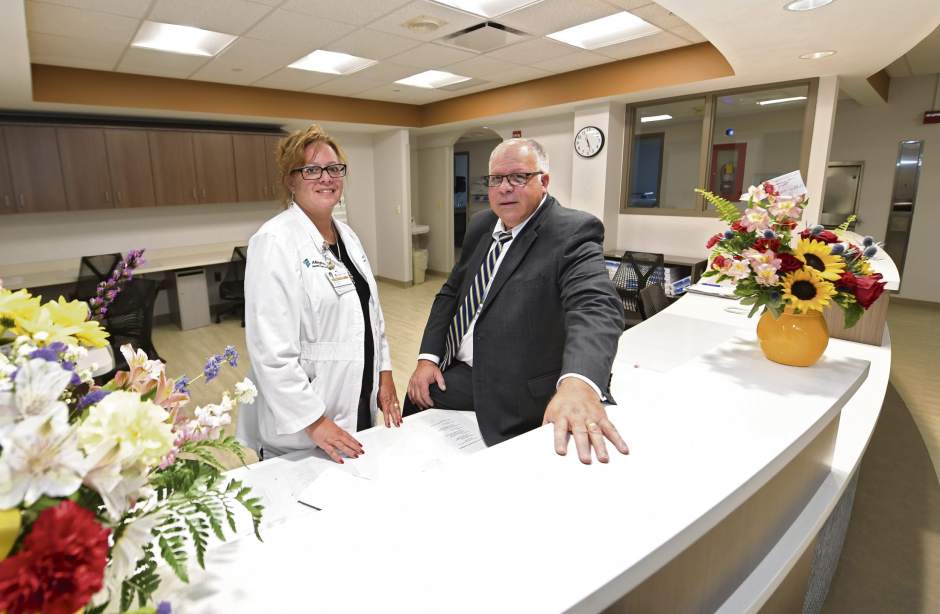
Allegheny Valley Hospital has a new orthopedic, neurosurgical and medical-surgical unit and inpatient rehabilitation unit — reflecting a focus on community needs and bringing hospital services closer to where patients live, hospital officials say.
The surgical unit at the Harrison hospital will provide care to patients recovering from total joint replacement surgeries, such as hips and knees; spinal and cervical surgeries and discectomies; and general surgeries such as appendectomies.
The inpatient rehab unit provides physical, occupational and speech therapy services to patients recovering from strokes, spinal cord injuries, brain injuries and other complex medical issues.
The $6.5 million in upgrades were planned well in advance of Allegheny Health Network's most recent financial statement, which reported operating income of $12.6 million for the six months ended June 30. The seven-hospital system had anticipated a $20 million loss for the period.
“This was an investment Highmark decided about a year ago that they'd make, well before the recent good news on our good financials,” said William Englert, hospital president and CEO, referring to insurer Highmark Inc., which owns Allegheny Health Network. “This area's important to Highmark.”
Construction on both units began in March. The surgical unit tentatively is to start admitting patients Thursday; the inpatient rehab unit admitted its first patient in July.
The surgical unit can house 14 people and the inpatient rehab unit can hold 17 patients at one time. Overall, the hospital is a 228-bed facility and employs 893 people.
Orthopedics is one of Allegheny Valley Hospital's biggest service lines, officials said; roughly 1,500 orthopedic surgeries and 150 to 200 neurosurgeries are performed there each year.
“A lot of our community, the population is elderly,” said Lisa Ciafre, nurse manager for the hospital's orthopedics and oncology unit. “What do they need? They need new knees and new hips.”
The new surgical unit has 12 inpatient rooms — 10 are private and two are semi-private. They feature wider door frames, raised toilet seats, sinks, recliners and bedside stands.
Before the new unit was added, maneuvering in and out of patient rooms had its difficulties, Ciafre said. Doorways to the rooms, as well as to the en-suite bathrooms, were narrow, and often workers were tasked with removing furniture from a room to make space for stretchers.
That's not the case anymore.
“We found things that were interfering with their day, and we made improvements everywhere, from the general things on how we handle isolation patients to where are we going to put clean utility,” Ciafre said during a tour of the new unit on Monday.
“If we have a patient that needs two people to help (them) walk, we can actually achieve that because there's more room. It was very difficult to help walk somebody into a bathroom. Now, we (have) a wide doorway; it will be easy.”
The unit has an open-concept nurses station, kitchen area, storage area, satellite work stations, and badge card-activated rooms for medications, linen and patient care supplies.
The inpatient rehab unit is in the hospital's former orthopedics unit, Allegheny Health Network officials said. Before it opened, patients had to travel outside the Harrison area for such services.
“Instead of these patients having to go somewhere Downtown to get this therapy, they can come right back to their community and their families here,” Englert said. “(This is) much easier, much better.”
“Families are so integral to the recovery of these folks,” added Justin Emerick, director of inpatient rehab operations at Allegheny Health Network. “Making sure that folks are involved and able to take that person home and remain home is ultimately our goal.”
The hospital has hired several nurses, an occupational therapist, an occupational therapy assistant, a physical therapist, a physical therapy assistant, a speech therapist, a social worker and coordinator to staff the rehab unit, which will provide therapy to 200 or more patients a year, Emerick said. The average length of a patient stay is 12 to 14 days.
Those admitted are required to undergo three hours of therapy a day, which is a combination of physical therapy, including balance and strength training; occupational therapy, which includes daily activities such as cooking and bathing; and speech therapy, in which patients can work on things such as swallowing.
Therapy is offered six days a week, sometimes seven if needed, officials said.
“Folks will be in this space working around,” Emerick said. “We'll make them prepare a meal for themselves, we'll make them get in and out of the bathtub or shower.
“Everything that they would have to do at home we would replicate here before transitioning them home to make sure that they were safe.”
Madasyn Czebiniak is a Tribune-Review staff writer. Reach her at 724-226-4702, mczebiniak@tribweb.com, or on Twitter @maddyczebstrib.
