
No guinea pig left behind at New Kensington rescue operation

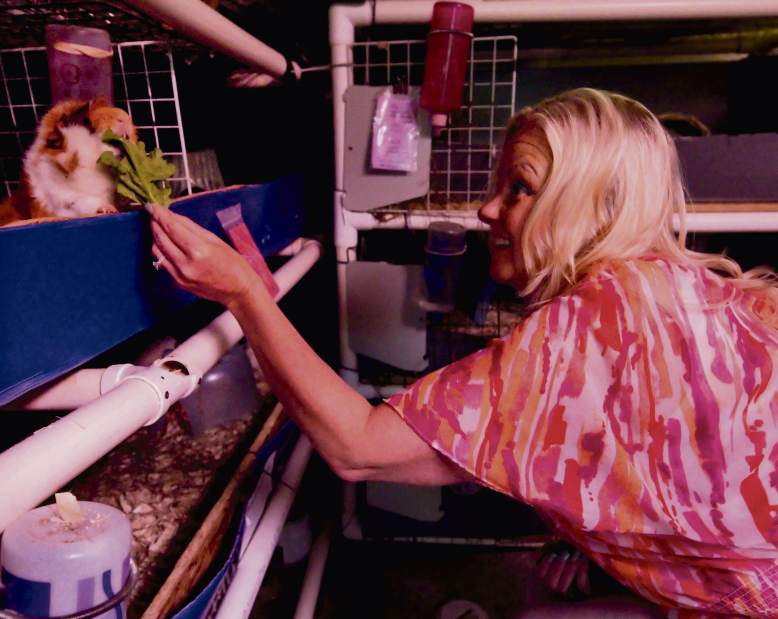
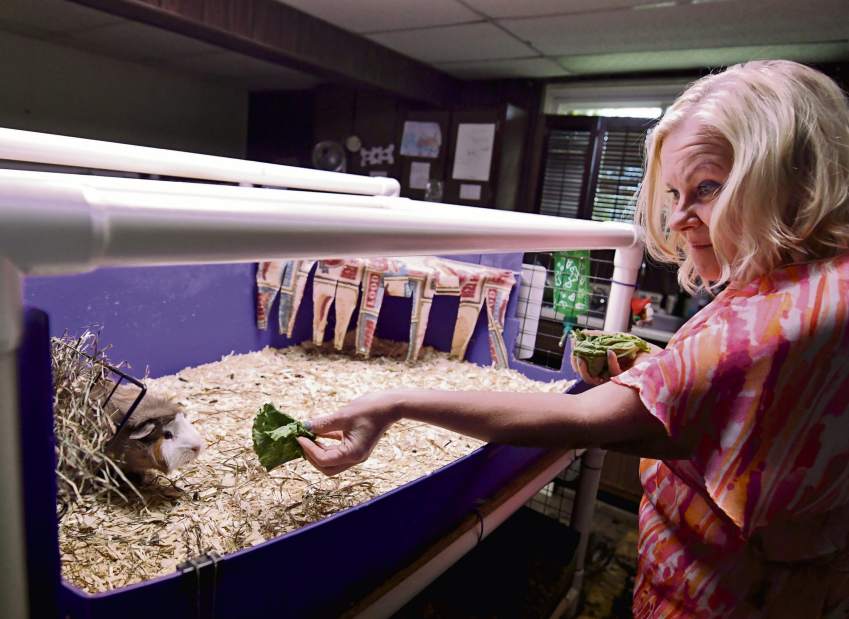


Julene Robinson's love for guinea pigs started nearly two decades ago when she received her very first one for Christmas — a black and white Abyssinian she named Belle.
"It started out in 2000," said Robinson, the executive director of the Wheek Care Guinea Pig Rescue in New Kensington. "I had a business here in Lower Burrell, and a friend of mine would come in and help me out occasionally, and she bought a couple guinea pigs for her kids for Christmas and kept them at our store."
At 47, she had never touched a guinea pig.
"I fell in love with them," she said. "I found out they were social animals and did better in a minimum of pairs, so by New Year's Day I had rescued my second guinea pig."
Two became four. Then, four became seven.
"People started (saying), 'Oh, you have guinea pigs, here, have mine.' That's pretty much how the rescue started."
The rescue outfit, which was officially established as a nonprofit last October, is located in the basement of Robinson's home on Esther Avenue. It provides rescue, medical, sanctuary, boarding, grooming, bonding and respite care services to all guinea pigs and sometimes chinchillas and rabbits.
The motto is: "No pig left behind."
"I was lucky enough to have a group of people get involved with me and help me out," said Robinson, who is 64. "It grew, and suddenly we are working with the Humane Society across the state with boarding situations. ... I have people calling from all across the country asking questions.
"It's just amazing because it's guinea pigs."
Robinson said guinea pig rescues are needed because they are one of the most neglected animals. She said lack of education about their care is a major problem.
"People think they're great first pets because they don't bite, and yet they do require work," she said. "We try to do the education, try to make the parents aware that this is not a child's full responsibility pet — it's a family pet. Parents have to be involved."
Wheek board President Maura Waggett said guinea pigs are commonly seen as "practice" or "disposable" animals, which saddens her.
"A lot of people will get guinea pigs assuming that they will teach their children responsibility, that the children are going to be in charge of taking care of these animals in preparation for getting the child a dog or a cat or one of the more common domestic animals," she said. "Unfortunately for these guys, that really leads to a bad situation for them. They might take care of them for a year, but after a year they stop feeding them a proper diet, they stop interacting with them. We've even had guinea pigs that people have dumped outside, that people have found in parks."
The rescue operation has a no kill policy.
Wheek takes in guinea pigs that people can't or don't want anymore. Some are abandoned, some need medical attention, and others need short- or long-term boarding. It also adopts guinea pigs out, and has a sanctuary for guinea pigs with medical issues or those who are too old for adoption. Guinea pigs generally live five to eight years.
"It's a very underserved area," Waggett said. "A lot of people, when we first talk to them about it they say, 'Oh, a guinea pig rescue, who's ever heard of that?' But realistically, so far this year, we've adopted 111 guinea pigs."
The rescue asks for a $20 surrender fee, which covers medical expenses, but Robinson said the rescue will still take the animals if someone can't afford to pay.
"We will never turn a pig away," she said.
The rescue will only let people adopt guinea pigs in pairs or in trios because of their social nature, Robinson said. Bonded guinea pigs can get depressed or heartbroken when one dies, which is why its best to adopt them in trios, Robinson said. If one dies, they'll still have a friend.
"They're little four-legged versions of a human," she said. "They like having their own kind there."
Robinson is the main animal caretaker at the rescue, but has volunteers that help clean cages.
Aimee Hinkle, 32, of Penn Hills has been volunteering for about six months.
She said she stumbled across the rescue when she was looking for a veterinarian for her guinea pig Ooshkie on the internet. She owns 10 and also fosters some.
Hinkle said she likes to help Robinson because she does amazing things for the animals.
"She helped me get (Ooshkie) better by helping me find a vet, and so I decided that I would go and volunteer and help her out," Hinkle said. "Ever since then, I've just been going every week ... to help her."
Robinson said guinea pigs can be therapeutic, and she credits them with saving her life when her husband and mother died within a few months of each another in 2005.
She said she is always happy to let people visit the rescue and hold and learn about guinea pigs for free.
"The guinea pigs were what kept me from becoming a statistic, because it was hard — I lost my family," Robinson said. "They needed me, I needed them. It was a symbiotic relationship."
Madasyn Czebiniak is a Tribune-Review staff writer. Reach her at 724-226-4702, mczebiniak@tribweb.com, or on Twitter @maddyczebstrib.
