
https://archive.triblive.com/local/westmoreland/belle-vernon-speers-bridges-20m-facelift-presents-special-challenges/
Belle Vernon-Speers bridge’s $20M facelift presents special challenges

• |
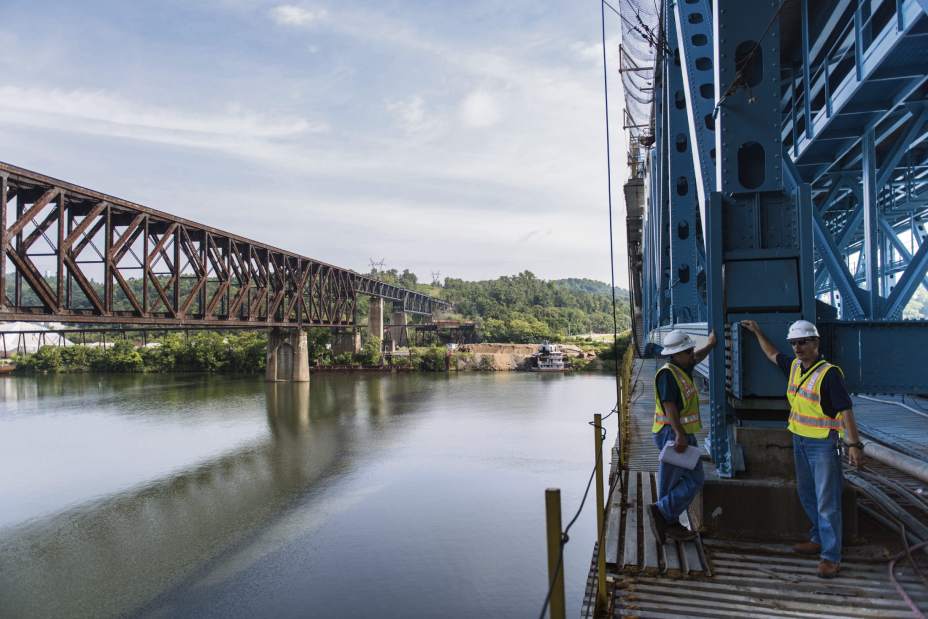
Dan Speicher | Tribune-Review
Mel Criswell (left), Inspector In Charge of the I-70 bridge between Belle Vernon and Speers, and Jay Ofsanik, PennDOT District 12 Safety Supervisor, discuss the rehab of the bridge, as work on the project continues, on Thursday, Aug. 31, 2017.
Unlike some, crews painting the Belle Vernon-Speers bridge have no qualms about climbing as high as 180 feet above the Monongahela River to coat the top of the span in a new layer of blue paint.
“I have no fear of heights. I was always the one who wanted to climb the highest up the tree,” said Michael Headlee of Carmichaels, Greene County, as he painted a steel beam underneath the 2,064-foot bridge. “The hardest part (of the job) is the challenge of just showing up every day and doing the same thing.”
Workers who climbed to the top of the arch — on structural steel beams about two feet wide — wear special retractable harnesses that would slowly stop their fall after a few feet, said Leonard Kubitza, assistant construction manager for PennDOT’s District 12.
Others work on aluminum decking platforms suspended by cables beneath the bridge, climbing on chain-link fencing in some sections to get to beams and piers.
The $20.7 million project to restore the bridge carrying Interstate 70 over the Monongahela River began in 2015. Painting should be completed by the end of October, Kubitza said. General contractor Titan Industrial Services Inc. of Dundalk, Md., had about 100 workers on the painting project and hired Superior Painting Co. Inc. of Upper St. Clair to supplement its workforce.
Those working on the bridge and its approaches, which connect the tips of Washington and Westmoreland counties, have grown accustomed to the structure swaying with the passing of tractor-trailers on a highway traveled by about 34,000 vehicles daily. The restoration project included work on the approachway to the bridge over Route 906 at the Westmoreland-Fayette border and the section of the bridge over Route 88, local streets and railroad tracks in Speers, Washington County. Repairs also were made to corroded steel trusses and the bridge’s substructure. The concrete roadway was patched where needed.
A Titan spokesman at the job site said they had to paint about 1 million square feet after blasting the steel beams with abrasive steel pellets.
The bridge was getting three coats: Two coats of zinc organic primer finished with a top coat of bright blue latex-based polyurethane. Workers apply the paint by spraying where possible but also with rollers and brushes to get inside and outside the beams, as well as the thousands of rivets and nuts and bolts, Kubitza said.
“We should get 25 years out of this paint,” said Mel Crisswell, a senior civil engineer and PennDOT inspector in charge of the bridge project.
While the bridge’s structural steel gets a new covering, a thin coat of epoxy was applied as an overlay on the deck to protect it against corrosion.
Painting over a river has challenges in addition to safety, said Crisswell, who has 30 years of experience working on bridges. For one, morning fog brings air moisture that delays painting for a few hours.
“You can’t really fathom what goes into this,” Crisswell said.
Joe Napsha is a Tribune-Review staff writer. Reach him at 724-836-5252 or jnapsha@tribweb.com.
Copyright ©2026— Trib Total Media, LLC (TribLIVE.com)