Latrobe ice cream shop helps woman in battle with brain tumor

Ice cream treat helps tumor patient
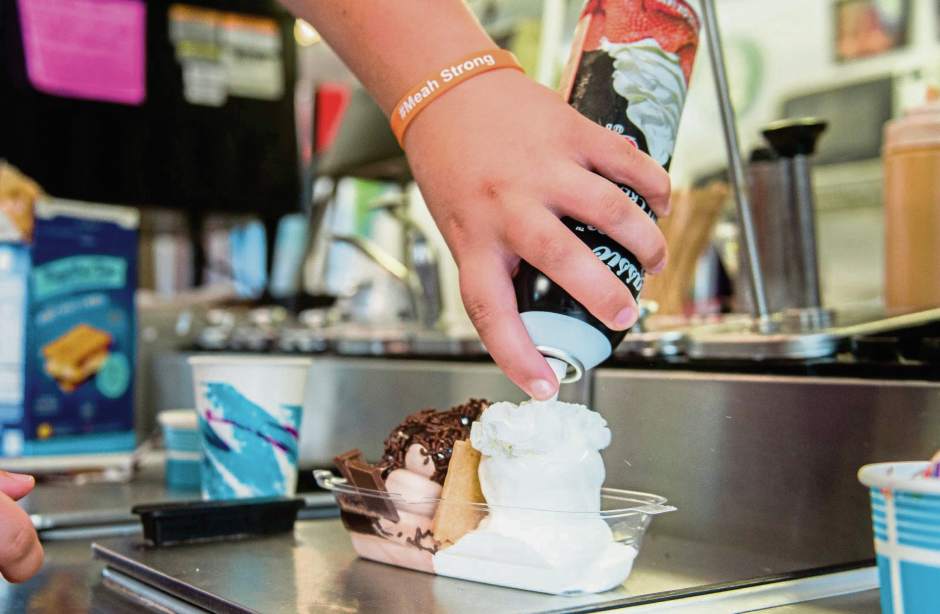
Latrobe Cone Zone sells s’more-flavored sundae, with proceeds assisting a local woman in her battle with a brain tumor.
Meah Ezykowsky is locked in a battle with Tina, the name she gave a brain tumor that robbed her memory and eyesight.
How she came up with that nickname, shortly after emergency surgery that removed 80 percent of the grapefruit-sized growth, is one of many things the 20-year-old from Latrobe cannot recall. But giving the tumor a separate identity from her own seems to help.
And that sobriquet literally is on the tips of many tongues at the Latrobe Cone Zone.
Now, “Tina” represents half of a new frozen confection being sold at the ice cream shop to help defray Ezykowsky’s medical expenses and raise awareness of others who struggle with similar challenges. Owner Kylie Roche was moved to create the “Meah vs. Tina” treat after getting to know Ezykowsky and her family through their frequent visits to her Unity drive-in restaurant.
Ezykowsky’s determination to confront her life-altering condition with a positive attitude and humor “inspired all of us,” said Roche, an 18-year-old entrepreneur.
Since the remaining portion of Ezykowsky’s tumor is inoperable, radiation is the main tool doctors have to control it if it grows again. But she is testing her own theory about the chilling power of repeated doses of Roche’s ice cream. “I jokingly said that maybe it will shrink the tumor,” Ezykowsky said. “With the brain freeze, maybe it will help.”
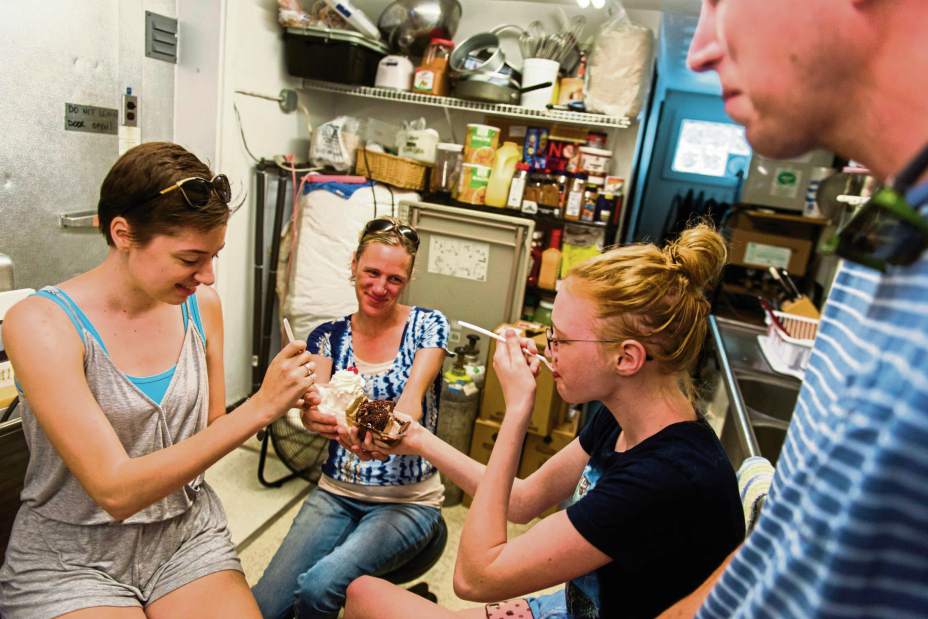
Last week, she taste-tested the s’more-flavored treat she inspired and was partial to the “Meah” half — vanilla ice cream topped with marshmallow, whipped cream and a cherry. “I really liked it. The marshmallow part was good,” she said.
Graham crackers divide it from chocolate ice cream topped with chocolate sauce, sprinkles and candy pieces. “That’s representing Tina, the bad side, to make it look dark and ugly,” Roche explained. The special treat sells for $3. All proceeds benefit Ezykowsky’s family.
“We’re just very grateful and humbled that Kylie would want to do something like this for us,” said Ezykowsky’s mother, Michele Kuba. She noted medical insurance won’t cover costly devices that project printed material on a screen and could help her legally blind daughter read once more.
Ezykowsky has had to relearn many basic living skills since March 22, 2017, when a medical team at UPMC Presbyterian in Pittsburgh required 15 hours to remove her meningioma — a normally slow-growing, noncancerous tumor that, in her atypical case, spread to about a third of her brain. That was just a day after a severe headache left her unable to walk or talk.
When she learned it was the largest meningioma the UPMC team had ever encountered, she quipped, “That was always my goal, to be an overachiever, but not when it comes to the biggest brain tumor.” She’s had additional eye surgery and had a shunt implanted to relieve a buildup of fluid in her brain.
As a result of her ordeal, she lost many memories from her Greater Latrobe high school years and didn’t remember what snow was. She’s also undergone a shift in personality and tastes.
“Meah was always quiet and serious,” her mother noted. “Not so much anymore.”
She’s explored new creative interests, learning to play the ukulele and cello and, with the help of local art instructor Gabrielle Nastuck, is using photography and painting to express her altered perspective on life.
Ezykowsky has no vision in her left eye and only partial vision in the right. Using a software program to distort and block out portions of images she captures with a camera, she explained, “I’m trying to start a collection of photos to show other people how I see things. That’s a work in progress.”
In high school, Ezykowsky was named the 2015-16 Student of the Year by the state Students Against Destructive Decisions as she spoke out about issues teens face and about the problem of drunken drivers — one of whom caused her father’s death in a 2006 crash.
Now she has a new mission — spreading awareness of those who, like herself, have special challenges that aren’t immediately apparent to others. She also enjoys assisting with classes at Nastuck’s studio, which emphasize inclusiveness and the healing power of art.
Moving forward, Ezykowsky’s goals are to learn to get around with a cane and, eventually, be partnered with a seeing-eye dog for increased independence. She’s also considering a return to the college career that Tina interrupted, though she may switch from her previous studies in social work to pursue an art degree.
For now, her mother said, “We just eat ice cream, pray a lot and keep going and checking with the doctors.”
Jeff Himler is a Tribune-Review
staff writer. You can contact Jeff at 724-836-6622, jhimler@tribweb.com or via Twitter @jhimler_news.