


Southmoreland Middle School student Kaylea Wright didn't expect to spend her first nine weeks of eighth grade building a hand.
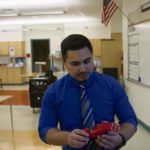
But that's the assignment she and her classmates received from teacher Gavin Sikorski, who teaches STEM — science, technology, engineering and mathematics.
“He sat us down the first day and explained the story behind the project, and we got to work immediately,” said Wright, 13.
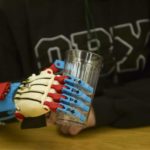
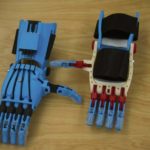
The class built two prosthetic hands, which will be donated to children in Texas and England.
Southmoreland's STEM program is relatively new, replacing the recently eliminated home economics class.
“Every other school district I've been in, they had a set curriculum,” said Sikorski, who joined the district last year. “When I came here, they gave me the freedom to do what I wanted.”
He knew he wanted students to work on a project involving a 3D printer. After a bit of searching and months of prototyping on his own, he decided on the hand project.
The students built the simple prosthetics for children who have symbrachydactyly, a disorder that can prevent limb growth.
The materials for each hand cost about $25, Sikorski said.
The simple prosthetics don't use electronics. Instead, they use elastic bands that allow the 3D-printed plastic fingers to contract and release.
“Whenever the child flexes their wrist down, the fingers will close, and they can grasp onto any kind of object they need,” explained Raygan Lewandowski, 13.
The fingers can't move independently, so complex tasks aren't an option. But the hands allow users to grip a bike handle or hold a glass.
Sikorski found families on social media who needed prosthetic hands for their children. He sent the new hands last week.
The endeavor combined different disciplines, making it perfect for the class, Sikorski said.
Students learned about biology with lessons about symbrachydactyly and how human limbs worked. They practiced engineering skills by 3D printing the components and assembling them into a working prosthetic. And they learned mathematics by converting measurements to make each hand fit its intended recipient.
He plans to continue the program with his next class.
“That's my job as a STEM teacher, to relate stuff that we do in class to the outside world,” Sikorski said.
He doesn't know of another middle school program in the state with a similar curriculum.
His students were more than up to the task, he said.
“I expected a lot more bumps than we ran into. Everything went really smoothly, and they were able to handle everything I threw at them,” he said.
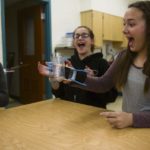
Melanie Ruyak, 14, said she's happy her work will make a difference.
“It really touches my heart that we're helping these kids, and they'll be able to do the things that they need to,” she said.
Jacob Tierney is a Tribune-Review staff writer. Reach him at 724-836-6646.
