
https://archive.triblive.com/local/westmoreland/smithton-rolls-out-red-carpet-for-monarch-butterflies/
Smithton rolls out red carpet for monarch butterflies

• |
Stephen Huba | Tribune-Review
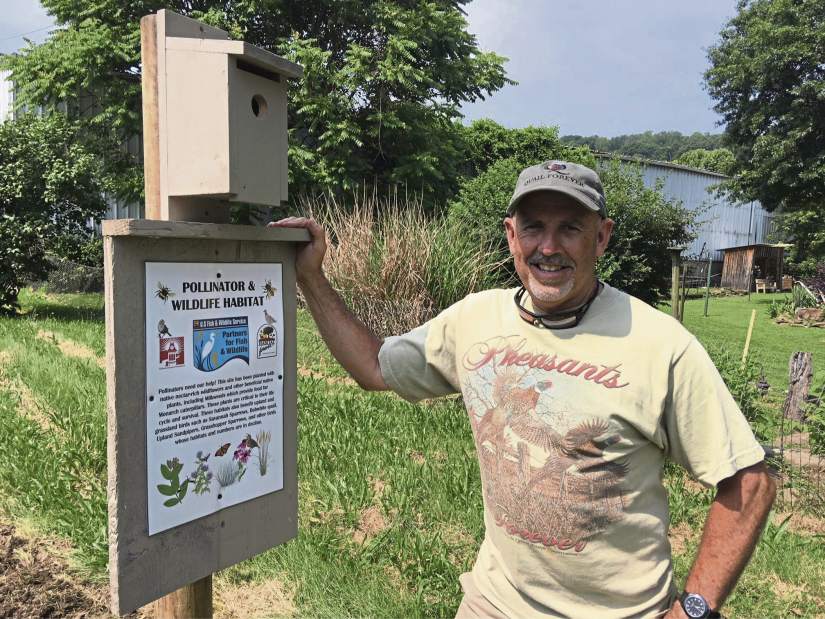
Jose Taracido, supervisor of the Partners for Fish & Wildlife Farmland Habitat Program at Cal U, poses next to a sign explaining the new pollinator habitat for monarch butterflies in Smithton.
A year after the opening of a new bed and breakfast, Smithton is making itself hospitable for a non-human species – the monarch butterfly.
On Monday, a crew from California University of Pennsylvania completed work on a pollinator and wildlife habitat in Smithton designed to facilitate the migration of monarch butterflies to and from central Mexico.
The three plots of land, freshly seeded with nectar-producing wildflowers, will provide a nesting and feeding area for monarch butterflies and could contribute to their resurgence in the United States, said Jose Taracido, supervisor of the Partners for Fish & Wildlife Farmland Habitat Program at Cal U.
“We’re looking for any area, from a yard to a 25-acre farm field, to make habitat for monarch butterflies,” Taracido said. “We came and looked at (Smithton), and we thought it would be an excellent habitat project here for them.”
Taracido noted the area’s potential earlier this spring after borough Councilwoman Karen Primm told him of a borough-owned piece of property that could be developed for such a use.
The project contributes not only to the beautification of Smithton but to the well-being of monarch butterflies, which are in decline in the United States because of a loss of habitat here and in Mexico, Taracido said.
Monarch butterflies need milkweed and other wildflowers as sources of food and as nesting sites for their eggs.
“Every stem we can get out there is important,” Taracido said, noting that 30 stems of milkweed are necessary for one monarch butterfly to make it from Western Pennsylvania to central Mexico.
The well-documented, round-trip journey of the monarch is an arduous one that requires three generations of butterflies to be completed, he said.
The migration that started in 2017 is coming to a close. “They’ll be here any day now,” Taracido said.
The butterflies that hatch in Smithton this summer will make it as far as Alabama, where they will lay their eggs this fall and die. Those eggs will hatch and produce butterflies that fly to Mexico, where they will spend the winter, he explained.
Those butterflies will fly to the Southern states next spring and lay their eggs before perishing. The third generation will then return to Western Pennsylvania, completing the cycle, he said.
Taracido said the Cal U project and programs like it are trying to keep the monarch butterfly off the U.S. endangered species list. One practical way to do that is to plant a pollinator garden mix of wildflowers wherever there is room for even a small seed bed, he said.
“Western Pennsylvania is one of the best habitats for monarch butterflies … and one of the best areas to produce the first generation that flies south,” he said.
The new Smithton garden, planted with annuals and perennials, will serve as a nesting area and feeding area this summer, as well as a launching area for the fall migration, Taracido said.
“It’s like a Holiday Inn and McDonald’s all in one. It provides them with everything they need,” he said.
Smithton borough leaders see the pollinator garden as part of an ongoing beautification process that recently got a boost from the Community Foundation of Westmoreland County . The borough received an $8,065 grant for a downtown beautification project that included planters, flowers, shrubs, hedges, benches and landscaping stones.
Primm said the grant process got her and other Smithton officials thinking about the borough in a new way, with a greater focus on economic development.
“It’s just changed our whole perspective,” she said. “We’re already starting to see the benefits (of the Community Foundation grant) in the development of this pollinator habitat.”
Taracido said the annuals will emerge in time for the butterflies to use them this summer, while the perennials will take three years to reach maturity.
The garden will be beneficial for all pollinators, including bees and grassland birds that have suffered from a loss of habitat. “When you attack the problem of the monarch, you help other species,” he said.
Stephen Huba is a Tribune-Review staff writer. Reach him at 724-850-1280, shuba@tribweb.com or via Twitter @shuba_trib.
Copyright ©2026— Trib Total Media, LLC (TribLIVE.com)