


The top three potentially life-threatening hazards for the region's tens of thousands of wooden utility poles are aging, vehicle crashes and damage from storms or fallen trees.
“The thing that takes down the most poles oftentimes is an ice storm or a heavy snow storm,” said Todd Meyers, spokesman for Greensburg-based West Penn Power.
Meyers pointed out a strong storm in late October can be just as damaging, when leaves add to the weight and surface of a toppled tree pushing down on a power line.
“When a tree comes down on a line, a lot of times the line is pretty strong,” he said. “It would be better if it would break quickly. Sometimes the line suspends the weight, and it breaks off pole tops or cross arms.”
There may be little a utility company can do when forces of nature target poles carrying its transmission lines. But West Penn takes steps each year to shore up its miles of poles against normal wear and tear.
This year, the utility checked the condition of about 30,425 of its roughly 500,000 wooden poles. It's part of a state-mandated, 12-year cycle the company follows to inspect all poles in its 24-county service territory covering parts of southwestern, south-central and north-central Pennsylvania,
The inspections centered around 17 communities, with Butler accounting for the largest number of poles reviewed — 3,968.
Locally, West Penn inspected 2,606 poles associated with its Jeannette service center — on circuits stretching to Arona, Export, North Huntingdon and Irwin. It also inspected 1,967 poles on circuits in Youngstown, Baggaley and other parts of Unity — all attached to the Latrobe service center; and 752 poles in New Kensington and Logan's Ferry Heights — falling under the Arnold service center,
It cost more than $1.6 million to inspect the poles and then replace or repair 370 of them.
The most common utility pole is 40 feet tall and made from southern yellow pine. It costs about $400 and is expected to last more than 50 years.
“Some go far longer,” Meyers said.
When crews inspected a sister company's poles in West Virginia following a powerful 2012 storm, he noted, they found some that had been “set by men with mules in the 1930s. These were still viable poles that continued to do the job.”
Southern yellow pine is an ideal tree species to harvest for utility poles because it grows straight, is plentiful in southeastern states and is easy to pressure-treat, which provides resistance to insects and fungal decay, Meyers said.
“Because up to one-third of the length of a utility pole is below ground, they are subject to termite damage. Carpenter ants can also infest poles,” he said.
Inspectors look for signs that poles have lost structural strength, including shrinkage that occurs over time as the wood loses moisture, Meyers said.
Workers also check for decay at the ground line and “sound” poles, he said.
“A thud lets them know inside there might be a void where it was chewed apart by insects,” Meyers said. “They'll drill into the pole and see what material is coming out.”
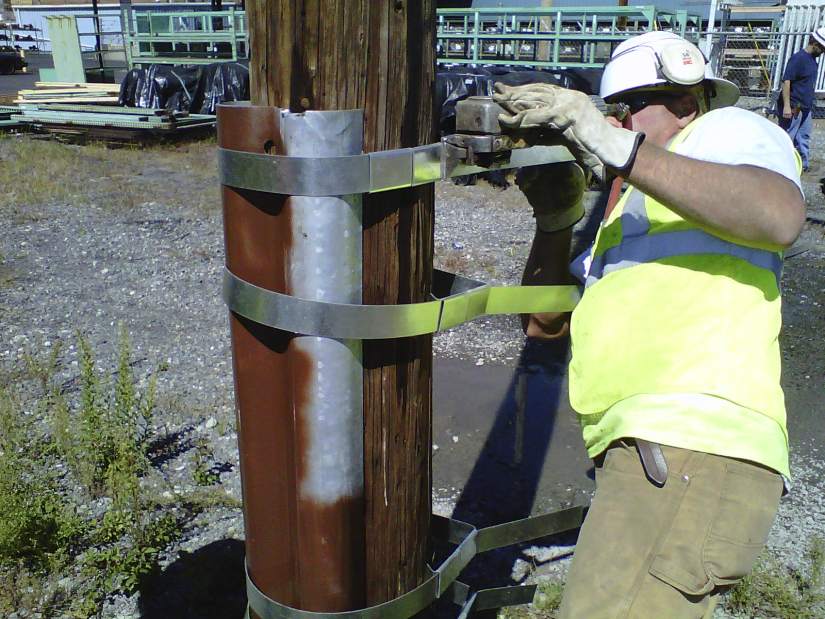
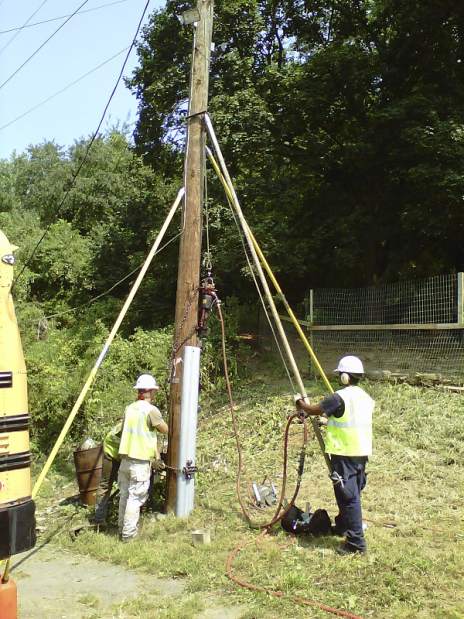
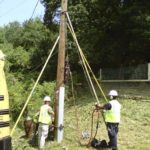
Where possible, West Penn repairs rather than replace poles that have stability issues. A two-man crew typically can complete a repair in a half hour and at 20 percent of the cost of a pole replacement, Meyers noted.
A replacement, he said, could involve four men working over half a day using a bucket truck and coordinating with phone and cable television companies that have lines hanging on the same pole. Power also may be interrupted while wires are transferred to the new pole.
West Penn Power transmits electricity to about 720,000 customers, including 183,457 in Westmoreland County.
Jeff Himler is a Tribune-Review staff writer. Reach him at 724-836-6622 or jhimler@tribweb.com.
